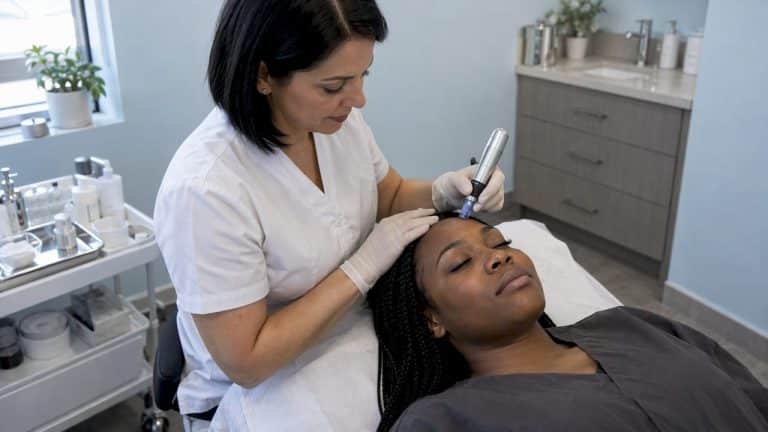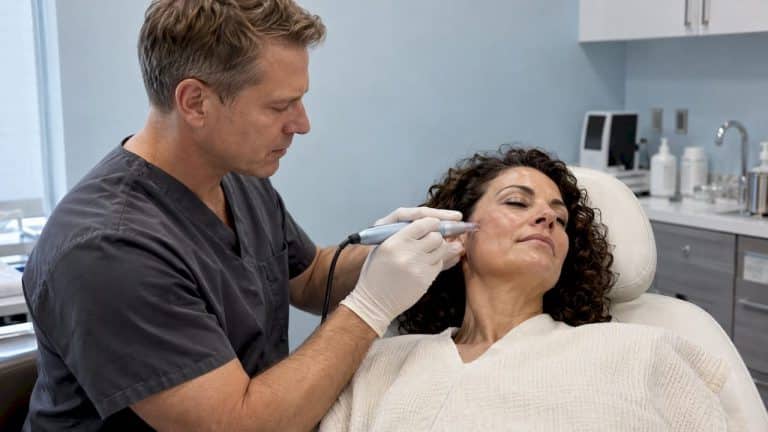
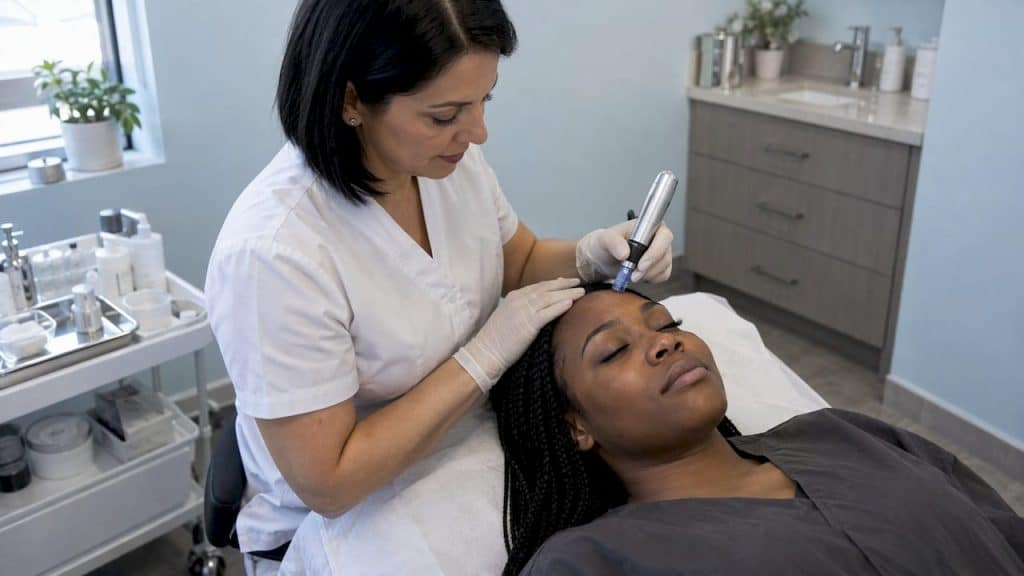
Microneedling depth is not one number for the whole face. Published clinical reviews report roughly 0.5 to 1.0 mm for fine lines and wrinkles and 1.5 to 2 mm for scars, and the right setting changes from the forehead to the cheeks to the chin. The setting depends on your skin thickness, your goal and the device, which is why it is chosen by a trained clinician after looking at your skin, not picked from a chart. Below we explain what the numbers mean, how they differ by area, and what to ask at your consultation.
TL;DR
- A 2025 clinical review reports 0.5 to 1.0 mm for wrinkles and 1.5 to 2 mm for scars, so the goal sets the range before the area does.
- The forehead, lower eyelids and nasal bridge sit at the shallow end (0.5 to 1.0 mm), while the cheeks and chin tolerate up to 1.5 mm.
- Deeper is not automatically better: more depth means more discomfort and more downtime, and a higher risk of irritation if the skin does not need it.
- Needle depth and skin depth are not the same thing, because skin gives under the device. That is one reason technique matters as much as the number.
- Depth is a clinical decision. We assess your skin first, then plan the treatment area by area.
Table of Contents
- What “depth” actually means
- Why the face needs different depths
- Typical needle lengths by facial area
- Microneedling depth on the forehead
- How your goal changes the depth
- Does deeper mean better results?
- What can go wrong when depth or technique is off
- What Canadian guidance says
- Why depth is decided in person, not from a chart
- What realistic results look like
- Microneedling at Enriched Med Spa
- Our perspective
- FAQ
- Sources
What “depth” actually means
Microneedling uses very fine, sterile needles to create controlled micro-injuries in the skin. The body responds by repairing that area, and that repair process is what the treatment aims to use for smoother texture and firmer-looking skin.
When people talk about depth, they usually mean the needle length set on the device, measured in millimetres. Modern electric pens let the clinician adjust it. The 2025 review in the medical literature describes electric pens with single-use sterile cartridges, variable needle lengths and adjustable penetration, and contrasts them with dermarollers. It also describes two techniques, sliding and stamping, which affect how the needles meet the skin.
The set length is a ceiling, not a guarantee of where the needle ends up in every spot. Skin stretches, rebounds and varies in thickness, so a trained hand adjusts pressure and passes as the device moves across the face. That is the part a chart cannot show you.
Why the face needs different depths
Facial skin is not uniform. The epidermis (the outer layer) and the dermis (the deeper layer that holds collagen) are thicker in some places and very thin in others. The eyelids are delicate. The cheeks and chin carry more substance. The forehead sits over bone, with little cushioning underneath.
A 2023 review of radiofrequency microneedling says facial needling depth should reflect the local epidermal and dermal thickness. A 2020 clinician review on scars makes a related point: adjustable-depth devices are useful because penetration needs vary by area, with oilier (sebaceous) areas generally needing deeper penetration than the forehead or the skin around the eyes.
The 2025 review adds that thicker or more fibrous skin may call for deeper needling than normal skin. That is one reason two people with the same concern can be treated at different settings.
Typical needle lengths by facial area
The table below summarizes what the 2025 review reports for needle lengths on the face. Treat it as the published range that clinicians work within, not a setting to apply yourself.
| Area | Reported needle length | Why it sits there |
|---|---|---|
| Forehead | 0.5 to 1.0 mm | Thin skin over bone |
| Lower eyelids | 0.5 to 1.0 mm | Very thin, delicate skin |
| Nasal bridge | 0.5 to 1.0 mm | Thin skin, little tissue beneath |
| Cheeks | Up to 1.5 mm | Thicker skin, more cushioning |
| Chin | Up to 1.5 mm | Thicker skin, firmer tissue |
| Scars (any area) | 1.5 to 2 mm | Remodelling needs to reach deeper layers |
Source: Micro-needling: current state of knowledge and clinical applications, 2025.
Notice that “up to” matters. A clinician may use less than the maximum in any area, and often does, particularly in a first session.
Microneedling depth on the forehead
The forehead is one of the most common questions we hear, and it has a slightly confusing answer, because two different numbers appear in the literature.
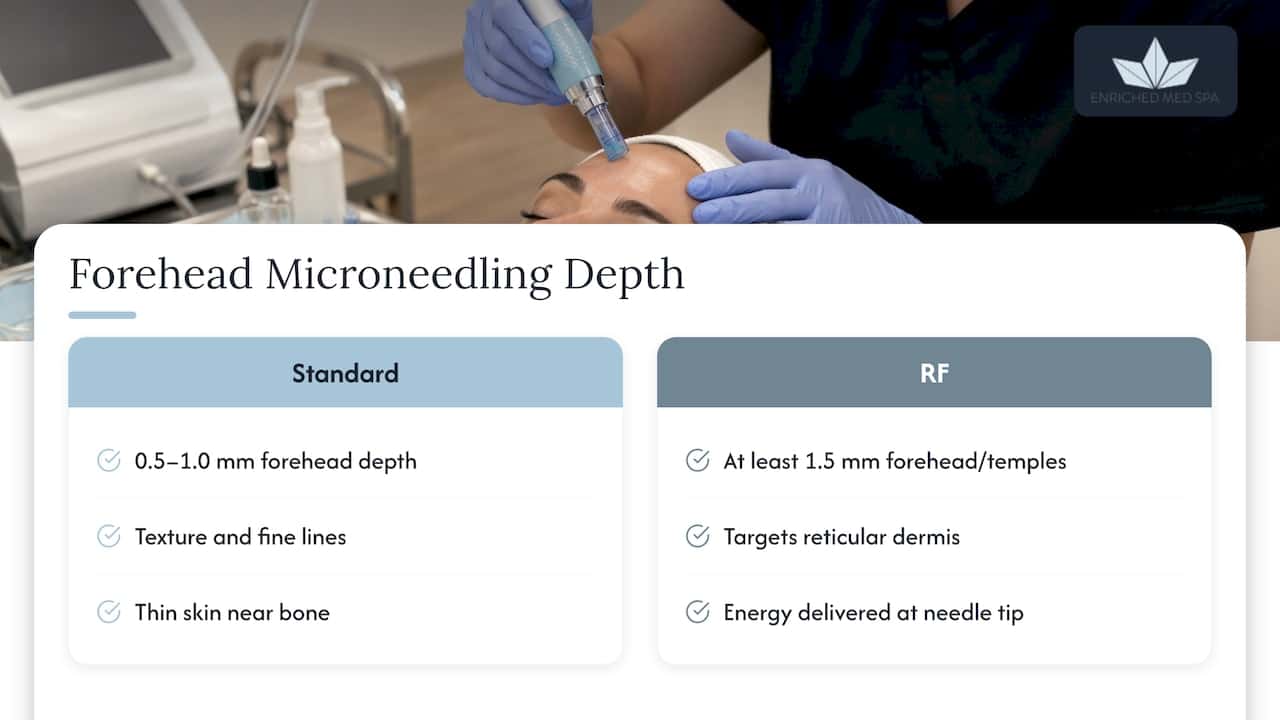
For standard microneedling, the 2025 review reports 0.5 to 1.0 mm on the forehead. The skin is thin and sits close to the bone, so there is little reason to go further for texture and fine lines.
For radiofrequency (RF) microneedling, which adds heat energy through the needles, the 2023 review recommends at least 1.5 mm for forehead and temporal skin (the temple area) and talks about targeting the reticular dermis, the deeper, firmer layer of the dermis. The difference comes from the technology: RF devices deliver energy at the tip, so the target depth is chosen differently.
In short, if you hear a number that sounds different from the one a friend was told, the device and the goal are usually the reason. This is also why a forehead plan should be built around what you want to change, whether that is fine horizontal lines, uneven texture or old acne marks near the hairline.
If your main forehead concern is the deeper expression lines that appear when you raise your eyebrows, microneedling is only one option. Many clients come in noticing exactly that, and we talk through whether a neuromodulator such as Botox, Nuceiva or Xeomin would suit those lines better, or whether the two approaches work well together.
How your goal changes the depth
The area is only half the decision. The other half is what you want the treatment to do.
Fine lines, early ageing and general texture
The 2025 review reports 0.5 to 1.0 mm for wrinkles. This is the range most first-time patients fall into: skin that looks a little tired, slightly rough or dull, with early lines around the eyes and forehead. Shallower settings, repeated over a series, are a measured way to start.
Acne scars and deeper texture changes
Scars are different. The same review reports 1.5 to 2 mm for scars, and notes that scar remodelling generally uses longer needles than wrinkle treatment. A scar is a change in the deeper structure of the skin, so the treatment has to reach further to prompt remodelling.
A caution about numbers on the internet: there is no single correct depth for every deep acne scar. The scar type, the area of the face, the device and your skin thickness all change the answer. This is why we plan scar work area by area and set expectations early: scars usually improve over several sessions, not one, and results build gradually.
Pigmentation and redness
Skin colour concerns are a different matter. Microneedling is mainly used for texture and scarring, and pigment or redness is often better matched to light-based treatments. We use MotusAZ+ for pigment reduction and for redness and vascular concerns, and a consultation is how we decide which route fits you.
Does deeper mean better results?
No. This is the most common misunderstanding we meet. It seems logical that going deeper must stimulate more collagen, but the evidence does not say that.
The 2025 review reports greater pain as needle penetration depth increases. The American Academy of Dermatology notes that excessive depth, dragging, dull needles or aggressive treatment may increase scarring risk, and that overuse may worsen dryness, redness, sensitivity, burning and chronic irritation.
The practical message is that the right depth is the shallowest one that reaches your target layer. Going beyond that adds discomfort and healing time without adding benefit.
What can go wrong when depth or technique is off
Most people who have microneedling in a professional setting have redness and sensitivity that settle, and that is expected. Problems come from the wrong depth, poor technique, unsuitable skin conditions or contamination.
- Irritation and scarring. Excessive depth, dull needles or dragging can increase the chance of scarring, as the AAD guidance above explains.
- Infection and granulomas. The AAD cautions about introducing non-sterile products through skin that has been opened by needling, and lists possible granulomas (small firm lumps), infection and dyspigmentation (uneven pigment).
- Skin that needs extra caution. The AAD flags additional concern for people with melasma, rosacea, eczema or acne-prone skin. Tell your clinician if any of these apply, as depth and timing may change.
- Raised scarring tendencies. If you tend to form raised scars, read about keloid risk and scarring and mention your history at your consultation.
If you notice signs of infection after any skin service, such as increasing redness, swelling, warmth, pus or fever, Durham Region Health Department advises seeing a family physician within 24 hours. Do not wait for it to settle on its own.
What Canadian guidance says
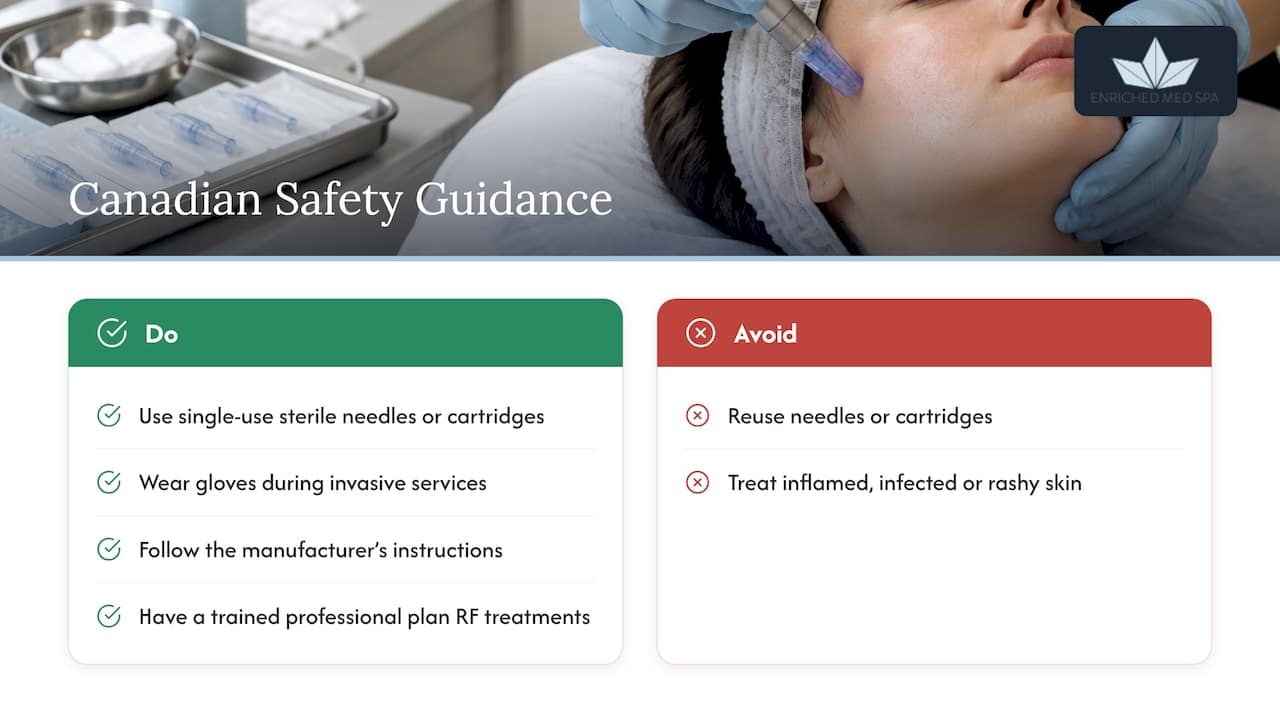
Safety standards in Ontario are set largely by public health units, and the guidance is consistent on the basics. Durham Region Health Department’s microneedling guidance says single-use sterile needles or cartridges must be discarded after use, and that certain devices should only be used by a regulated health professional following the manufacturer’s instructions. It also says not to treat inflamed or infected skin, or skin with a rash, and requires the operator to wear gloves during an invasive service.
On radiofrequency microneedling specifically, Health Canada’s January 2026 InfoWatch classifies licensed RF microneedling devices as Class III (the higher-risk device class). It notes that US FDA warnings identified potential risks including burns, scarring, fat loss, disfigurement and nerve damage, and it asks health professionals to remain vigilant and report suspected incidents. In practice, this is a reason to have RF treatments, and any treatment that reaches deeper, planned and performed by a trained professional.
For your own safety, always check before booking that the provider uses single-use sterile needles, wears gloves and will assess your skin first.
Why depth is decided in person, not from a chart
Depth charts are popular online because they are simple. The trouble is that a chart assumes an average face, one device and one goal. Real faces vary in skin thickness, oiliness, scarring and healing, and the 2025 review notes that thicker or more fibrous skin may warrant deeper needling.
A good plan looks at several things together:
- Your goal. Texture, fine lines, scars or a mix, and how soon you want to see change.
- Your skin. Thickness, sensitivity, any active acne, rosacea, eczema or melasma, and your history of scarring.
- Each area. The forehead, eyes, cheeks and chin are treated differently, not at one setting.
- Your timeline. An event in a few weeks calls for a different plan than a gradual, preventative one.
- Your comfort. Pain rises with depth, so comfort is part of the plan.
At Enriched Med Spa, treatments are performed by experienced nurse-level injectors and aestheticians, and every plan begins with a consultation and pre- and post-care guidance. That is the setting in which depth should be decided.
What realistic results look like
We keep expectations honest. Microneedling is not a one-visit change. Skin builds up gradually, and most plans involve a series of sessions with time between them for the skin to recover. Shallower settings suit regular maintenance. Deeper work for scars needs more recovery time and more patience.
If you are preparing for a wedding, vacation or photoshoot, tell us the date at your consultation. The goal is to avoid scheduling a deeper session too close to the event, when redness could still be settling. Our microneedling preparation guide and safety checklist cover what to do before and after.
Microneedling also pairs well with other options on a plan, and we compare lighter treatments such as peels and facials with more advanced ones such as laser or radiofrequency. If tightening is your goal, our guide to RF skin tightening results explains what that route looks like.
Microneedling at Enriched Med Spa
If you live in Woodbridge, Vaughan or East Gwillimbury and want a plan built around your skin rather than a chart, our microneedling service is priced at $359 per treatment. We start with a consultation, talk through your goals and your skin, and explain what to expect before and after. If you want to understand more first, our article on what microneedling does to your face is a good place to begin.
Our perspective
Many clients arrive with a number in mind. They have seen a depth chart and want to be treated at 1.5 mm, or they have heard that deeper means more collagen. We understand why. A number feels like control.
What we try to explain is that the number is the last thing we decide, not the first. We begin with your skin and your goal, then work out what each area of the face needs. The forehead is thin and sits over bone. The cheeks have more substance. A scar is a different problem from a fine line. One setting cannot serve them all.
We also believe that the gentlest plan that reaches your goal is the right plan. Skin needs time to rest between sessions, and results build over a series, not in a single visit. That is a calmer, more reliable way to improve texture, and it is how we like to work with first-time patients and long-standing clients alike.
If you are unsure where to start, come in for a conversation. You will leave knowing what we would treat, how we would approach it and what to expect.
Felix
FAQ
How deep does microneedling go on the face?
Published reviews report about 0.5 to 1.0 mm for wrinkles and about 1.5 to 2 mm for scars. Within the face, thin areas such as the forehead, lower eyelids and nasal bridge sit at 0.5 to 1.0 mm, and the cheeks and chin can go up to 1.5 mm. Your clinician sets the exact depth after assessing your skin.
What is the right microneedling depth for the forehead?
For standard microneedling, the reported range is 0.5 to 1.0 mm because the skin is thin and sits close to bone. Radiofrequency microneedling is different, and one review recommends at least 1.5 mm for forehead and temple skin. The device and your goal decide which applies.
Does a deeper setting give better results?
Not necessarily. Research reports more pain as depth increases, and the AAD notes that excessive depth or aggressive treatment may raise scarring risk and irritation. The aim is the shallowest depth that reaches the layer you want to treat.
When should I see a doctor after microneedling?
If you notice signs of infection, such as spreading redness, swelling, warmth, pus or fever, see a family physician within 24 hours, as Durham Region Health Department advises. Contact your clinic as well so they can follow up.
Is microneedling suitable if I have rosacea, eczema, melasma or acne?
These conditions call for extra care, and the AAD flags additional concern for them. Mention them at your consultation so your clinician can decide whether to treat, adjust the depth or wait. Skin that is inflamed, infected or has a rash should not be treated.
Sources
- Micro-needling: current state of knowledge and clinical applications (2025)
- Radiofrequency Microneedling: Technology, Devices, and Clinical Applications (2023)
- Microneedling for the Treatment of Scars: An Update for Clinicians (2020)
- American Academy of Dermatology: At-home microneedling
- Durham Region Health Department: Microneedling (2021)
- Health Canada InfoWatch, January 2026