
Fillers can soften marionette lines effectively when volume loss is the main driver, usually with hyaluronic acid (HA) as the first-line choice. Many treatment plans layer in a micro-dosed neuromodulator, a thread lift, or skin tightening when muscle pull or laxity contribute too. Results are temporary, and a conservative, staged approach tends to preserve natural movement better than trying to erase the fold in one visit.
TL;DR:
- Fillers primarily support the depressed tissue, with hyaluronic acid being the most common choice due to its immediacy and reversibility.
- Candidates suitable for filler alone generally have isolated volume loss, good skin elasticity, and minimal jowling, while more complex cases benefit from multimodal approaches.
- Results from fillers last typically between six and eighteen months, with longer-lasting options like calcium hydroxylapatite and PLLA providing extended support.
- Risks are minor and temporary but include swelling, bruising, and rare vascular complications, emphasizing the importance of choosing a licensed, experienced injector.
- Treatment planning should focus on individual anatomy and root causes, as no single filler brand is universally superior for marionette lines.
Table of Contents
- What are marionette lines and what causes them?
- How do dermal fillers treat marionette lines?
- Who is a good candidate for filler alone?
- What results should you expect, and how long do they last?
- What are the risks, and how do you choose a safe injector?
- How should you prepare for treatment and recover afterward?
- How much does marionette lines filler cost?
- How Enriched Med Spa approaches marionette line treatment
- Why “best filler” is the wrong question to ask
- Book a consultation for your marionette lines
- Sources
- FAQ
What are marionette lines and what causes them?
Marionette lines, sometimes called melomental folds, run from the corners of your mouth down toward the jawline. The name comes from their resemblance to the hinged jaw lines on a wooden puppet, and once you notice them, you can’t unsee them on yourself.
They rarely have one single cause. Anatomy usually plays several roles at once, which is exactly why treatment needs to be individualized, rather than formulaic.
- Volume loss in the cheek and jawline lets skin settle downward, deepening the crease
- Midface descent over time pulls tissue toward the fold
- The depressor anguli oris (DAO) muscle pulls the mouth corners down every time it contracts, creating a dynamic component
- Skin laxity and reduced collagen let the fold persist even at rest
Whether your lines show up mainly when you talk and smile (dynamic) or sit visible even with a relaxed face (static) changes everything about the plan. A dynamic pattern points toward muscle-focused treatment; a static, volume-driven pattern points toward filler.
How do dermal fillers treat marionette lines?
A filler works by physically supporting the depressed tissue from underneath, lifting the fold and softening its shadow rather than “erasing” a line on the surface. Which material your injector reaches for depends on how deep the deficit is and how much structural support the area needs.
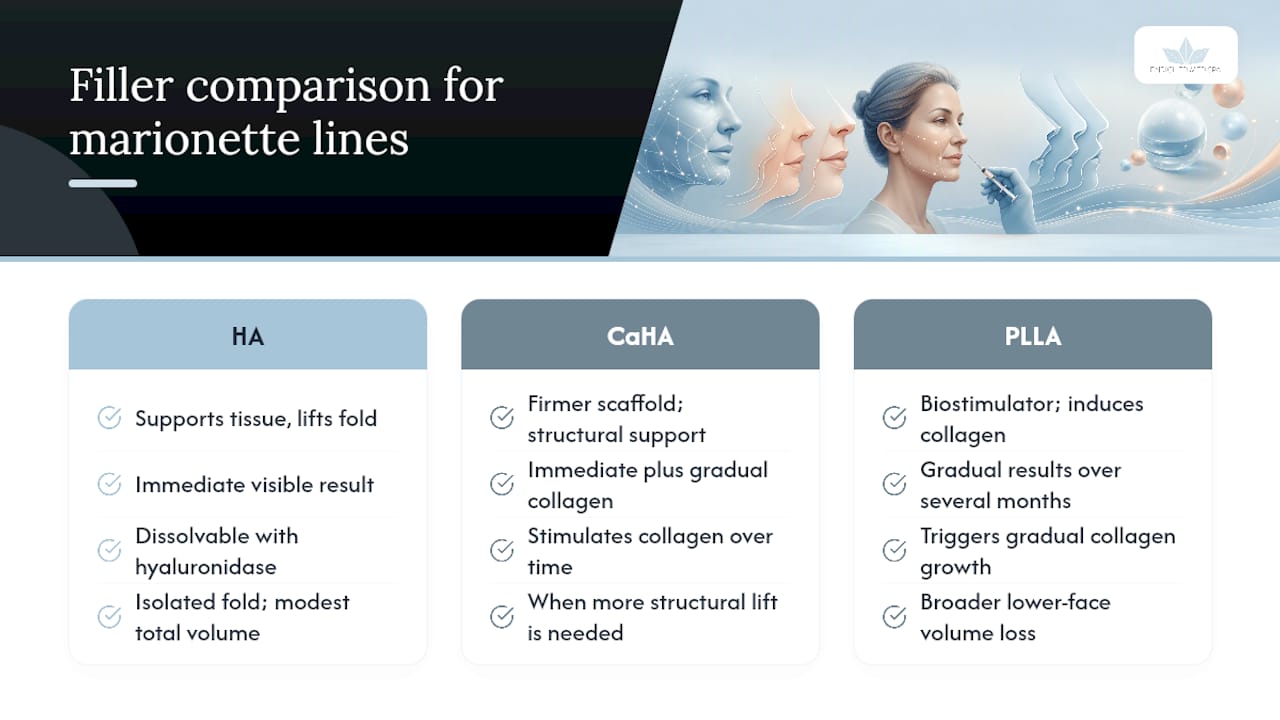
Hyaluronic acid (HA) is the usual starting point. It gives an immediate, visible result, moves naturally with facial expression, and, if something looks off or a complication arises, can be dissolved with hyaluronidase. That reversibility is a big reason HA fillers are commonly used to treat marionette lines as the default choice, with most patients needing a small amount of filler, typically a modest volume total.
Calcium hydroxylapatite (CaHA) offers a firmer scaffold and stimulates some collagen production over time, which makes it useful when the area needs more structural lift than a single HA session provides.
Poly-L-lactic acid (PLLA), sold under the brand Sculptra, works differently again. It’s a biostimulator, meaning it doesn’t fill space directly but triggers gradual collagen growth over several months. It suits people with broader lower-face volume loss rather than an isolated fold.
Technique matters as much as product choice. Many injectors prefer a cannula over a needle in this region because it reduces bruising risk and allows retrograde, fanning placement in deeper tissue planes rather than a single concentrated bolus.
Pro Tip: Ask your injector whether they plan to layer product deep along the bone first before addressing the surface crease. Building support underneath usually looks more natural than filling the line itself.
Who is a good candidate for filler alone?
Not everyone with visible marionette lines needs the same plan, and figuring out which category you fall into saves time and money.
You’re likely a strong candidate for filler on its own if your lines come mainly from isolated volume loss, your skin still has reasonable elasticity, and jowling is minimal. In that scenario, HA or CaHA placed at the right depth often produces a clean, natural-looking improvement.
Filler alone tends to fall short when:
- Jowls have developed and are contributing weight to the lower face
- Skin laxity is significant enough that volume alone won’t lift it
- The DAO muscle is doing most of the work, pulling the mouth corners down regardless of volume
In those cases, combining filler with neuromodulator injections targeted at the DAO, a PDO thread lift, or energy-based skin tightening tends to produce a more balanced result. This lines up with broader anatomy-based treatment guidance for marionette lines, which recommends multimodal planning whenever muscle activity or laxity contributes to the fold. Cheek volume can also matter more than people expect, since restoring midface support sometimes softens a marionette line before you’ve even touched it directly.
What results should you expect, and how long do they last?
Timelines and staying power vary by product, and setting the right expectations upfront avoids disappointment two weeks in.
- Day of treatment: you’ll see visible improvement immediately, though swelling can make the area look slightly overfilled at first.
- Around two weeks: swelling and any bruising resolve, revealing the settled, final result. This is the point your injector will typically ask you back for evaluation.
- Six to eighteen months: HA fillers generally last in this range depending on the specific product and your own metabolism, with a 12-month post-marketing study of an HA filler for marionette lines showing strong improvement at one month that gradually declines through the full year.
- Twelve to twenty-four months or longer: CaHA and PLLA often last on the longer end of this range, since PLLA’s collagen-stimulating effect builds gradually rather than fading from a fixed starting point.
Most patients need a modest total volume for isolated marionette line correction, though deeper deficits sometimes call for a staged approach across two or more sessions rather than one large volume at once. Maintenance is ongoing, not a one-time fix. Plan for a touch-up conversation at your two-week check and periodic top-ups after that on a schedule your injector sets based on how you’ve responded.
What are the risks, and how do you choose a safe injector?
Most side effects from marionette line filler are minor and temporary. Swelling, bruising, redness, and small lumps are common in the first few days, and occasional delayed nodules can appear weeks later. A 2024 clinical review of filler complications documents these early and delayed reactions in detail and stresses that understanding filler rheology, injection depth, and facial anatomy is what actually prevents them.
The rare but serious risk is vascular compromise: filler accidentally entering a blood vessel, which can cut off blood supply to skin tissue and, in rare cases, affect vision. This highlights why the Australian aesthetic clinic market needs discipline to ensure regulated practice standards and patient safety. The FDA is direct about this danger, and it’s the single biggest reason provider selection matters more than product selection.
If vascular compromise is suspected, time matters. Clinics need immediate access to hyaluronidase for HA-based fillers, along with protocols for warm compresses and urgent referral, because minutes can affect the outcome.
When you’re evaluating an injector, look for:
- A licensed healthcare professional with documented anatomy training
- A clear consent process that discusses risks specific to the marionette line region
- Visible before-and-after examples of similar treatments
- A stated protocol for complications, including hyaluronidase on hand
- A follow-up appointment built into the plan, not an optional afterthought
In Canada, nurse practice guidance from CSASN reinforces that ongoing training and clear clinical directives are part of what separates a safe injector from a risky one. Reviewing facial anatomy relevant to injectables before your consultation also helps you ask sharper questions.
How should you prepare for treatment and recover afterward?
A few practical steps before and after your appointment reduce bruising risk and support a smoother result.
Before your visit, give your injector your full medical history, including any previous filler in the area. If you take NSAIDs, aspirin, or fish oil supplements, ask your prescriber whether pausing them beforehand is safe. Come with clean, product-free skin, and plan a quiet afternoon rather than booking treatment right before an event.
Afterward:
- Sleep with your head slightly elevated the first night to limit swelling
- Skip heavy exercise, saunas, and steam rooms for 24 to 48 hours
- Apply a cold compress if swelling feels uncomfortable
- Contact your clinic promptly if you notice increasing pain, unusual paleness, or skin discolouration near the injection site
Pro Tip: Keep your follow-up appointment even if you’re happy with the result. Swelling can mask minor asymmetry that’s easier to correct at two weeks than three months later.
These aftercare basics match general clinical guidance on recovery after filler treatment, and a full step-by-step safety guide can walk you through the details before you book.
How much does marionette lines filler cost?
Filler pricing depends on several variables, so there’s no single number that applies to everyone. Product type is one factor. HA, CaHA, and PLLA are priced differently, and the number of syringes required changes the total. Injector experience and clinic overhead also factor in, along with where you live, since aesthetic pricing varies by market.
Budget for maintenance, not a one-time fix. Since HA effects typically fade over six to eighteen months, factor in a touch-up cost down the line rather than assuming today’s result is permanent. Because so much depends on your specific anatomy and goals, a proper consultation with facial assessment is the only reliable way to get an accurate estimate, and it’s a step worth taking seriously rather than rushing through.
How Enriched Med Spa approaches marionette line treatment
We start every marionette line consultation with a facial assessment, not a product pitch. We talk through whether HA, a biostimulator, or an adjunct like neuromodulator micro-dosing fits your anatomy best. Our approach favours conservative initial correction, layering product gradually across sessions when needed, so your expression still moves naturally and the result looks like you, just rested.
Why “best filler” is the wrong question to ask
Most searches for the best filler for marionette lines are looking for a product name, and that’s understandable. But after working through the anatomy, the mechanisms, and the safety data, the more honest answer is that the question itself is slightly off.

The research consistently points toward a personalized, often combined plan rather than a single winning product. HA is the sensible default for most people because it’s reversible and predictable, but it isn’t automatically superior for someone whose lines are driven by DAO muscle pull or advanced jowling. In those cases, filler alone can even make things look heavier if it’s used to compensate for a problem it wasn’t designed to solve.
Where conventional advice tends to fall short is in treating marionette lines as a single, static target. The fold itself is often a symptom of what’s happening elsewhere in the lower face, cheek volume, jaw support, muscle tone, not the root cause. If you take one thing from this, prioritize a thorough assessment over a specific product request. The injector’s judgment about anatomy and layering technique will shape your result far more than which filler brand ends up in the syringe.
— Felix
Book a consultation for your marionette lines
If you’ve read this far, you already know that the right plan depends on your anatomy, not on a generic product recommendation. Enriched Med Spa’s dermal filler consultations start with exactly that kind of assessment: a full medical history review, a facial evaluation to see whether volume loss, muscle activity, or laxity is driving your marionette lines, and a personalized plan with a clear cost estimate before you commit to anything.
Booking is straightforward. Come in with a clean face, a list of any previous cosmetic treatments, and any questions about products or timeline you want answered in person. Injectors follow documented safety protocols, including hyaluronidase availability for HA-based corrections, and every treatment plan includes a follow-up appointment to check results and adjust if needed. If a multimodal approach makes more sense, whether that means cheek support or a neuromodulator alongside filler, the reasons will be explained before recommending it.
This article is general information, not a substitute for advice from a qualified doctor. Consult a qualified healthcare professional about your own circumstances before acting on anything here.
Sources
- Dermal Filler Do’s and Don’ts for Wrinkles, Lips and More | FDA
- Complications and management strategies related to soft tissue fillers (PMC)
- Postmarketing study: VYC-17.5 L for marionette lines (Journal of Cosmetic Dermatology)
- Marionette lines: what they are, causes, filler, & treatments | Cleveland Clinic
FAQ
Do fillers actually work for marionette lines?
Yes, for most people whose lines are driven mainly by volume loss. Hyaluronic acid fillers restore support under the fold and produce visible softening, though people with significant jowling or muscle-driven lines usually need a combined approach for a fully natural result.
How long do marionette line fillers last?
HA fillers generally last between six and eighteen months depending on the specific product and your metabolism, with a post-marketing study showing strong improvement at one month that gradually declines through the full year. CaHA and PLLA biostimulators often last longer because they stimulate collagen rather than simply occupying space.
How much does filler for marionette lines cost?
Cost depends on the product used, the number of syringes needed, and injector experience, so it varies by patient. Enriched Med Spa doesn’t publish fixed filler pricing online since every plan is based on assessment; current details are available through a dermal filler consultation.
What is the best treatment for marionette lines?
There isn’t one universal best option. HA filler is the common first-line choice for isolated volume loss, but many patients get better, more natural-looking results from a combined plan that adds neuromodulator micro-dosing, a thread lift, or skin tightening depending on what’s causing their specific lines.
When are fillers not enough for marionette lines?
Filler alone tends to underperform when jowls have developed, skin laxity is significant, or the depressor anguli oris muscle is actively pulling the mouth corners down. In those situations, adding a neuromodulator or considering a thread lift or surgical referral usually produces a more balanced outcome.