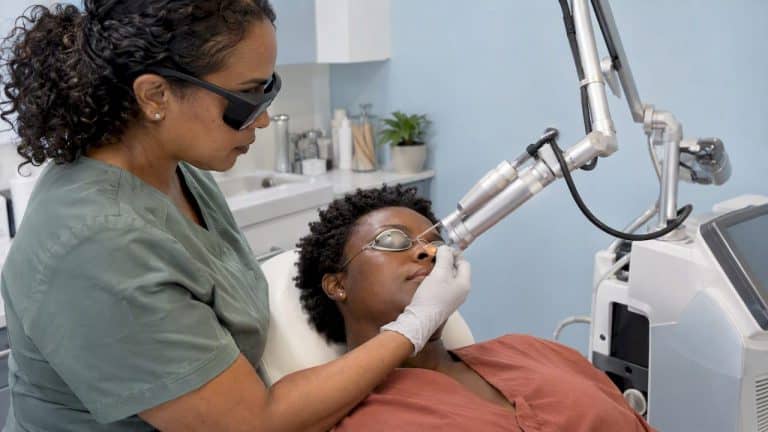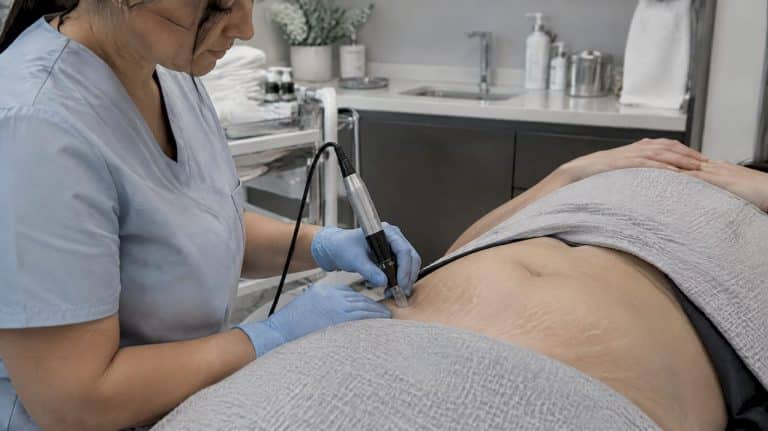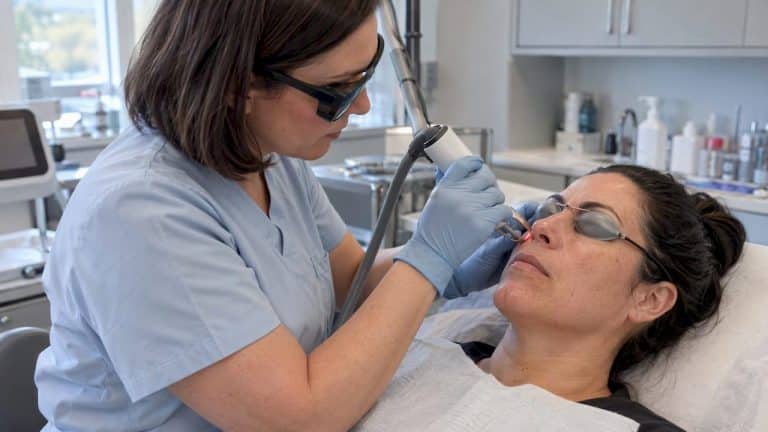
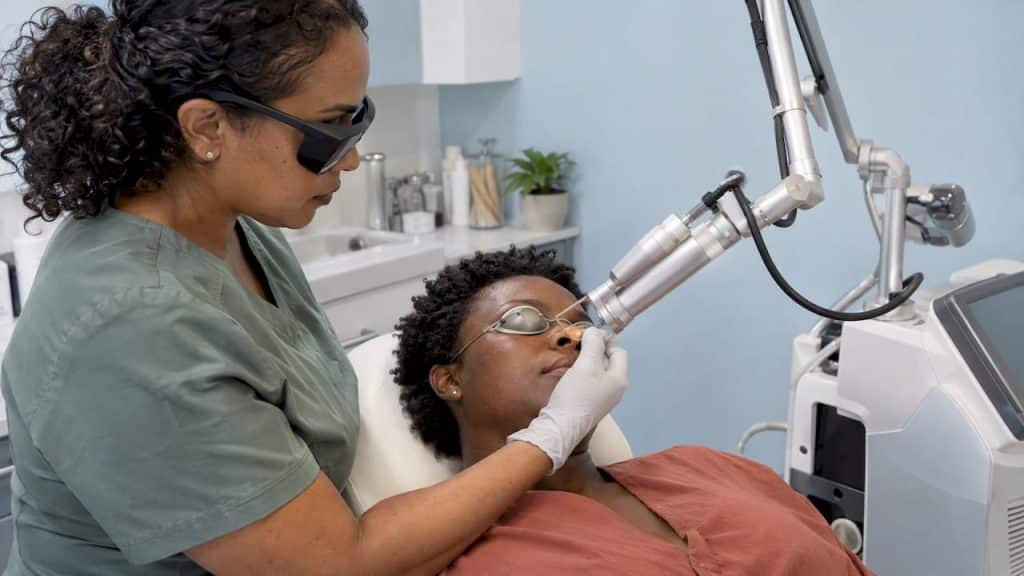
A CO2 laser is not a simple yes or no for darker skin, but it is a treatment that needs real caution. Melanin absorbs laser energy, and an ablative laser that injures the surface of the skin can leave behind dark patches, light patches or scarring. For many people with deeper skin tones, a different laser is the better first choice. In a small number of carefully selected cases, a very conservative CO2 protocol is still used by experienced clinicians.
Below, we explain why the risk exists, who is more likely to be a candidate, what the alternatives are, and what to ask before you book anywhere.
TL;DR
- Standard CO2 resurfacing is generally considered unsuitable for Fitzpatrick skin types V and VI because of the risk of lasting pigment change and scarring, according to DermNet.
- Skin types III and IV sit in a grey zone. Some people are treated with low-energy, low-density settings, but only after a careful assessment and often with skin preparation.
- Longer-wavelength options such as the 1064 nm Nd:YAG are usually preferred for darker skin because they are far less absorbed by melanin.
- Tan, recent sun exposure, a history of dark marks after breakouts, and unsupervised operators all raise your risk.
- A consultation and a test area tell you far more than any general rule. Bring your questions and your skin history.
Table of Contents
- Why melanin changes the conversation
- What the evidence says about CO2 and darker skin tones
- What pigment problems actually look like
- Safer laser options for darker skin
- How good clinics reduce risk when lasers are used
- A closer look at acne scars
- Perspective: how we approach this at Enriched
- Who should be extra careful, or wait
- Choosing a provider in Ontario
- Where our care fits
- After any laser: what recovery should look like
- FAQ
- Sources
Why melanin changes the conversation
Lasers work by delivering energy that a target in the skin absorbs. Melanin, the pigment that gives skin its colour, is one of those targets. In darker skin there is more of it in the top layer, so it competes with the intended target. DermNet explains that melanin can act as a competing chromophore, which increases the risk of side effects once the surface of the skin is injured by a laser.
The CO2 laser is ablative. It emits infrared light at 10,600 nm and vaporizes thin layers of tissue, which is why it is so effective for deep acne scars, wrinkles and sun damage. That same injury is what triggers inflammation. In skin that is rich in melanin, inflammation often produces extra pigment. This is called post-inflammatory hyperpigmentation, or PIH.
It helps to separate two things. The laser is not “unsafe” in itself. The problem is how much thermal injury the skin has to recover from, and how readily your skin responds to injury by making pigment. Many clients tell us a mosquito bite, a pimple or a scrape leaves a mark for months. That history is exactly what we want to know about before we discuss any laser.
What the evidence says about CO2 and darker skin tones
The guidance is fairly consistent. DermNet states that CO2 laser resurfacing is generally considered contraindicated for Fitzpatrick skin types V and VI because of the high risk of permanent dyspigmentation and hypertrophic scarring.
The Fitzpatrick scale runs from I to VI and describes how your skin reacts to sun. Very roughly:
| Fitzpatrick type | Typical description | CO2 resurfacing outlook |
|---|---|---|
| I–II | Very fair to fair, burns easily | Generally the most straightforward candidates |
| III | Medium, sometimes tans | Possible with careful settings |
| IV | Olive to light brown, tans easily | Higher risk, case-by-case judgment |
| V–VI | Brown to deep brown or black | Generally avoided for standard CO2 resurfacing |
The scale is a guide, not a verdict. Skin type is not the same as ethnicity, and two people of the same background can sit on different rows. A clinician should assess you in person, in good light.
There is also a more nuanced side. A review of laser treatments for post-inflammatory hyperpigmentation in skin of colour notes that expert practitioners sometimes use conservative, low-fluence, low-density fractional settings in stubborn cases. It describes this as requiring extreme caution, meticulous patient selection and often pre-treatment with depigmenting agents. That is not a green light for routine use. It describes specialist judgment applied to a narrow group of patients who have not responded to other options.
One published study on facial resurfacing in Fitzpatrick type IV highlights the same tension: fractional CO2 is often used for atrophic acne scars, yet PIH in darker skin types remains a significant limitation on outcomes. In plain terms, even when treatment is possible, the pigment risk shapes everything about how it is done.
What pigment problems actually look like
It is worth knowing the complications so you can recognize them and ask about them.
- Hyperpigmentation: dark patches that usually appear a few weeks after treatment. They often fade over months, but they can be stubborn and sometimes last longer.
- Hypopigmentation: lighter patches where pigment-producing cells were damaged. This can be permanent and is harder to correct than darkening.
- Scarring: raised or thickened scars, more likely when too much energy is delivered or the skin is not allowed to heal properly.
- Prolonged redness and swelling: common after any ablative treatment, but longer or more intense in some skin.
The lighter and darker patches are the reason many careful clinicians say no. A temporary result is one thing. A visible change in your natural tone is another.
Safer laser options for darker skin
When the goal is skin revitalization, texture or scar improvement, the question to ask is not “can I have CO2?” but “what is the gentlest device that can still reach my concern?”
DermNet describes the long-pulsed 1064 nm Nd:YAG as the preferred option in skin of colour, because its longer wavelength passes the melanin-rich top layer and reaches deeper tissue. Dr. Arielle Kauvar, a clinical professor of dermatology at NYU Grossman School of Medicine, makes a related point in an interview with AJMC: colourblind devices and longer-wavelength lasers are considered safest for darker skin tones, and shorter visible wavelengths that melanin absorbs strongly are best avoided.
Here is how the main options compare for common concerns:
| Concern | Often considered for lighter skin | Often considered for darker skin |
|---|---|---|
| Deep acne scars | Fractional CO2 | Gentler fractional or non-ablative devices, microneedling, combined approaches, specialist review |
| Texture and fine lines | CO2 or other resurfacing | Microneedling, superficial peels, non-ablative laser |
| Unwanted hair | Several laser types | Nd:YAG (see our guide to laser hair removal for dark skin) |
| Dark marks and melasma | Laser or IPL | Carefully chosen peels and topical preparation (see our melasma peel guide) |
No option is risk-free, and results vary. Expect gradual improvement over a series of sessions rather than a single dramatic change.
Microneedling and peels
For many of our clients with deeper skin tones, microneedling is a sensible starting point for scars and texture because it stimulates collagen without vaporizing the skin surface. Our microneedling treatment is listed at $359 per session. Most people need a series, spaced out, and we talk through that plan at the consultation.
Chemical peels can help with uneven tone, but the same pigment rules apply. Depth, ingredients and preparation matter. If you are curious about the broader range of peels and skin therapies we offer, you can see them on our services page.
How good clinics reduce risk when lasers are used
When a laser is appropriate for darker skin, a thoughtful plan usually includes several layers of protection.
- A full history. Dr. Kauvar advises a thorough pre-treatment history covering earlier pigment problems, and confirming there is no active tan or chronic sun exposure.
- Skin priming. Dr. Jill Waibel describes, in MDedge’s coverage of scar treatment, a multimodal approach that can include preparing the skin with topical lightening agents, conservative energy settings and longer intervals between sessions, in the range of six to eight weeks.
- A test spot. Providers often treat a small, inconspicuous area first and watch how your skin responds before treating the whole face.
- Low energy, low density. Less injury per session means less inflammation, at the cost of needing more sessions.
- Strict sun avoidance afterwards. Daily broad-spectrum SPF and shade are not optional while the skin heals.
The tan point deserves emphasis. Tanned skin holds more melanin, which raises the risk of thermal injury and pigment change. Health Canada’s notice on thermal harm from energy-based devices covers the wider safety picture for lasers and similar devices. If you have just come back from a trip or spent a summer outdoors, we would usually suggest waiting before any laser treatment. Our guide on how to prepare for laser treatment walks through that timeline.
A closer look at acne scars
Acne scars are the reason most people with darker skin ask about CO2 in the first place. Boxcar and ice pick scars can be deep, and CO2 is often described as a powerful tool for them. But deeper scars also tend to sit alongside a history of post-acne marks, which is exactly the pattern that signals higher PIH risk.
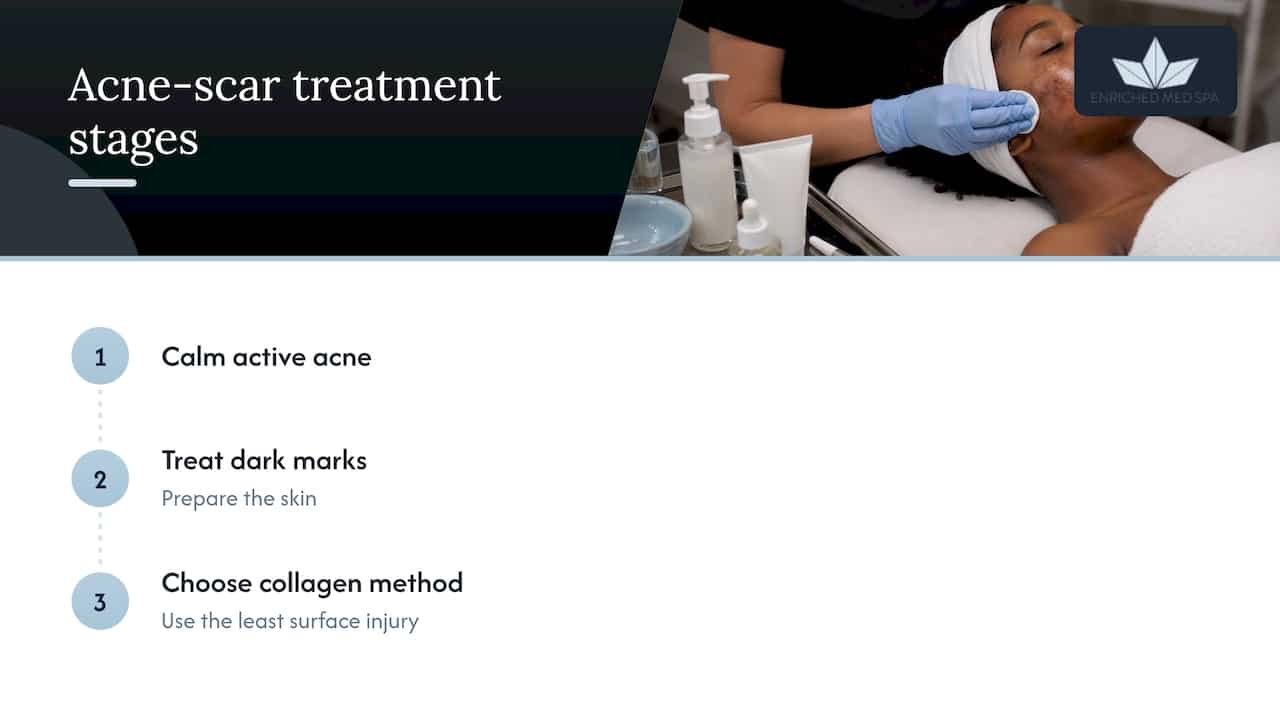
In practice, we think about it in stages. First, calm active acne. Second, treat existing dark marks and prepare the skin. Third, choose a method that rebuilds collagen with the least surface injury. Our article on CO2 laser for acne scars goes into scar types and skin-tone risks in more detail.
It is also worth being honest about limits. Very deep scars may only improve partially without more aggressive treatment, and sometimes the right call is to accept a smaller improvement rather than risk a new pigment problem. That is a trade-off you should make with your eyes open.
Perspective: how we approach this at Enriched
We see many clients who have been told online that a laser will fix everything, or that they are “not allowed” to have any laser at all. Neither is true. What we focus on is the individual: your skin type, your healing history, your recent sun exposure and what you actually want to change.
Our starting point is a consultation, not a machine. We ask whether marks linger after breakouts, whether you tan easily, which products you use and what you have tried before. If a treatment is not suitable, we say so and explain why. Often the more useful answer is a slower route: preparing the skin, using lower-risk treatments, and revisiting the question once your skin is in good condition.
We would rather you leave with a realistic plan than a promise. Natural-looking improvement, built gradually, tends to look better and be safer than a single aggressive session.
— Felix
Who should be extra careful, or wait
Even outside the skin type question, some situations call for caution before any ablative or heat-based laser:
- You have a fresh tan or have been in strong sun in recent weeks.
- You have a history of keloid or thick scars.
- You have active acne, infection or cold sores in the area.
- You are prone to dark marks after minor injury.
- You are using products or medications that make skin more sensitive. Tell your clinician about everything you take, and ask your doctor or pharmacist about prescription medications.
If any of these apply, mention them at the start of the consultation. A dermatologist is the right person to see for medical skin conditions, suspicious spots, or pigment that is changing, before you book a cosmetic treatment.
Choosing a provider in Ontario
The operator matters as much as the device. Health Canada’s guidance on cosmetic laser treatments points out that safety and effectiveness depend on operator training and device licensing. Ablative lasers can cause burns, scarring and pigment changes, so it advises choosing facilities where procedures are performed or closely supervised by licensed medical professionals who can manage complications.
Before you book, ask:
- Who will perform the treatment, and what is their training?
- How often do they treat skin tones like mine?
- Which device and wavelength will be used, and why?
- Will you do a test patch, and how long before I see the result?
- How do you prepare my skin and what is the aftercare?
- Who do I contact if something looks wrong, and how fast do you respond?
A good provider will answer these without hesitation. If you feel rushed or the answers stay vague, that is useful information.
Where our care fits
At Enriched Med Spa, serving Woodbridge, Vaughan and East Gwillimbury, treatments are performed by experienced nurse-level injectors and aestheticians, and every plan starts with a thorough consultation. If you are weighing laser resurfacing, you can read more in our guides on how laser resurfacing works and its benefits for clearer skin. If you would like us to look at your skin and suggest a safer path, you can start from our services page or book a consultation through our website.
After any laser: what recovery should look like
Whatever treatment you choose, aftercare is where a lot of pigment problems are won or lost. Your skin needs time to breathe and heal, and that means keeping things simple.
- Cleanse gently with a mild, non-comedogenic cleanser and avoid scrubs or exfoliants until your clinician says the skin is ready.
- Moisturize often with a bland product.
- Wear broad-spectrum SPF every day, and add a hat in strong sun.
- Do not pick at crusts or flakes. Picking can cause scarring and uneven colour.
- Report spreading redness, blistering, pus, fever or darkening that is getting worse to your provider promptly, and seek urgent care if you feel unwell.
Pigment changes often show up a few weeks after treatment rather than on day one, so keep in touch with your clinic during that period even if the skin initially looks fine.
FAQ
Is CO2 laser safe for dark skin?
It carries a higher risk than in lighter skin. Standard CO2 resurfacing is generally considered contraindicated for Fitzpatrick types V and VI, and types III to IV need careful judgment. Safer alternatives often exist, so ask about them first.
Can brown skin have CO2 laser?
Sometimes, but only in selected cases. Experts describe using conservative, low-fluence, low-density settings with skin preparation for stubborn problems. If you are brown-skinned and considering it, see a clinician experienced with your skin tone and request a test area.
Which laser is best for darker skin?
For many concerns, the long-pulsed 1064 nm Nd:YAG is the preferred option because it spares the melanin-rich top layer. The right choice still depends on your goal, whether that is hair removal, tone or scars.
How long should I wait between laser sessions on darker skin?
Some experts recommend longer intervals, around six to eight weeks, so the skin can recover from inflammation. Your clinician will adjust this to how your skin heals.
Does a tan make a difference?
Yes. Tanned skin contains more melanin, which increases the risk of thermal injury and pigment change. Most clinics will postpone treatment until the tan has faded.
Sources
- DermNet: Carbon dioxide laser treatment
- DermNet: Laser therapy in skin of colour
- AJMC: Colourblind devices and longer-wavelength lasers, Ariella Kauvar, MD
- MDedge: Fractional ablative lasers a mainstay for scar treatment
- Review of laser treatments for post-inflammatory hyperpigmentation in skin of colour
- Facial resurfacing in patients with Fitzpatrick skin type IV
- Health Canada: Cosmetic laser treatments
- Health Canada: Risk of thermal harm from energy-based medical devices