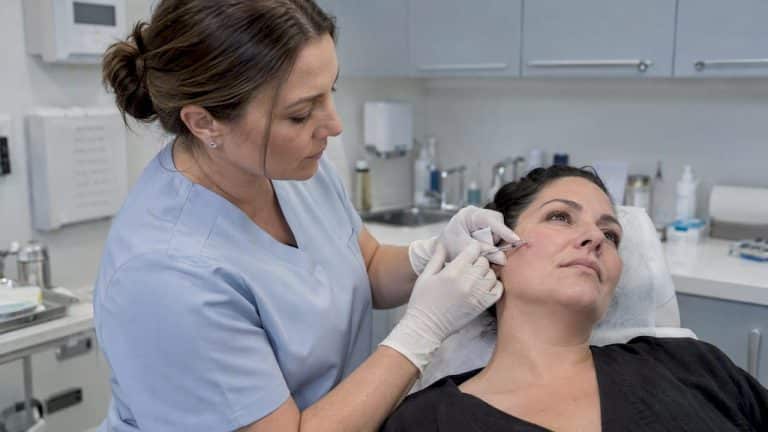
Most hyaluronic acid (HA) fillers last somewhere between 6 and 18 months. Health Canada’s guidance on cosmetic injections gives that range and notes that it depends on the product, the area treated and your own metabolism. Lips sit at the short end of that range, and cheeks and the lateral face sit at the long end. Below, we explain why, what the first two weeks look like, and how to plan maintenance so your results stay natural.
TL;DR
- HA filler typically lasts 6 to 18 months. The box may promise more, but the visible, aesthetic result usually fades sooner.
- Lips tend to break down fastest because they move constantly. Static areas like the cheek can hold product for much longer.
- Swelling, redness and bruising are common after treatment. Swelling generally settles within days, and you should judge the final result after about two weeks.
- HA filler can be dissolved with an enzyme called hyaluronidase, which is one reason we favour it.
- Think of filler as a maintenance plan, not a one-time fix. Technique and product choice matter as much as the syringe.
Table of Contents
- How long dermal fillers last, in plain terms
- Why lips fade faster than cheeks
- What changes how long your filler lasts
- The first two weeks: swelling, bruising and what is normal
- Can you make filler last longer?
- Filler versus Botox: why they wear off differently
- Our perspective
- Choosing safely in Canada
- Booking a filler consultation in Woodbridge
- FAQ
- Sources
How long dermal fillers last, in plain terms
The honest answer is a range, because “filler” is not one product. HA fillers are made from a sugar molecule your body already produces, cross-linked so it holds its shape under the skin. Your body slowly breaks it down. How fast depends on several things working together.
The Health Canada page puts HA filler at roughly 6 to 18 months. Botox works differently, since it relaxes muscle rather than adding volume. According to Medical News Today, neurotoxin results last about 3 to 4 months, while filler lasts 6 to 18 months. So if you are wondering why your forehead lines return before your cheeks lose their lift, that is the reason.
Here is a rough guide to what we see and what the published ranges suggest:
| Area | Movement | Typical pattern |
|---|---|---|
| Lips | High | Shorter end of the range, often softening first |
| Nasolabial folds and marionette lines | Moderate | Mid-range, depends on depth and product |
| Cheeks and mid-face | Low | Longer end of the range |
| Chin and jawline | Low to moderate | Often longer, since product sits deeper |
These are patterns, not promises. Two people with the same syringe in the same area can have very different timelines.
Why lips fade faster than cheeks
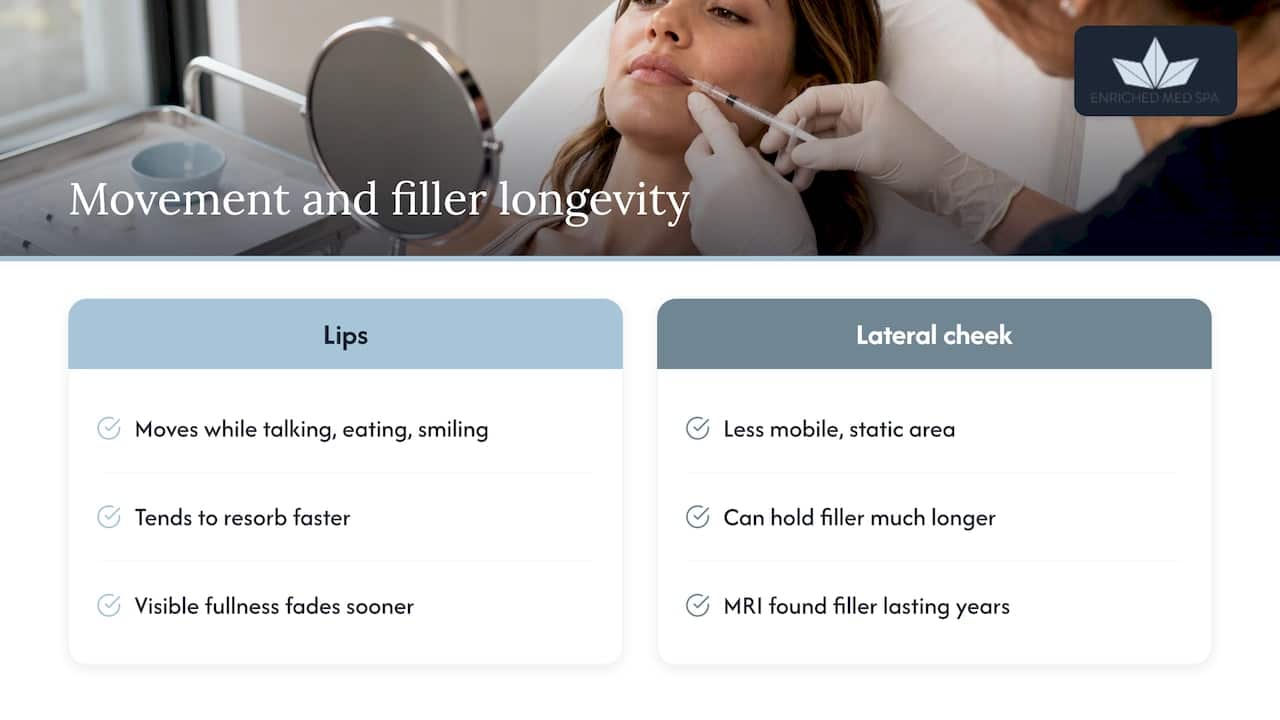
Lips move all day: talking, eating, smiling. Areas with that much movement tend to show faster resorption, while static areas such as the lateral cheek can hold filler much longer. A long-term MRI case report followed HA placed in the lateral face, mid-face and chin and found it persisted for years in the less mobile areas.
That last point surprises many people. Product can remain detectable on imaging long after you can see or feel any effect. Health Canada’s page notes that some MRI data show remnants lasting well beyond the cosmetic effect. This does not mean your lips look full for years. It means the visible result and the physical presence of the gel are two different things, and it is a good reason to space treatments sensibly rather than topping up on a fixed schedule.
If you want a deeper look at lips specifically, we have written about how long lip fillers last and how to maintain them.
What changes how long your filler lasts
Many clients come in expecting a single number. In consultation we talk through these factors instead.
The product
Fillers differ in how firmly they are cross-linked, how cohesive they are and how much they lift. Experts note that choosing a filler whose physical properties suit the target area is central to avoiding lumps and migration. A softer, more flexible gel suits lips. A firmer one suits the chin or cheek. Using the wrong gel in the wrong place can shorten results and affect how natural they look.
The area and the depth
Deeper placement and less mobile areas generally last longer. That is why a mid-face treatment can still be going strong when lips have softened.
Your body and lifestyle
Metabolism, how much you exercise, sun exposure and smoking all play a part. Clinicians often report that very active people metabolise filler faster, though we would not promise that this applies to you. The honest approach is to watch how your first treatment behaves and plan the second around it.
The amount and the technique
A conservative amount placed precisely often looks better and lasts as long as a heavier hand. Lumps and irregularities are often a consequence of technique, meaning non-homogeneous material placement, rather than just the product itself. Proper massage after injection, where appropriate, helps the gel settle smoothly.
Your own expectations
Practitioners point out that patient expectations often outpace product reality. A product may be marketed as lasting up to two years, but the aesthetic lifespan is generally shorter because your face keeps ageing around the filler. Plan on maintenance rather than a single fix.
The first two weeks: swelling, bruising and what is normal
Swelling and bruising are the questions we hear most, especially about lips. Lips have a rich blood supply and soft tissue, so they react more visibly than most areas.
HealthLink BC says to expect pain, redness, swelling and possibly itching after a filler injection, and that swelling may last up to 36 hours. Health Canada lists temporary pain, redness, swelling, bruising and tenderness as common side effects that typically resolve within a few days. Lips can look noticeably larger than your final result for a little longer than other areas, so we ask clients not to judge the outcome on day one.
A realistic timeline looks like this:
- Day of treatment: some swelling, tenderness and possible tiny bruises at injection points.
- Days 1 to 3: swelling is usually at its most visible. Bruising, if it appears, may darken before it fades.
- Days 3 to 7: most swelling settles. Bruises shift from purple to yellow-green.
- Around 2 weeks: the filler has settled, and this is when we assess shape, symmetry and whether anything needs adjusting.
How to keep swelling and bruising down
- Use a clean cold compress in short intervals during the first day, without pressing hard on the lips.
- Sleep with your head slightly raised for the first night or two.
- Skip intense exercise, saunas and alcohol for the first day or two, as heat and increased blood flow can worsen swelling and bruising.
- Tell your injector about blood-thinning medication or supplements before treatment, and do not stop any prescribed medication on your own. Ask your prescriber first.
- Avoid massaging the area unless your injector has told you to.
We cover this in more detail in our guide to dermal filler recovery and our step-by-step filler guide.
When swelling is not normal
Serious complications such as vascular occlusion are rare, but they need urgent attention. Health Canada advises seeking immediate medical help for increasing pain or skin colour changes after treatment. HealthLink BC adds that if symptoms get worse 1 to 3 days after treatment, you may have an infection and should call your doctor. If you notice blanching, a dusky or mottled colour, severe pain, or vision changes, contact your injector right away and go to the nearest emergency department if you cannot reach them.
Can you make filler last longer?
You can support it, but you cannot override biology. What helps in practice:
- Matching the product to the area at the first appointment.
- Sun protection. Daily broad-spectrum SPF protects the skin that holds the filler.
- Good skin quality. Hydration, sensible exfoliation and treatments that support collagen help the area look better for longer, even as filler fades. Some clients pair filler with microneedling or radiofrequency tightening for that reason.
- Realistic top-up timing. Topping up as the first signs of softening appear often takes less product than waiting until everything is gone. That said, you do not need to rush.
- Avoiding unnecessary corrections. Overfilling to chase longevity usually backfires.
Be wary of anything that promises a result lasting several years. Longer is not automatically better. Modern practice favours temporary HA fillers because they are predictable and safer, allowing us to adapt to facial changes over time instead of living with permanent products that are hard to correct or remove.
Filler versus Botox: why they wear off differently
Botox softens lines caused by muscle movement, like frown lines and forehead lines. Filler replaces lost volume and smooths static folds. They are often combined, but they are not interchangeable. If you are unsure which concern you have, our comparison of dermal fillers and Botox explains the difference, and our Botox page covers neurotoxin treatment with Botox, Nuceiva and Xeomin.
Our perspective
When clients ask us how long filler lasts, we try to move the conversation from “how many months” to “what are we trying to achieve and how will we maintain it?” The strongest results we see come from small, planned treatments, not from the longest-lasting product on the shelf.
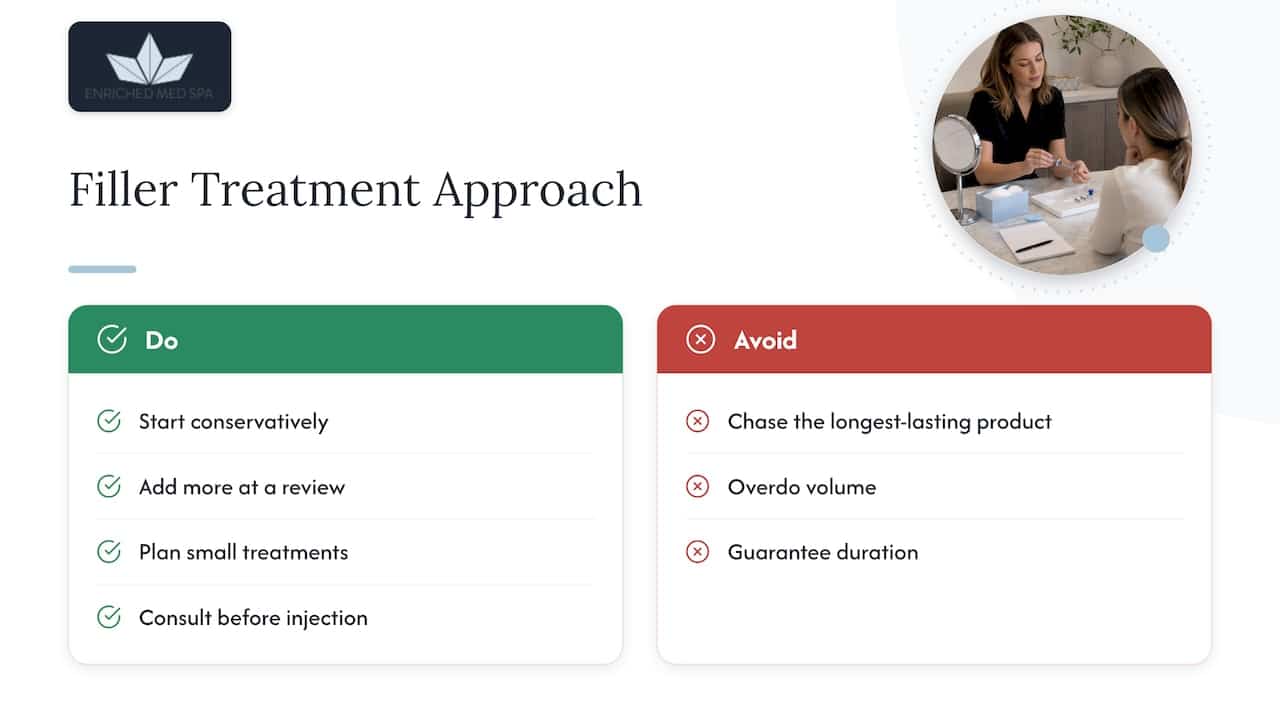
For first-time patients, we usually recommend starting conservatively, especially in the lips. You can always add more at a review appointment. It is much harder to take away volume from a result that looks overdone, although HA filler can be dissolved if needed. We also tell clients plainly that we do not guarantee a duration. Your body decides that, and we adjust the plan as we learn how you respond.
Technique matters just as much as the product. All treatments here are performed by experienced, nurse-level injectors, and we spend time on consultation and aftercare before anything is injected, because that is where most avoidable problems are prevented.
— Felix
Choosing safely in Canada
Longevity is irrelevant if the product or the provider is not safe. Two points we want every reader to know:
- Avoid needle-free “hyaluron pens”. Health Canada has stated that needle-free dermal filler devices are not authorized in Canada and may pose health risks, including to people seeking lip volume.
- Ask what is being injected. Health Canada has also warned about unauthorized injectables seized from a Hamilton, Ontario business in 2026. Ask which product is used, whether it is authorized for use in Canada, and who will perform the injection.
If you are unhappy with a result, HA filler is reversible with hyaluronidase, as Health Canada notes. If you are worried about a lump or shifted product, read our article on how filler migration is corrected.
Booking a filler consultation in Woodbridge
If you live in Woodbridge, Vaughan or East Gwillimbury and want to talk through what filler could and could not do for you, start with a consultation. We will review your goals, explain which area and product make sense, and give you a realistic view of timing and upkeep before any treatment. You can read more on our dermal fillers page, or look through everything we offer on our services page.
FAQ
How long does lip filler last?
Most people see lip filler soften within several months to about a year, and lips usually sit toward the shorter end of the 6 to 18 month HA range. Movement, metabolism and the amount injected all play a part. Your first treatment may fade faster than later ones, so we review it with you before planning a top-up.
Is bruising after lip filler normal?
Yes, small bruises are common, and they usually fade within about a week. Avoiding alcohol, intense exercise and heat for the first day or two can help. Tell your injector about any blood thinners or supplements beforehand, and call if bruising is severe, spreading or paired with worsening pain.
How long does lip filler swelling last?
Swelling is usually most visible in the first few days and eases over the first week. Health authorities describe swelling lasting up to 36 hours in many cases, though lips can stay puffy a little longer. Wait about two weeks before judging your final shape.
Does filler go away on its own?
The visible effect of HA filler fades as your body breaks the gel down. Imaging studies show small amounts can remain detectable for much longer than the cosmetic effect lasts. If you want it gone sooner, HA filler can be dissolved with hyaluronidase.
Sources
- Cosmetic injections, Health Canada
- Botox and fillers compared, Medical News Today
- Long-term MRI follow-up of hyaluronic acid dermal filler, PMC
- Sequential MRI follow-up of hyaluronic acid filler, PMC
- Botulinum toxin A literature review, Clinical, Cosmetic and Investigational Dermatology
- Patient expectations and filler duration, PMC
- Soft tissue fillers, Canadian Society of Plastic Surgeons
- Filler injections, HealthLink BC
- Needle-free dermal filler devices, Health Canada
- Unauthorized injectables seized in Hamilton, ON, Health Canada