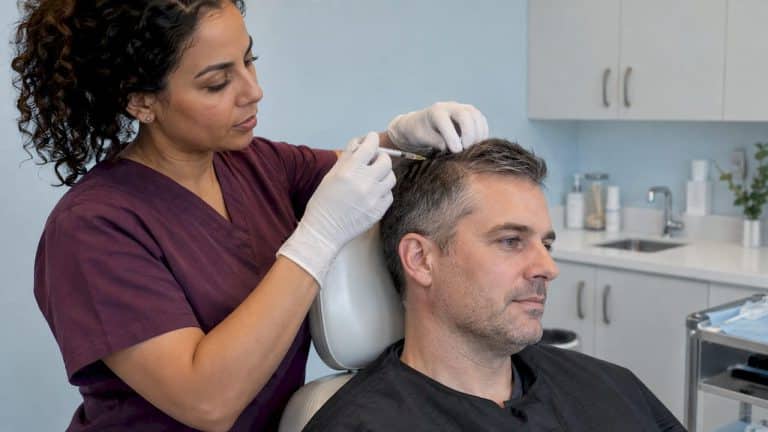
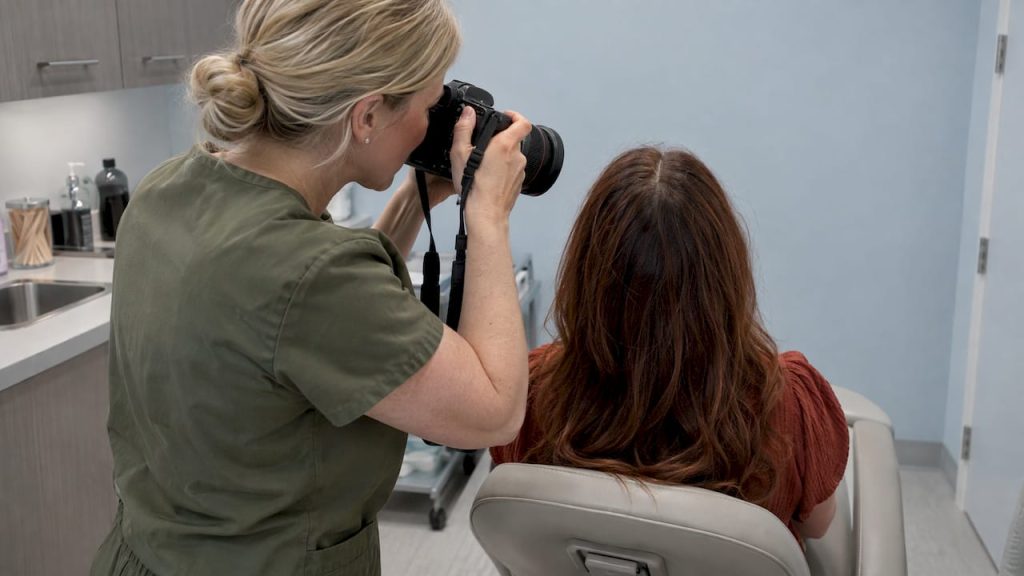
PRP for hair is slow by design. Most people notice less shedding first, then finer hairs filling in around the third month, and the clearest change tends to show between months 3 and 6, with some studies tracking gains out to a year. Knowing that calendar in advance is what keeps you from judging the treatment too early. At Enriched Med Spa in Woodbridge, PRP hair restoration is offered at $800, and a consultation is where we map this timeline to your own pattern of thinning.
TL;DR
- Temporary shedding can appear around weeks 4 to 6 after treatment and has settled by about week 8 in the cases described in the literature.
- Early improvement in density is usually measured from about month 3, after a series of sessions spaced roughly a month apart.
- Fuller results are commonly assessed between months 6 and 12, and the evidence for what happens after that is more limited.
- PRP results are not permanent, so a maintenance plan based on your own response is part of the picture.
- Averages from studies cannot predict one person’s outcome, which is why a consultation comes before a treatment plan.
Table of Contents
- Why hair takes months to respond
- The PRP hair results timeline, stage by stage
- How many sessions, and how far apart
- Why two people can have different timelines
- Does it last? Planning for maintenance
- Supporting your results between sessions
- Who it suits, and who should wait
- A realistic week-by-week plan
- Starting your PRP plan in Woodbridge
- FAQ
- Sources
Why hair takes months to respond
PRP stands for platelet-rich plasma. A small sample of your own blood is spun to concentrate the platelets, which carry growth factors, and the plasma is then placed in the scalp. The aim is to nudge follicles that are shrinking but still alive back into an active growth phase.
Hair simply does not grow quickly. Even when a follicle is stimulated today, the new hair has to grow long enough and thick enough to be seen and measured. That is why a clinician talks about months rather than weeks, and why photographs taken at the same angle and lighting matter more than a mirror check in week three.
This timeline applies mainly to androgenetic alopecia, the common pattern of gradual thinning (pattern hair loss) that runs in families. If your hair loss has another cause, such as a thyroid problem, low iron or recent illness, that needs to be sorted out first, and your family doctor is the right person for the bloodwork.
The PRP hair results timeline, stage by stage
The ranges below combine what published studies measured with how those studies were scheduled. Protocols differ, so treat each stage as a window, not a deadline.
| Stage | What commonly happens | What it means |
|---|---|---|
| Weeks 1 to 4 | Scalp may feel tender or tight for a short time. Sessions in a series are usually given about a month apart. | Little visible change is expected yet. |
| Weeks 4 to 8 | Some people notice more shedding. | Often a temporary reset, not a failure. |
| Months 2 to 3 | Shedding eases. Finer, shorter new hairs may appear. | Early signs, easier to see in photos than in the mirror. |
| Months 3 to 6 | Density gains are most often reported in this window. | The first meaningful checkpoint. |
| Months 6 to 12 | Fullest response in many studies. | The point where a maintenance plan is decided. |
Weeks 4 to 8: the shedding phase
This is the part that worries people most. A review of treatment-induced shedding describes a study of 210 patients receiving PRP with microneedling in which three cases of transient shedding appeared 4 to 6 weeks after treatment and resolved by week 8, attributed to growth factors pushing follicles into a new growth phase. It was uncommon in that group, but if you do notice extra hairs in the shower drain, it is a reason to book a check-in rather than to stop.
For what is normal in the days right after a session, our guide to PRP hair treatment side effects covers it in detail.
Month 3: the first measurable change
Month 3 shows up again and again in the research. In a 2015 randomized trial by Gentile and colleagues, 20 patients received three PRP injections at 30-day intervals, and at 3 months the treated side showed a mean gain of 45.9 hairs per square centimetre while the placebo side lost density. A 2018 literature review likewise found that improvement was most often reported after the third month.
A 2014 study using three sessions 21 days apart plus a booster at 6 months found that hair density peaked at 3 months and stayed significantly above baseline at 6 months and at one year.
The practical reading: at month 3 you are looking for less shedding and the first fine hairs, not a transformation.
Months 4 to 7: where most improvement is documented
A 2020 study of 24 people with androgenetic alopecia, who had four treatments over 14 weeks, recorded density rising from about 102 to about 162 hairs per square centimetre at seven months, with significant increases at every checkpoint. Patient satisfaction averaged about 73 out of 100, a useful reminder that numbers and happiness do not move in lockstep.
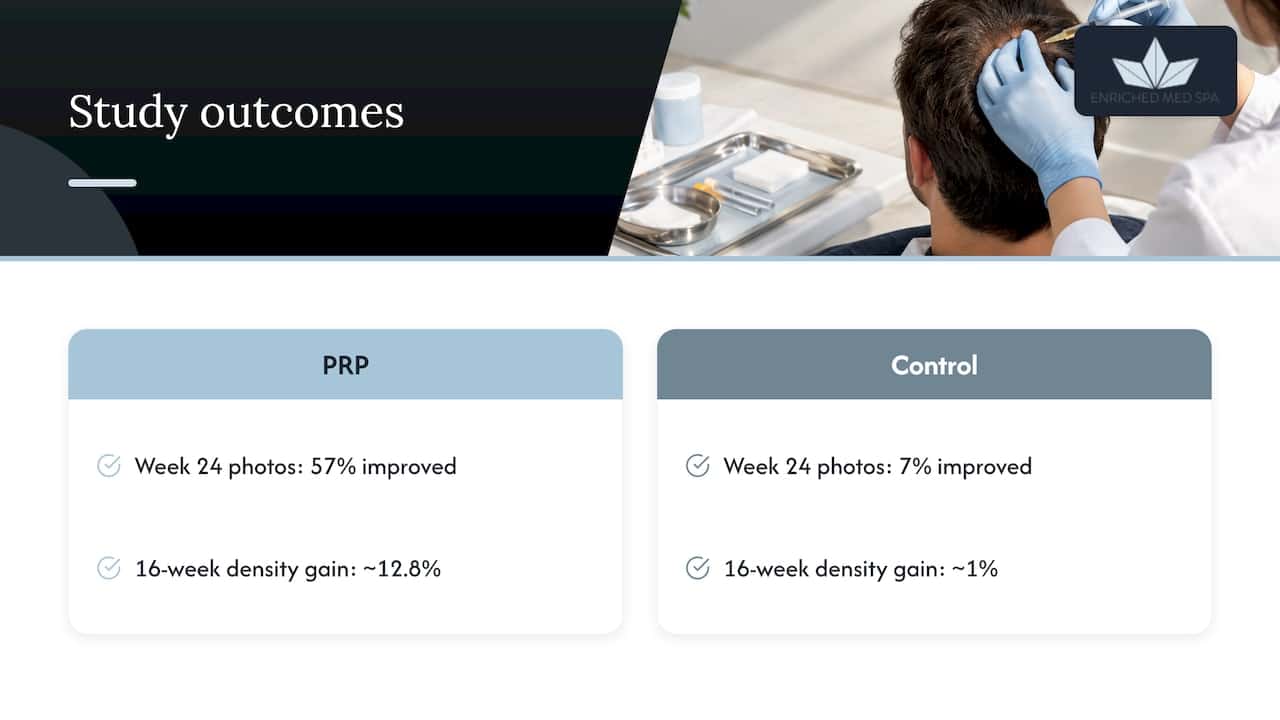
A 2020 randomized trial in women, where PRP was given at weeks 0, 4 and 8, found that 57% of the PRP group improved on blinded photography at week 24, compared with 7% of the saline group. If you are a woman reading this, our page on PRP for female hair loss goes further into who qualifies.
A small Canadian pilot study measured an average density increase of about 12.8% at 16 weeks, versus about 1% on the placebo side. Its authors also noted that growth factor levels in PRP varied widely between patients, and that individual responses differed significantly.
Months 6 to 12: the fuller picture
Many clinics and studies call 6 to 12 months the point of full effect. A 2026 ten-year trial in the Aesthetic Surgery Journal followed 234 patients after three sessions at 30-day intervals and reported density up 31.4% at 12 months, still 24.1% above baseline at 36 months and 17.3% at 60 months. Patients who received maintenance treatment showed an 11.2% improvement at 120 months.
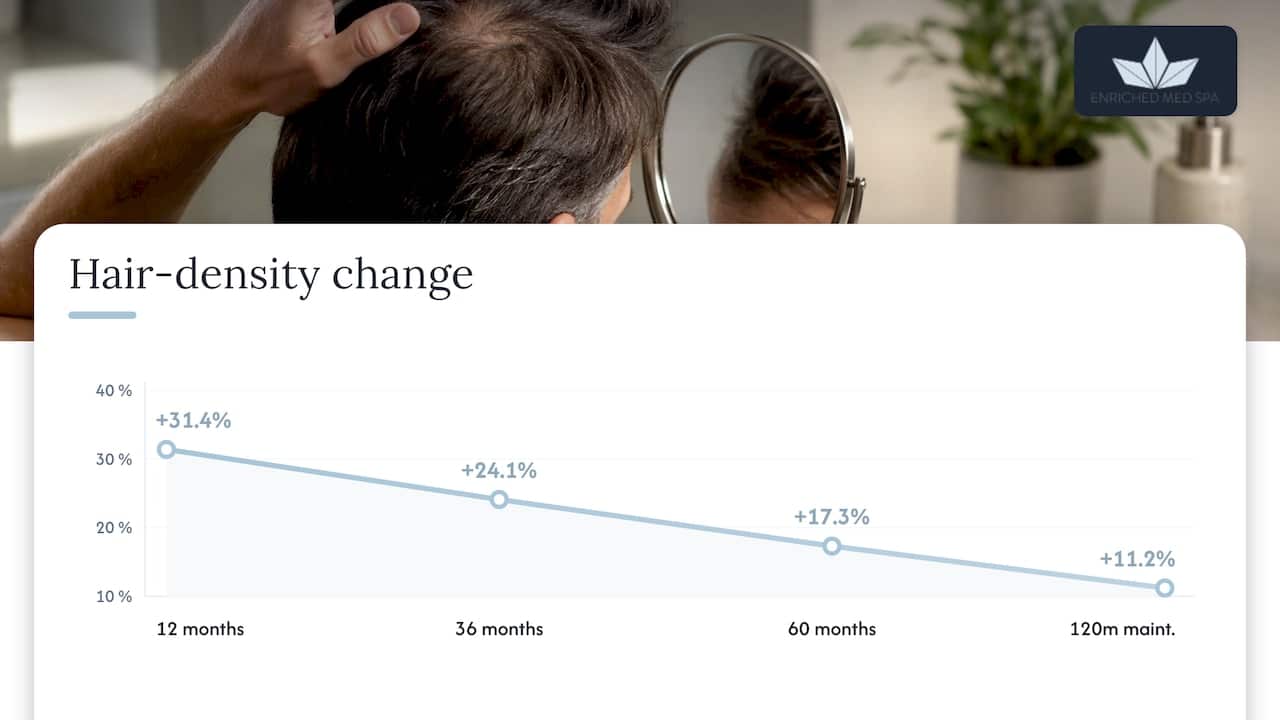
That shape is worth absorbing: the response builds, peaks within the first year, then gradually tapers without maintenance.
How many sessions, and how far apart
There is no single universal protocol. The studies above used three sessions at 21 to 30 day intervals, three sessions at weeks 0, 4 and 8, or four sessions over about 14 weeks. A trial of 60 patients combining PRP with microneedling concluded that at least four sessions at four-week intervals were needed for good results, with follow-up at 3 and 6 months after the last one.
So “is three sessions enough?” depends on the person: how advanced the thinning is, how you respond, and what you want to see. We set that plan after a consultation instead of fixing a number in advance. Our PRP hair restoration is listed at $800, and the hair restoration page also lists DERIVE exosomes hair restoration at $950.
Why two people can have different timelines
Research is encouraging but honest about variability. A 2024 systematic review of eight randomized trials and one cohort study, covering 291 men, found that six studies showed a statistically significant increase in hair density, while also noting that differences between studies limit firm conclusions.
The factors that most often shape your own timeline:
- Stage of thinning. Follicles that are still producing fine hair respond better than areas that have been smooth for years.
- Your own blood and growth factors. As the Canadian pilot found, platelet growth factor levels differ from person to person.
- Preparation and session spacing. Protocols that vary in concentration, dose and interval produce different results.
- The underlying cause. Pattern hair loss continues to progress, so the treatment works alongside that process.
- Your expectations. A measurable gain in density is not always a dramatic change in the mirror, which is why we talk through realistic outcomes up front.
Does it last? Planning for maintenance
PRP scalp results are not permanent. Johns Hopkins Medicine notes that additional injections may be needed at your doctor’s direction. In the 2015 Gentile follow-up, four patients noticed progressive loss after 12 months, more evident by 16 months after their last treatment, and were retreated.
The 10-year data above points the same way: the benefit fades gradually, and patients who kept up maintenance held more of it. A sensible approach is to review photos at months 6 and 12 and then decide on top-ups from your documented response, not on a fixed calendar. Our article on how long PRP lasts for hair walks through that.
Supporting your results between sessions
PRP works best as part of a routine. Gentle scalp care, a balanced diet with enough protein and iron, and avoiding harsh styling all help the hair you are growing. Some people also ask about at-home scalp products such as a copper peptide scalp serum to use between visits. Bring any product you are using to your consultation so we can look at your whole plan.
Who it suits, and who should wait
PRP is generally considered for early to moderate pattern thinning, where follicles are still active. It is not a fit for everyone. Because it is made from your own blood, anyone with a blood disorder, an active scalp infection or a condition affecting platelets, or who takes blood thinners, should speak with their family doctor before booking, and tell us about any of this at consultation. Pregnancy and the months after birth have their own considerations, covered in our guide to postpartum hair loss and PRP.
A sudden or patchy loss of hair, a scalp that is painful, scaly or red, or hair loss that began after a new medication should be looked at by your doctor first.
A realistic week-by-week plan
Here is how many clients map it out, as an example and not a promise:
- Consultation. We review your pattern of thinning, health history and goals, and take baseline photos.
- Treatment series. Sessions are spaced about a month apart.
- Weeks 4 to 8. Expect possible shedding. Keep your routine steady and reach out if you are unsure.
- Month 3. Compare photos in the same lighting. Look for reduced shedding and fine new hairs.
- Month 6. The main checkpoint. Density and thickness are easier to judge.
- Month 12. Decide on maintenance based on what the photos show.
Our perspective
Many people come to us worried that they have already waited too long, or frustrated that nothing seems to be happening at week six. Both feelings are understandable, and both are usually about timing. Hair follows its own calendar, and a good plan respects it.
We believe the right way to approach PRP is the way you would in a one-to-one consultation: look at your pattern of thinning, agree what a good result would look like for you, take photos, and check in at the points where change can actually be seen. All treatments at Enriched Med Spa are performed by experienced, nurse-level injectors and aestheticians, and we put thorough aftercare guidance and honest expectations at the centre of the visit.
Studies give us useful ranges, but they are averages, and your scalp is not an average. That is why we prefer to set expectations in your own photographs instead of in promises. PRP at $800 and DERIVE exosomes at $950 are options we can talk through side by side, based on what suits your hair.
Felix
Starting your PRP plan in Woodbridge
If you live in Woodbridge, Vaughan or East Gwillimbury and want to know whether PRP suits your thinning, the first step is a consultation. We will talk through your history, take baseline photos and explain the timeline above in terms of your own scalp. You can read about the treatments and book on our PRP hair restoration page. The page lists PRP Hair Restoration at $800 and DERIVE Exosomes Hair Restoration at $950.
FAQ
How long after PRP will I see hair growth?
Most people see less shedding first, then early signs of new fine hair around month 3. Studies most often report density gains between months 3 and 6, with the fullest response commonly assessed between 6 and 12 months.
Is 3 sessions of PRP enough?
Three sessions about a month apart is a commonly studied series, and several trials used it. Others used four, and one trial concluded that at least four were needed with microneedling. The right number depends on your pattern of thinning and your response, which we review at consultation.
Does PRP regrow hair permanently?
No. PRP results are not permanent, and additional treatments may be recommended over time. A ten-year study found that patients who had maintenance treatment held their improvement longer than those who did not.
Is shedding after PRP normal?
Temporary shedding has been described about 4 to 6 weeks after treatment, settling by around week 8. It is generally seen as growth factors prompting follicles to restart. If it worries you, or lasts longer, contact us or your doctor.
Sources
- The Effect of Platelet-Rich Plasma in Hair Regrowth (Gentile et al., 2015)
- Platelet-rich plasma for androgenetic alopecia: a review (2018)
- Growth factor concentrations in platelet-rich plasma (Siah et al., 2020)
- PRP in female androgenetic alopecia, randomized controlled trial (JAAD, 2020)
- Clinical efficacy and safety of autologous activated PRP (2020)
- Treatment-induced hair shedding associated with PRP
- PRP with microneedling in androgenetic alopecia: number of sessions
- Study of PRP injections in the treatment of androgenetic alopecia (2014)
- Long-term clinical outcomes of autologous nonactivated PRP (2026)
- The role of PRP in androgenetic alopecia, systematic review (2024)
- Platelet-rich plasma (PRP) injections, Johns Hopkins Medicine