Laser can be one of the most effective ways to treat sun damage and well-defined dark spots such as age spots (lentigos). It is not the right first step for every kind of pigment. Melasma and post-inflammatory hyperpigmentation (the dark marks left after acne, a rash or an injury) can get worse if the wrong device or settings are used. The right answer depends on what is causing your pigment, your skin tone, and how your skin has behaved with past treatments.
Many clients come to us saying they want “a laser for dark spots.” In the consultation we often find that they have two or three different kinds of pigment on one face, and each needs a different plan. This guide explains how to tell them apart, which laser and light options exist, and what to expect from sessions, downtime and maintenance.
TL;DR
- Lasers and light devices work best on discrete sun spots (lentigos) and general sun damage. A 2025 global consensus describes them as often first-line for visible lentigos.
- Melasma and post-inflammatory hyperpigmentation need extra caution. Lasers are usually not first-line for them and can worsen them if chosen poorly.
- Skin tone changes the risk. Ablative lasers such as CO2 carry a higher chance of rebound pigmentation in skin of colour.
- Expect several sessions, sun protection every day, and maintenance. Pigment, especially melasma, tends to come back.
- Have the pigment identified in person by a trained professional before any device is chosen.
Table of Contents
- First, work out which type of pigment you have
- Which lasers are used for pigment
- Laser for sun damage: where it shines
- Melasma and dark skin: slower, gentler, combined
- Post-acne marks and PIH
- Laser, IPL, peels or microneedling: how to choose
- What a session is like
- How many sessions and how long results last
- Perspective
- Staying safe: choosing who treats you
- Book a pigment consultation in Woodbridge
- FAQ
- Sources
First, work out which type of pigment you have
The word “hyperpigmentation” covers very different conditions. Lasers target melanin, but where that melanin sits, and why it is there, decides whether a laser helps or harms.
The European Society of Laser in Dermatology states that precisely recognizing the specific disorder is mandatory before choosing a laser or light device, because some devices can make certain conditions worse. That is why we start with a conversation and an assessment, not a device.
| Type of pigment | What it looks like | How lasers generally fit |
|---|---|---|
| Sun spots (solar lentigos) | Flat, well-defined tan to brown spots on the face, hands, chest | Often a good candidate; lasers and light devices are commonly first-line |
| General sun damage | Uneven tone, freckling, rough texture, small broken vessels | Often responds well to laser or light-based care, sometimes combined |
| Melasma | Larger, patchy, symmetrical brown areas, often linked to hormones and sun | Needs great caution; gentle settings and topical support |
| Post-inflammatory hyperpigmentation (PIH) | Flat dark marks where acne, eczema or injury was | Lasers usually not first-line; can aggravate it |
| Café au lait macules | Smooth, light-brown patches, often present from childhood | Requires caution; results are unpredictable |
The table follows the 2019 European position paper, which found laser treatment can be effective for lentigos, dermal hypermelanocytosis and heavy metal depositions, but calls for great caution with melasma, café au lait macules and post-inflammatory hyperpigmentation.
Why a sun spot and melasma are treated so differently
A sun spot is a localized cluster of pigment-producing cells that has been overstimulated by years of UV. A short, focused pulse of energy can shatter that pigment, and the body clears it away.
Melasma is different. The pigment-producing cells are chronically overactive and easily provoked by heat, inflammation, hormones and light. A treatment that heats the skin can wake them up further. This is why a laser that clears a sun spot beautifully can leave melasma darker.
Which lasers are used for pigment
There is no single “best laser for hyperpigmentation.” There is a best match between a device, a diagnosis and a skin type. Here are the main categories, in plain language.
Pigment-targeting lasers (nanosecond and picosecond)
These deliver very short bursts of energy that break pigment into tiny particles. According to a 2025 global consensus on managing melanin hyperpigmentation, nanosecond, picosecond and IPL devices are effective for established, visible lentigos and often serve as first-line management.
Picosecond technology is also being studied for melasma. A review of laser and light therapy in melasma notes that picosecond lasers may offer less photothermal damage than older lasers, which is why they are of interest for pigment that is sensitive to heat.
Non-ablative fractional lasers
These create microscopic columns of treatment in the skin without removing the surface layer. For melasma, non-ablative fractional lasers, especially 1550 nm, are considered better tolerated than ablative techniques, though a risk of post-inflammatory hyperpigmentation remains in darker skin types.
Ablative lasers (CO2 and erbium:YAG)
Ablative lasers remove the outer layers of skin. They are strong tools for texture, wrinkles and scarring. The same dermatology review says they can be useful for melasma but are not preferred for skin of colour because post-inflammatory hyperpigmentation is common, with one chart review reporting 37%. If you have deeper skin and are curious about CO2, our guide to CO2 laser on dark skin walks through the limits and safer options.
IPL: light, not laser
Intense pulsed light is often grouped with lasers, but it works differently. A laser uses a single, precise wavelength. IPL releases a broad spectrum of light that is filtered for the target, which makes it well suited to sun spots, freckles, redness and small surface vessels across a wider area. Because the light is less specific, it demands careful screening and is generally better suited to lighter skin tones. Our article on IPL photofacials for dark spots explains how this treatment feels and what it targets. If you are comparing it to a laser for hair removal, that is a different question, covered in the difference between IPL and laser hair removal.
The 2026 summary of the European Academy of Dermatology and Venereology (EADV) guideline says that lasers, IPL and other energy-based devices should be tailored to the disorder, skin type and genetic background. The same summary notes that lasers and chemical peels are recommended first-line for pigment changes from chronic photodamage.
Laser for sun damage: where it shines
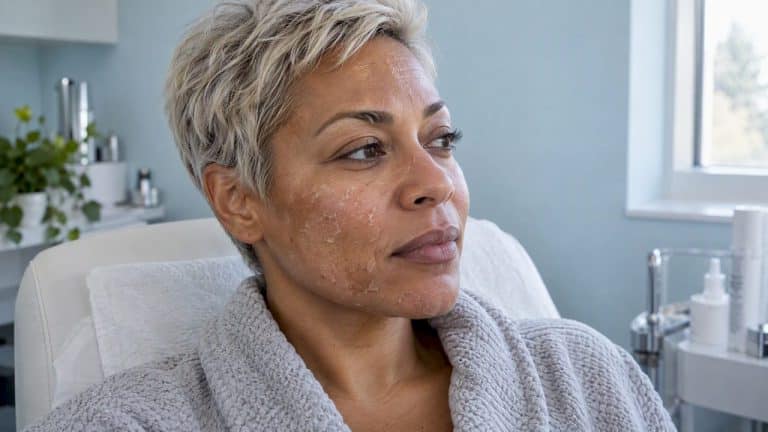
Sun damage is the strongest case for pigment lasers. Typical signs are scattered freckles, age spots on the cheeks and backs of the hands, and a dull, uneven tone that builds over years. Most of our clients in Woodbridge and Vaughan who ask about this are in their late thirties to fifties and remember sunburns or summers abroad more than they expect.
What a plan often looks like:
- Assessment. We look at the pattern, depth and colour of the spots, ask about sun exposure, medications, pregnancy and previous reactions, and check for anything that needs a physician’s review first.
- Targeted treatment. For visible spots and overall tone, we use pigment-targeting technology suited to your skin type. Our menu includes pigment reduction and skin revitalization on the MotusAZ+ platform, as well as vascular and redness reduction. Which setting is suitable is decided at your consultation.
- Support between sessions. Daily broad-spectrum sunscreen, gentle cleansing and, where appropriate, a brightening topical.
- Maintenance. Sun damage keeps accumulating unless you protect against it, so we plan upkeep rather than a one-time fix.
The texture side of sun damage, such as fine lines and rough skin, may call for a different tool, such as microneedling or a peel. We compare these below.
Melasma and dark skin: slower, gentler, combined
If you have melasma, the goal changes from clearing it to calming and controlling it. The review of laser and light therapy in melasma says difficult cases are best managed by combining topical regimens that inhibit melanin production with procedures that speed up melanin removal.
The same review reports that low-fluence Q-switched Nd:YAG lasers have shown promise for melasma but are linked to high recurrence at three months, 64% to 81%, and often require many sessions, sometimes weekly. Results for chronic conditions like melasma are frequently temporary, so maintenance is part of the plan.
In practice, for melasma and for deeper skin tones, we often begin with lower-risk steps:
- A careful sun-protection routine, including tinted or mineral sunscreen and a hat.
- Topical brighteners. If you are weighing options, a comparison of alpha arbutin versus hydroquinone can help you understand the ingredients you may be asked about.
- Gentle chemical peels after a priming period. We explain this in our guide to melasma peels in darker skin.
- Microneedling with a conservative approach. See microneedling for melasma for the evidence and the risks.
Laser may still play a role, but we introduce it carefully, sometimes with a small test area first. For laser hair removal in deeper skin, the concerns are similar, and our dark-skin laser hair removal guide explains why the wavelength matters.
Post-acne marks and PIH
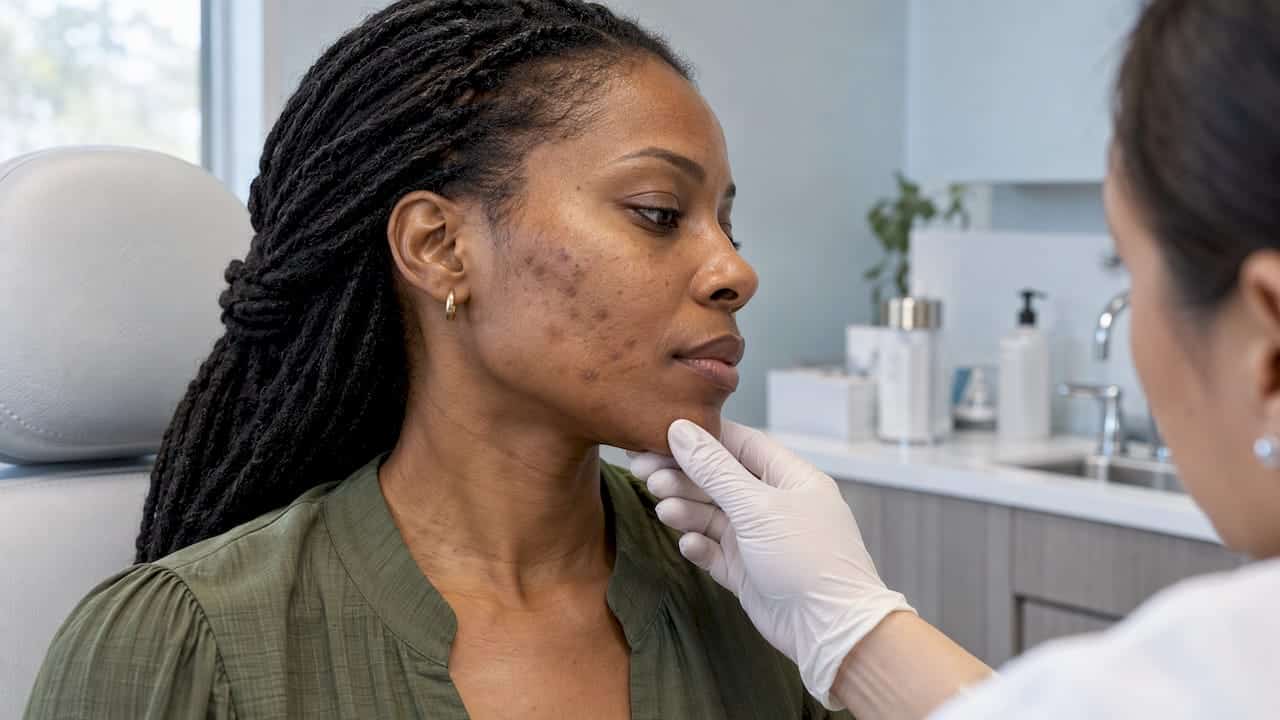
Dark marks after acne are among the most common concerns we see. The 2025 global consensus says that for PIH, procedural therapies such as lasers are usually not first-line and must be used with caution to avoid making them worse.
PIH often fades on its own over months when the underlying acne or irritation is controlled and you protect the skin from the sun. Calming the skin first, then using peels, brighteners or gentle resurfacing, is usually kinder than starting with a laser. Raised or pitted acne scars are a separate issue; our CO2 laser acne scar guide covers when resurfacing makes sense.
Sometimes a laser used for another purpose can also change pigment. Heat-related changes after hair removal are a real risk when settings or aftercare are wrong, which is why we put so much emphasis on laser hair removal aftercare.
Laser, IPL, peels or microneedling: how to choose
| Option | Best for | Downtime | Caution |
|---|---|---|---|
| Pigment-targeting laser | Defined sun spots, some stubborn pigment | Spots may darken and flake over about a week | Needs correct diagnosis and skin-tone match |
| IPL photofacial | Sun spots, freckles, redness over a broad area | Usually mild | Better suited to lighter skin tones; screening is key |
| Ablative laser (CO2) | Texture, scars, deeper sun damage | Longer healing | Higher PIH risk in skin of colour |
| Chemical peel | Superficial pigment, dullness, early melasma care | Peeling for several days | Priming and sun avoidance matter |
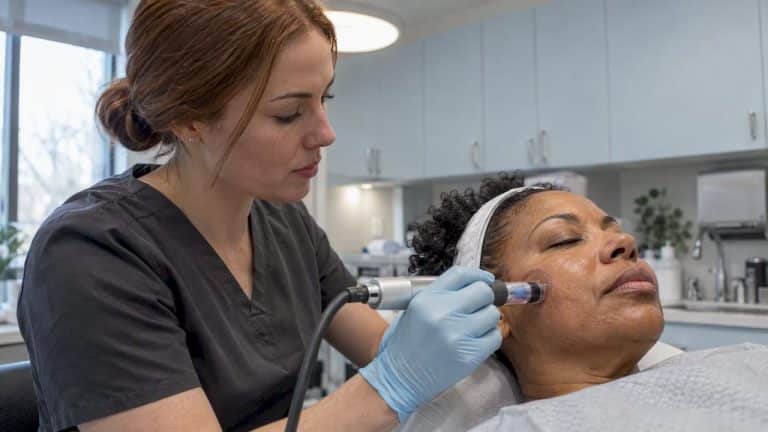
| Microneedling | Texture, scars, uneven tone | Redness for a day or two | Needs conservative settings with melasma |
Lighter options such as facials and peels brighten and prepare the skin. They will not usually remove a deep, well-formed sun spot. Our article on whether facials help with dark spots is honest about that line. More advanced options such as lasers, radiofrequency and microneedling deliver stronger change, with more planning around downtime and sun avoidance.
At our clinic, the menu covers several of these routes: peels such as CoolPeel and the Herbs2Peel B and C peels, the OxyGeneo facials, and MotusAZ+ pigment treatments. Microneedling is listed at $359 per session on our microneedling page.
What a session is like
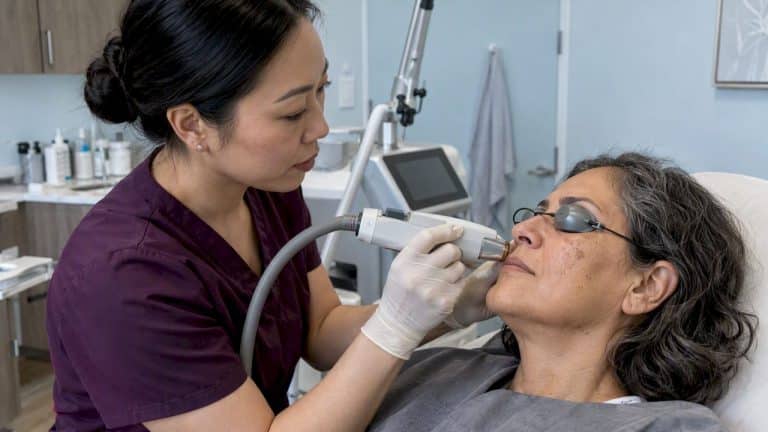
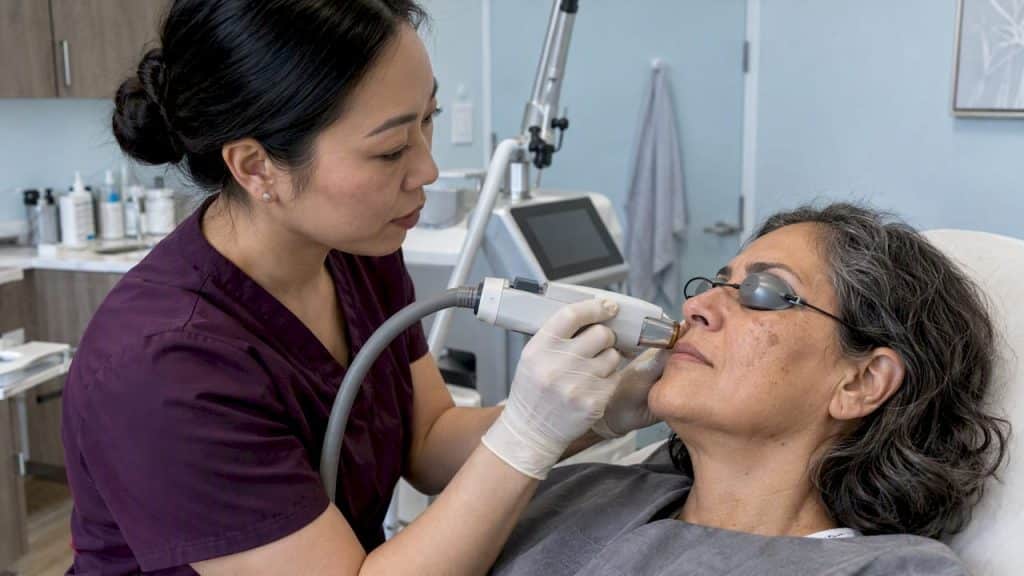
Health Canada’s guidance on cosmetic lasers says you should wear eye protection and ask about skin cooling. It lists possible side effects including pain, reddening, bruising, swelling, blisters, burns and infection.
A typical visit goes like this:
- We cleanse the skin and review your history and photographs.
- You get protective eyewear. Numbing or cooling is used as appropriate.
- The handpiece delivers pulses over the treated areas. Most people describe a snapping or warm sensation.
- We apply soothing products and sun protection before you leave.
After pigment lasers, treated spots can look temporarily darker as pigment lifts and flakes, usually over a week or so. Do not pick at them. Keep the area moisturized, avoid hot yoga and saunas for a few days if we advise it, and use broad-spectrum SPF every day, reapplied outdoors.
How many sessions and how long results last
The number of sessions depends on the device and the condition. The melasma review states that session counts vary significantly, with Q-switched lasers often needing frequent repeat treatments. Individual sun spots may respond in one to a few visits, while broader sun damage and melasma take longer and need upkeep.
Be cautious of anyone who promises a fixed number or a permanent result. The EADV summary stresses that recurrence, treatment resistance and procedure-triggered worsening make hyperpigmentation challenging to manage. A cleared sun spot usually stays gone, but new ones can form with more UV. Melasma can return with sun, heat or hormonal changes.
Perspective
Our view at Enriched is that pigment is a diagnosis first and a treatment second. The most common mistake we see is a client who bought a laser package for dark patches that turned out to be melasma or PIH, and whose skin got more reactive as a result.
That is why our nurse-level team starts every pigment plan with a consultation, a look at your skin tone and history, and a conservative approach. For sun spots and photodamage, targeted technology can deliver visible, natural-looking improvement. For melasma and deeper skin, we layer in sun protection, topicals and gentler procedures, and we bring in energy-based devices only when it is safe for you.
We would rather tell you to wait, prime the skin, or choose a milder treatment than rush you into a device. Done this way, results are more predictable, and you can trust the plan. If the first appointment ends with a clear picture of what you have and what is realistic, we have done our job.
Felix
Staying safe: choosing who treats you
Health Canada advises that anyone seeking treatment for pigmented areas should use a licensed health care professional with specialized training in laser procedures. Before you book anywhere, ask:
- Who will perform the treatment, and what is their training?
- Will someone assess the spot first? If a spot is new, changing, bleeding, or has uneven edges, see your family doctor or a dermatologist before any laser, because it needs to be checked and not treated as a cosmetic spot.
- Which device and which setting suit my skin tone? Can you test a small area?
- What is the aftercare plan, and who do I call if something looks wrong?
Tell us if you are pregnant or breastfeeding, take photosensitizing medications, have a history of cold sores in the treatment area, or have recently been tanned. These change the plan, and some of them mean waiting.
Book a pigment consultation in Woodbridge
If you are in Woodbridge, Vaughan or East Gwillimbury and want a straight answer on what your pigment is and what to do about it, we can map out a plan with you. Our team can discuss MotusAZ+ pigment reduction, peels, microneedling and OxyGeneo options in one visit and tell you honestly which fits your skin. See the full list on our services page and book from there.
FAQ
Which laser is best for hyperpigmentation?
It depends on the type of pigment and your skin tone. Picosecond and nanosecond pigment lasers are often favoured for sun spots, while gentler non-ablative options are considered for melasma. An accurate diagnosis matters more than the device name.
How many laser sessions are needed for dark spots?
Defined sun spots may need only a few sessions, while broader sun damage or melasma take more and need ongoing maintenance. Research shows that some melasma lasers require repeated, sometimes weekly, treatments and still see high recurrence. We set expectations at your consultation instead of promising a number.
Is IPL better than laser for sun damage?
Neither is better across the board. IPL covers larger areas of freckles, sun spots and redness with a broad spectrum of light, while lasers use a single wavelength for more targeted work. Skin tone and the type of pigment decide which is safer for you.
Can laser make hyperpigmentation worse?
Yes, particularly with melasma and post-inflammatory hyperpigmentation, or when the device or settings do not suit your skin tone. That is why professional guidance says to identify the disorder first. Choosing a trained clinician and protecting your skin from the sun afterwards lowers that risk.
Sources
- Laser treatment of hyperpigmented lesions: position statement of the European Society of Laser in Dermatology
- Global consensus on the management of melanin hyperpigmentation disorders
- Melanin Hyperpigmentation Disorders, Management: Global guideline summary
- Dermatology: how to manage facial hyperpigmentation in skin of colour
- A review of laser and light therapy in melasma
- Cosmetic Laser Treatments, Health Canada