
Botox results typically last about 3 to 4 months, with some treatment areas stretching to 3 to 6 months depending on the product and dose. You’ll usually notice changes within a few days, with the full effect settling in by about two weeks. Individual factors, from muscle strength to how often you treat, shape where you land in that range.
TL;DR:
- Muscle strength, dose, and injection technique directly influence the duration of Botox, which typically lasts three to four months but can extend to six months in some cases.
- Patients with larger, stronger muscles metabolize the toxin faster, often resulting in shorter-lasting effects compared to those with lower muscle tone.
- Frequent injections scheduled less than three months apart or high cumulative doses can increase the risk of developing neutralizing antibodies, leading to reduced effectiveness over time.
- Long-term use generally maintains consistent results for most clients, but periodic reassessment of dose and technique can optimize outcomes and address individual changes.
- Proper provider qualification, product authorization, and personalized treatment planning based on muscle pattern and response are essential in ensuring safety and efficacy.
Table of Contents
- What “typical duration” and onset actually mean
- Factors that change how long Botox lasts
- When Botox stops working as expected
- Safety, product approval, and choosing a qualified provider
- How to maintain results without rushing the process
- What long-term use usually looks like
- What we see in practice at our clinic
- A realistic view on maintaining results
- Botox options at Enriched Med Spa
- FAQ
- Sources
What “typical duration” and onset actually mean
When we talk about Botox lasting 3 to 4 months, we mean the window where a treated muscle stays visibly relaxed before movement gradually returns. Health Canada notes that cosmetic Botox effects generally last 3 to 4 months, though some clinical reviews report ranges extending to 6 months for certain areas or formulations.
Onset isn’t instant. Most clients see early softening within days, but full effect typically takes up to two weeks to develop. That’s why we ask clients to wait before judging results.
Duration also varies by area:
- The glabella (frown lines) often responds predictably and holds for a full 3 to 4 months.
- The forehead can fade a bit sooner in clients with strong frontalis muscles.
- Crow’s feet, a smaller muscle group, sometimes show earlier return of movement.
- The masseter, a much larger muscle used for jaw treatments, often requires higher doses and follows a different timeline entirely.
Factors that change how long Botox lasts
Many clients come in asking why a friend’s results lasted six months while theirs faded at three. The honest answer is that several variables stack together.
- Muscle mass and strength: larger, stronger muscles metabolize the toxin faster and may show earlier return of movement.
- Age and sex: younger patients with more muscle tone sometimes see shorter duration than older patients with naturally reduced muscle activity.
- Dose and dilution: the number of units and how they’re diluted affects both strength and spread of the treatment.
- Injection sites and point count: increasing injection points for certain muscles can improve duration compared with concentrating the same dose in fewer spots.
- Product choice: Botox Cosmetic, Nuceiva, and Xeomin use different formulations, and units are not interchangeable between products.
- Injector technique: precise placement relative to muscle anatomy matters as much as the product itself.
Pro Tip: Ask your injector how they’re adjusting dose and placement for your specific muscle pattern, not just applying a standard map.
When Botox stops working as expected
A small number of long-term patients develop secondary nonresponse (SNR), where the body builds neutralizing antibodies that blunt the treatment’s effect over time. Recent narrative reviews identify this as a recognized, if uncommon, issue in aesthetic practice.
Certain patterns raise the risk:
- Injections scheduled more frequently than every 3 months.
- High cumulative doses built up over years of treatment.
- Use of unapproved or improperly handled products.
- Frequent “booster” sessions between scheduled visits.
If results seem to fade faster than before, the right response isn’t simply a higher dose. We assess the pattern first, then consider whether spacing treatments further apart or switching to a different formulation under medical guidance makes sense.
Safety, product approval, and choosing a qualified provider
Health Canada advises using only authorized cosmetic injectables administered by a qualified health care provider, and to seek emergency care immediately if you experience difficulty breathing, swallowing, or speaking after treatment. The Botox Cosmetic product monograph also specifies that injections should not be given more frequently than every two months, a guideline that protects against the overuse patterns linked to nonresponse.
Before booking, it’s worth asking a few direct questions:
- Which product are you using, and can you confirm it’s Health Canada authorized?
- What is your training and experience with facial injectables specifically?
- What should I expect for aftercare, and when should I follow up?
A provider who answers these clearly, without hesitation, is giving you the transparency this treatment deserves.
How to maintain results without rushing the process
Realistic maintenance starts with patience rather than early intervention. We generally ask clients to wait the full two weeks to assess effect before even discussing a touch-up, and we avoid booster injections within three weeks of initial treatment.
- Let full effect develop before judging whether more product is needed.
- Schedule your next session based on the return of movement, not a fixed calendar date.
- Keep a simple record of how long each treatment lasted to spot patterns over time.
On the question of what extends results: hydration and sleep support overall skin health, but there’s no strong evidence they meaningfully change how long Botox itself lasts. Supplements marketed for this purpose fall into the same category.
For some concerns, like static lines that remain even at rest or volume loss, a filler or a skin-resurfacing treatment addresses the issue better than adding more toxin. Mapping your response over several visits lets us fine-tune dose and timing for more consistent results.
Pro Tip: Track the date of each treatment and when movement starts returning. That pattern tells us more than guesswork ever could.

What long-term use usually looks like
Retrospective cohort data on repeated upper-face injections show that effectiveness generally holds steady across many treatment cycles, with an acceptable safety profile over time. Most clients who maintain a sensible schedule continue to see consistent results year after year.
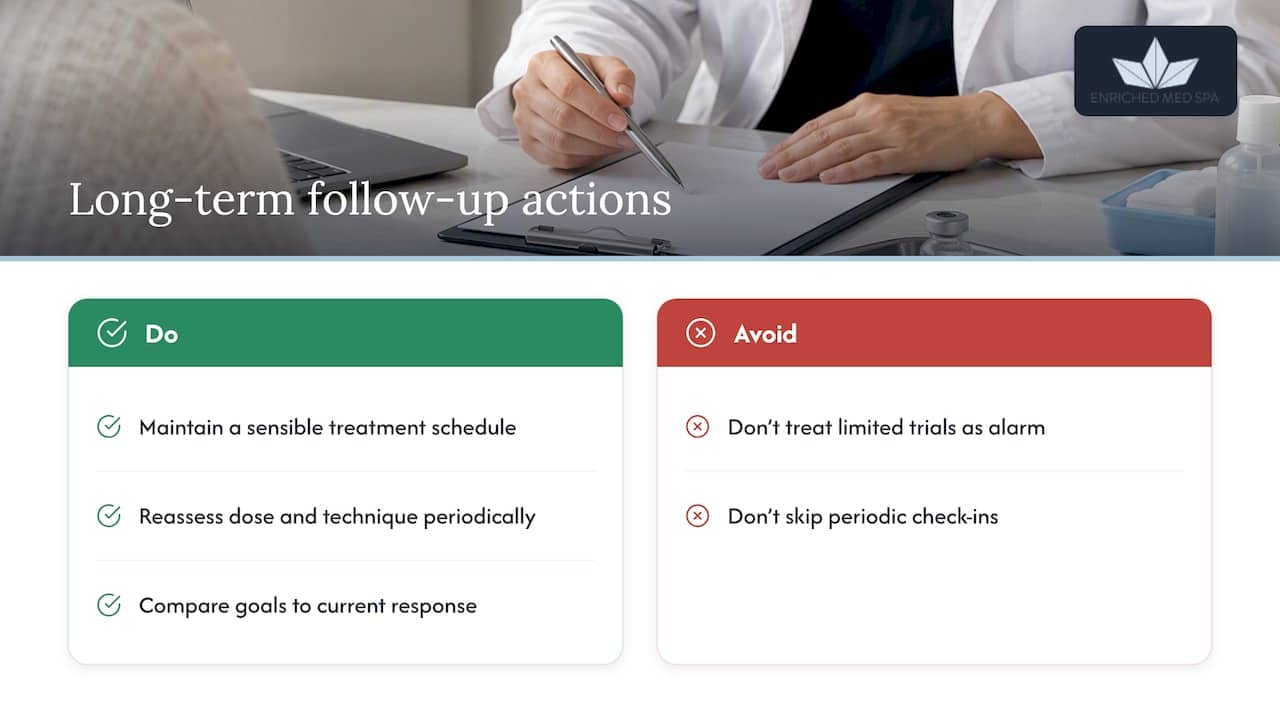
That said, long-duration clinical trials remain limited, and some reviews caution that evidence beyond several years is still developing. We don’t treat this as a reason for concern, but as a reason for periodic check-ins: reassessing dose, technique, and goals every so often keeps your plan aligned with how your body is actually responding, not just how it responded five years ago.
What we see in practice at our clinic
Many clients come in noticing early signs of aging or tired-looking skin and want to know what will actually hold up over time. We hear the same questions often: how long will this really last for me, and am I using too much?
Our approach starts with a thorough consultation where we map your muscle patterns before recommending a product or dose. From there:
- We discuss product options (Botox, Nuceiva, or Xeomin) based on your treatment history and goals.
- We plan a schedule built around your individual response, not a fixed calendar.
- We follow up to assess how you’re healing and whether any adjustment is needed for next time.
A realistic view on maintaining results
Three to four months is the honest baseline, and your actual timeline will shift with your anatomy, product, and treatment history. The variability isn’t a flaw in the treatment. It’s simply how individual biology works.
If you’re researching this, the next steps are straightforward: confirm your provider uses an authorized product, ask how they’re spacing your sessions, and book a consultation before assuming you need a touch-up. Measured, well-timed care is safer and more effective than reflexive top-ups.
— Felix
Botox options at Enriched Med Spa
If you’re ready to move from research to a plan, we offer Botox, Nuceiva, and Xeomin with a consultation built around your muscle pattern and treatment history, not a one-size map. We also pair injectables with complementary skin treatments when that serves your goals better than more toxin would.
Book a consultation with us to talk through timing, product choice, and a maintenance plan suited to how your body responds.
This article is general information, not a substitute for advice from a qualified doctor. Consult a qualified healthcare professional about your own circumstances before acting on anything here.
FAQ
What happens after 20 years of Botox?
Cohort data on repeated treatment generally show maintained effectiveness and an acceptable safety profile across many cycles. Long-duration trials remain limited, so periodic reassessment of dose and technique is a sensible part of decades-long use.
How long does Botox last realistically?
Most people see effects for about 3 to 4 months, with some areas and products lasting up to 6 months. Your actual duration depends on muscle strength, dose, and how your body processes the treatment.
What does 10 years of Botox look like?
For most patients who space treatments appropriately, results tend to remain consistent, with retrospective studies showing stable satisfaction over repeated cycles. A small number of patients may develop reduced response over time, which is why spacing and dose tracking matter.
Does Botox age you in the long run?
Current evidence doesn’t support the idea that Botox itself accelerates aging. Some reviews note that longer-term follow-up data are limited, which is a reason for periodic monitoring rather than a sign of harm.
How often should I book Botox touch-ups?
Most clients return every 3 to 4 months, timed to when movement starts coming back rather than a fixed date. Booking too frequently, such as within 3 months, raises the risk of reduced response over time.
Sources
- Cosmetic injections – Health Canada
- Exploring nonresponse to botulinum toxin in aesthetics: narrative review of key trigger factors and effective management strategies
- Key parameters for the use of abobotulinumtoxinA in aesthetics: onset and duration
- Repeated botulinum toxin A injections for the treatment of lines in the upper face: retrospective study
Recommended
- How Long Do Botox Results Last and When Should I Get a Touch-Up? – Botox Laser Hair Removal OxyGeneo Medi Facial Microneedling – Enriched Med Spa – Vaughan Woodbridge Maple Vellore Village
- How to extend Botox longevity: your 2025 guide
- Post-Botox Touch Ups: When and Why You Might Need Them – Botox Laser Hair Removal OxyGeneo Medi Facial Microneedling – Enriched Med Spa – Vaughan Woodbridge Maple Vellore Village
- Post-Botox Touch Ups: When and Why You Might Need Them – Botox Laser Hair Removal OxyGeneo Medi Facial Microneedling – Enriched Med Spa – Vaughan Woodbridge Maple Vellore Village