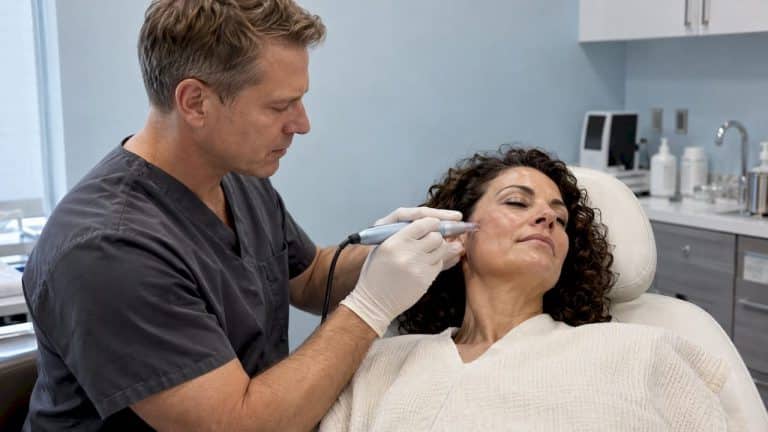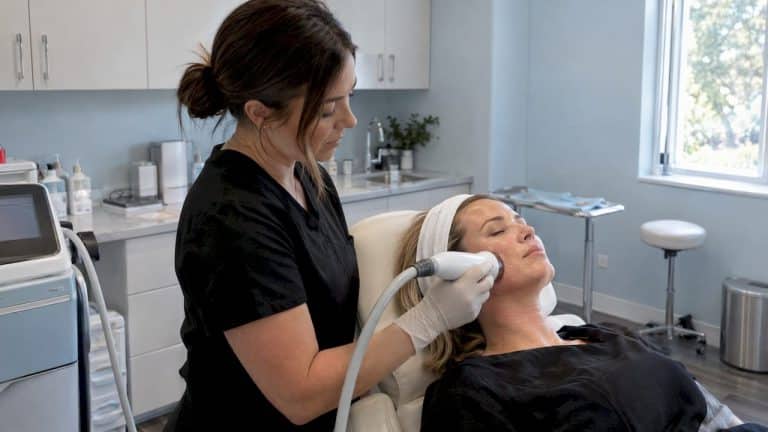
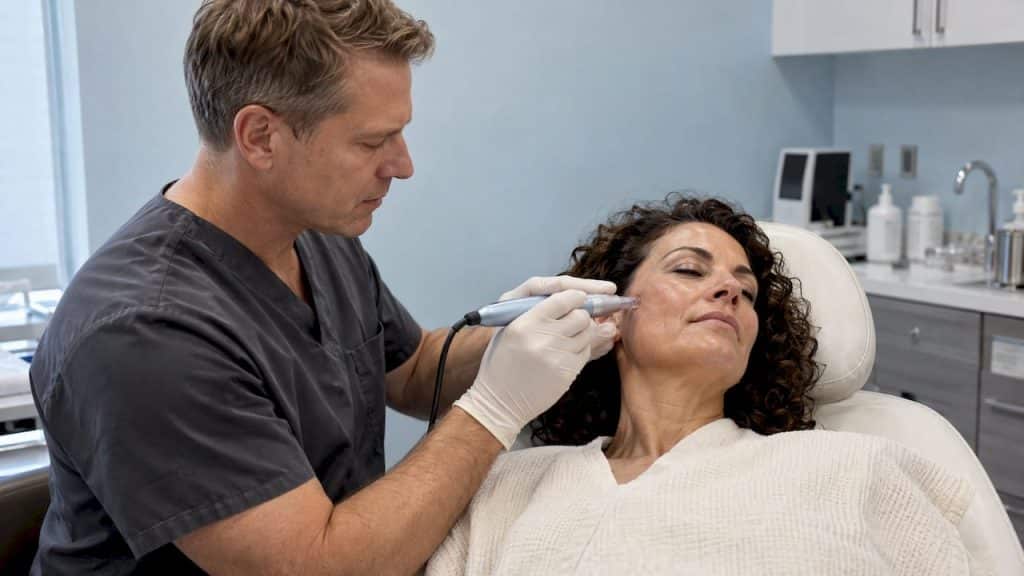
For professional microneedling, most people space sessions about four to six weeks apart, usually across a series of three to six visits. After that, a maintenance session once or twice a year is common. Your own interval depends on your skin concern, how deep the treatment goes and how quickly your skin recovers. Treating more often does not speed up results. It gives your skin less time to finish rebuilding.
Many clients come to us asking whether they should book monthly, or whether more sessions mean faster improvement. This guide walks through the typical timeline, how it shifts for acne scars, pigmentation, texture and early signs of ageing, and how to tell when your skin is ready for the next visit.
TL;DR
- Professional microneedling is usually spaced 4 to 6 weeks apart, because collagen remodelling takes time between sessions.
- A typical first course is 3 to 6 sessions. Acne scars often sit toward the higher end of that range.
- Results build gradually, and full improvement can take several months after your last session.
- Maintenance is usually a single session once or twice a year, set by your practitioner based on how your skin responds.
- If your skin is still red, tender or peeling, postponing the next session is better than keeping the date.
Table of Contents
- Why the gap between sessions matters
- The standard schedule for an initial course
- How the schedule changes by skin concern
- When can maintenance begin?
- Signs your skin is ready for the next session
- Professional versus at-home microneedling
- Why more frequent is not better
- Our perspective
- Preparing so each session counts
- Microneedling at Enriched Med Spa
- FAQ
- Sources
Why the gap between sessions matters
Microneedling uses fine needles to create tiny, controlled channels in the skin. Your body responds by repairing the area and producing new collagen and elastin. That repair is the treatment. The needles only start it.
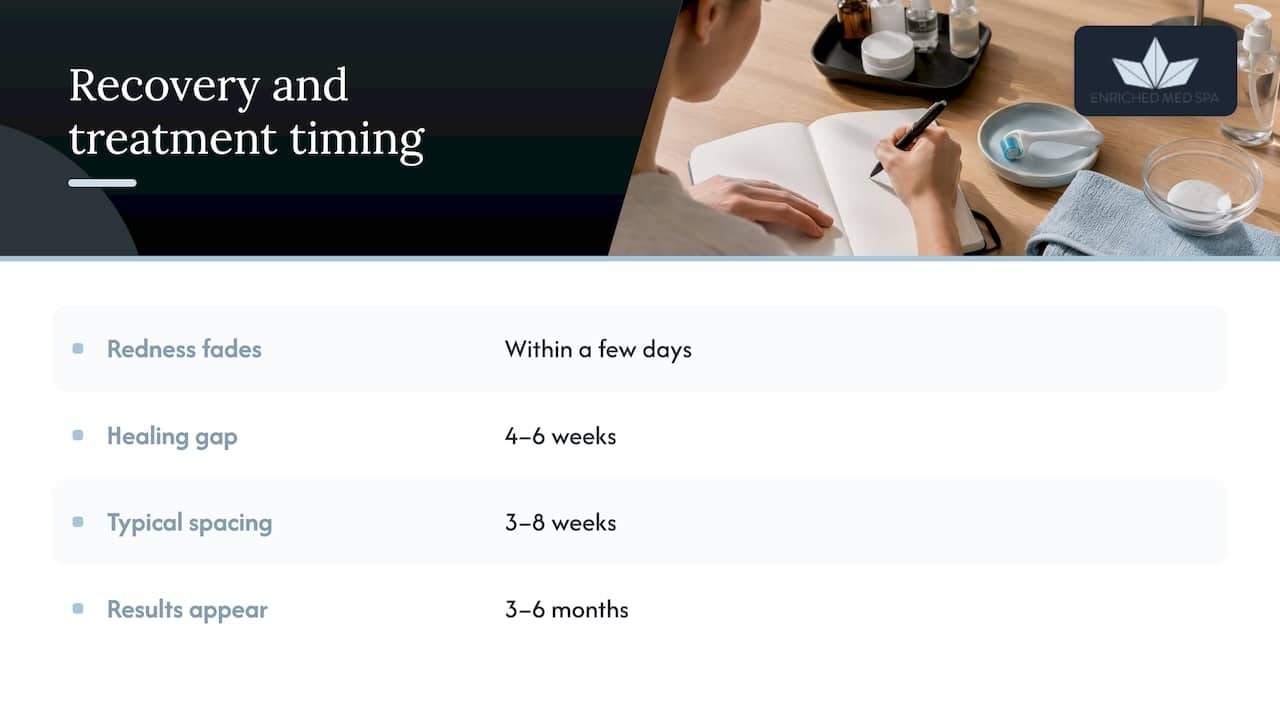
The repair takes weeks, not days. The redness fades first, usually within a few days, but the deeper rebuilding carries on underneath. If a second session lands before that process has settled, you interrupt it. The most common result is longer redness, more sensitivity and no extra benefit.
Think of it as your skin needing time to breathe between visits. A four to six week gap is not a sales schedule. It is roughly the time your skin needs to heal and lay down new collagen before you ask it to do so again.
The Cleveland Clinic notes that most people need several treatments, typically spaced somewhere between about three and eight weeks apart, and that it can take three to six months to see results. The range is wide on purpose. It reflects differences in needle depth, skin concern and individual healing.
The standard schedule for an initial course
Here is the pattern we see most often for a first course of professional treatment:
- Session one: a consultation, a skin assessment and the first treatment. Most clients notice redness and some tightness that settles over a few days.
- Sessions two and three: about four to six weeks after the previous one. This is where many people first notice smoother texture or a more even glow.
- Sessions four to six, if needed: added when your concern is deeper, such as scarring, and when your skin is recovering well between visits.
- Review: your practitioner looks at your skin with you and decides whether to stop, extend the course or move to maintenance.
Nobody can promise a result, and we do not. Some people are happy after three sessions. Others need more, or find that a different treatment suits their goal better. Part of the consultation is being honest about which of those you are likely to be.
What a month of waiting looks like
It can feel slow to wait a month between treatments when you want to see change. In practice, this is when the work happens. Most of the visible payoff comes in the weeks after a session, not on the day itself. If you book your next visit too early, you also lose the chance to judge what the last one did.
If you are planning around a wedding, a trip or photos, work backwards. Start your series early enough that the final session lands well before the event. Our guide to microneedling downtime helps you plan around the days when your skin looks its most flushed.
How the schedule changes by skin concern
The four-to-six-week rule is a starting point. The right plan depends on what you want to treat and how deep the treatment needs to go.
| Concern | Typical number of sessions | Typical spacing | What to expect |
|---|---|---|---|
| Fine lines and mild texture | About 3 to 4 | 4 to 6 weeks | Gradual smoothing and a fresher tone |
| Acne scars | About 3 to 6 | 2 to 6 weeks, set by depth and your skin | Gradual softening of scar texture, not erasure |
| Uneven tone or selected pigment concerns | About 3 to 5 | 4 to 6 weeks | Often paired with sun protection and skincare |
| Stretch marks | About 4 to 6 | 4 to 6 weeks | Improvement in texture over several sessions |
| Maintenance | One session | Every 6 to 12 months, sometimes sooner | Helps preserve earlier gains |
These are typical ranges, not promises. Your practitioner adjusts them after looking at your skin in person.
Acne scars
Acne scars are the concern where the schedule varies most. The American Academy of Dermatology says you may need three to five treatments performed every two to four weeks for acne scars. It adds that studies have found this plan can fade acne scars by 50% to 70%, and recommends a maintenance session once a year.
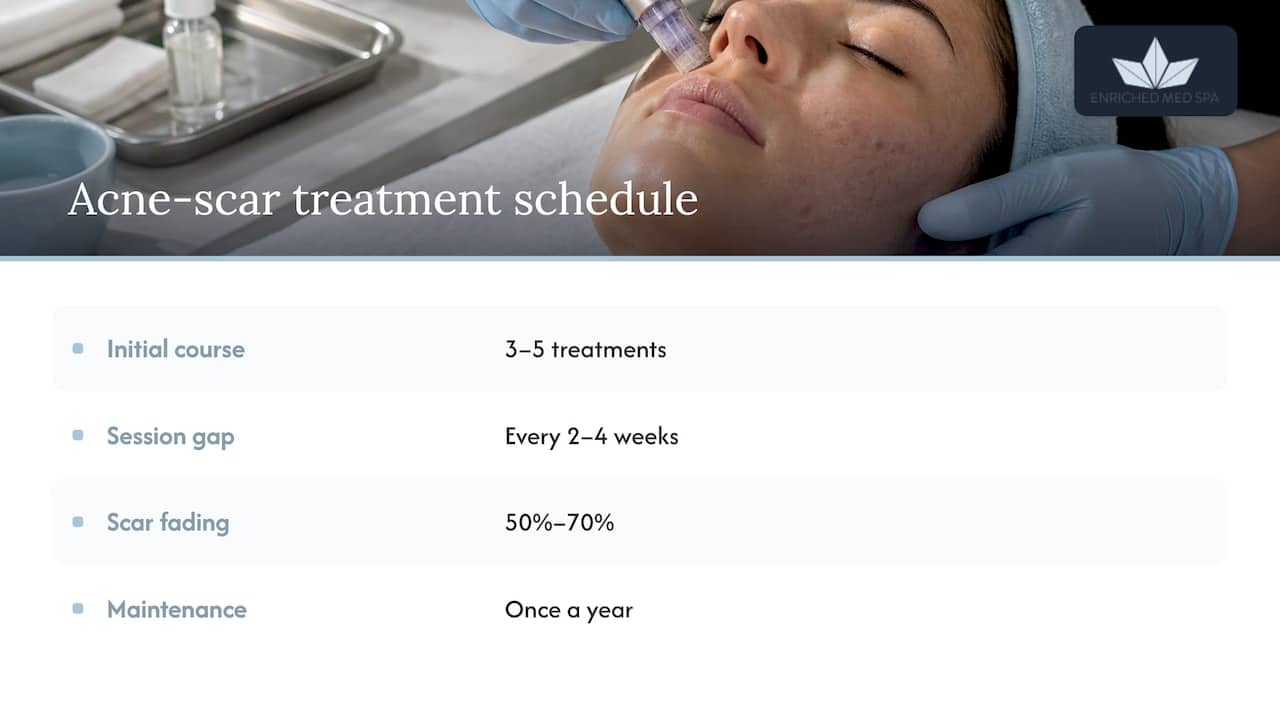
That two-to-four-week spacing is shorter than the common four-to-six weeks you will see elsewhere. The difference usually comes down to needle depth and device, which is a clinical decision. It is also a good reason not to copy a schedule from the internet. If your scars are deep, the plan has to match your skin, your healing and the equipment used.
Fine lines, texture and early signs of ageing
Many of our clients come in noticing early signs of ageing or tired-looking skin: fine lines around the eyes, rougher texture, makeup that no longer sits as smoothly. For these concerns a course of about three or four sessions, four to six weeks apart, is a common starting point. The goal is gradual, natural-looking improvement in how the skin feels and reflects light.
If lines come mainly from muscle movement, such as frown lines, microneedling is not the tool that addresses the cause. In that case we may suggest wrinkle-relaxing injectables alongside, or instead. Our overview of cosmetic injectables explains how the two approaches differ.
Pigmentation and uneven tone
Microneedling can help some tone concerns, but pigment needs care. Skin that darkens easily after irritation can develop post-inflammatory pigmentation if it is treated too aggressively or too often, and strict sun protection afterwards matters a great deal in Canada, including on bright winter days. Tell your practitioner about your skin tone, any history of dark marks after healing, and any sun exposure or tanning before booking. For stubborn pigment, a laser designed for pigment may be a better fit, and we will tell you if that is the case.
Hair and scalp
Microneedling-style treatments are also used in scalp protocols, often combined with PRP. These plans have their own spacing and session counts set by the provider. If thinning hair is your concern, our hair restoration page explains the options we offer.
When can maintenance begin?
Once you finish your initial course, collagen production does not stop, but the gains from treatment gradually fade as skin continues to age and sun exposure adds up. Maintenance is a way of topping up.
The AAD recommends a maintenance session once a year after treating acne scars. The Cleveland Clinic similarly says the procedure may be needed about once a year for upkeep. Some clinics schedule touch-ups more often, for example every few months, when the goal is general skin quality rather than scar treatment. There is no single universal rule, so the interval is best set by your results.
In practice, a maintenance plan usually looks like this:
- Wait until your final session has fully healed and results have had time to develop, which can take a few months.
- Book a review rather than automatically rebooking. If your skin still looks good, you can wait longer.
- Choose a maintenance interval that fits your skin, whether that is once or twice a year.
- Keep up daily sunscreen and your home routine, because these protect what you have gained.
Maintenance is also the time to ask whether your skin might benefit from something different. Some clients add a chemical peel or other skin treatment between microneedling sessions to target tone or radiance.
Signs your skin is ready for the next session
The calendar is a guide, not a rule. Before each session, your practitioner should look at how your skin has recovered. Here is what we check:
- Redness has fully settled.
- There is no lingering tenderness or sensitivity.
- Dryness and peeling have resolved.
- There are no active breakouts, cold sores or irritation in the area.
- You have avoided sunburn and harsh active ingredients.
If any of those are not true, it is usually more useful to postpone than to push ahead. A delay of a week or two costs you very little. Treating irritated skin can set you back.
Signs you should wait, or call us
Some swelling, redness and tightness after treatment is expected. The Cleveland Clinic says your skin might stay red and swollen for up to five days. It advises contacting a healthcare provider if the area bleeds for longer than 24 hours, blisters, or stays swollen for more than a week.
Persistent redness, stinging, new breakouts or flaking that does not settle are all good reasons to hold off on the next appointment and let us have a look. Our guide to post-microneedling care covers what to do in the days after treatment, and our safety overview explains who should not be treated.
Professional versus at-home microneedling
The schedules you see online often mix clinic treatments with home devices, which causes confusion. Clinic treatment uses sterile, single-use needles at depths chosen and controlled by a trained professional. Home rollers and pens are generally much shorter and are designed mainly to help skin care products absorb. They are a different category and should not be scheduled like a clinic series.
A few practical points:
- Do not use your clinic-based schedule to justify deeper needling at home. Deeper work belongs in a clinic.
- Do not use a home device in the weeks around a professional session unless your practitioner says so.
- Skip any device on skin that is irritated, sunburned, infected or breaking out.
- Tell your practitioner about prescription acne medication or recent treatments before any session, because it can change what is safe and when.
If you are unsure whether you are a candidate, start with a consultation instead of a device.
Why more frequent is not better
It is natural to think that two sessions a month would halve the wait. It does not work that way. Collagen remodelling follows its own pace, and repeated injury before healing is complete tends to bring longer redness, more sensitivity and a higher chance of irritation or pigment changes. Smaller, well-timed sessions generally serve you better than a crowded calendar.
The reverse also holds. If you can only manage a visit every eight or ten weeks, you have not ruined anything. Results may build more slowly, but you are not starting over. The more important thing is consistency across the whole course.
Our perspective
When someone asks us how often they should come in, the honest answer is that it depends on their skin, not a fixed rule. We would rather lengthen a gap than rush one.
At Enriched Med Spa, microneedling is performed by experienced, nurse-level practitioners who look at your skin before every session. That means we can adjust your plan as we go: pause if your skin needs more time, extend the course if your concern is deeper, or suggest a different treatment if microneedling is not the best match.
We like to pair a series with a realistic conversation about timelines. Collagen takes time, and the best results usually show up after you have finished the course, not the day after. Most of our clients do best when they book their series early, protect their skin from the sun and keep their aftercare simple.
If you are preparing for an event, plan with us from the start, so the schedule works for your calendar and for your skin.
Felix
Preparing so each session counts
Good preparation makes each session more comfortable and helps your skin recover on schedule. In general, that means arriving with clean skin, avoiding sunburn and tanning, and checking with us about retinoids, exfoliating acids and any prescription skin medication. Our step-by-step guide to preparing for microneedling and our microneedling checklist walk through it in detail.
After treatment, gentle products, sun protection and patience matter most. Many of the problems we see come from the days after a session, not the session itself.
Microneedling at Enriched Med Spa
We offer microneedling at our clinic serving Woodbridge, Vaughan and East Gwillimbury. A single session is listed at $359 on our site. We start with a consultation to look at your skin, talk through your goals and map out a realistic schedule, including how many visits are likely to make sense for you.
If you are not sure whether microneedling is the right first step, a consultation is the best way to find out. We will tell you plainly if a lighter treatment, a peel or an injectable would suit you better.
FAQ
How often can you do microneedling?
For professional treatment, most people space sessions about four to six weeks apart. Some acne scar plans use shorter gaps, such as two to four weeks, depending on depth and device. Your practitioner sets the interval after seeing your skin.
How many sessions will I need?
A first course is commonly three to six sessions, depending on your concern. Fine lines and mild texture often need fewer, while acne scars may need more. Results keep developing for months after the last session, so the full effect is not visible straight away.
Can I get microneedling every two weeks?
Sometimes, but only under clinical direction. Short gaps are used for specific plans, such as some acne scar protocols, and are not a general shortcut. For most concerns, a gap that short does not give your skin enough time to heal and rebuild.
How often is maintenance needed?
After an initial course, maintenance is typically once a year for scar treatment, according to the American Academy of Dermatology. Some people book touch-ups more often for general skin quality. Your results and goals decide the interval.
What should I do if my skin is still red before my next appointment?
Let us know and consider postponing. Redness, tenderness or peeling that has not settled means your skin is still healing. Contact a healthcare provider promptly if you have bleeding beyond 24 hours, blistering or swelling that lasts more than a week.
Sources
- Cleveland Clinic: Microneedling, what it is, uses, benefits and results
- American Academy of Dermatology: Microneedling can fade scars, uneven skin tone, and more