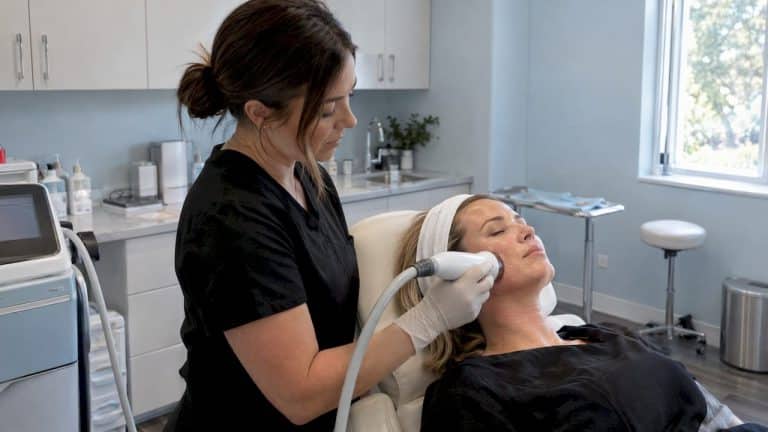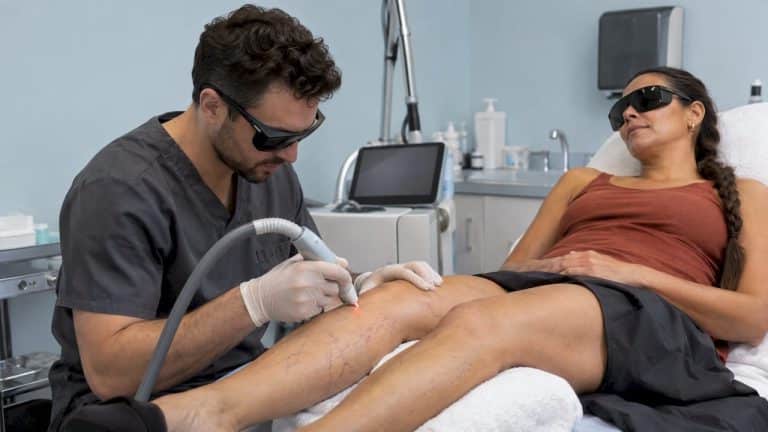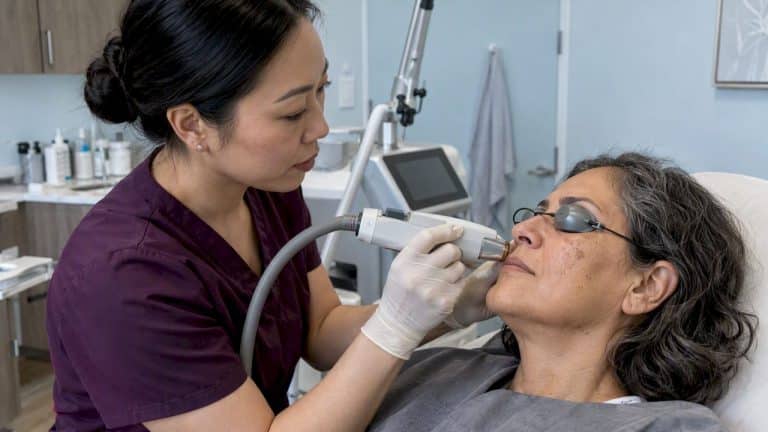
Radiofrequency (RF) skin tightening can give mild to moderate facial laxity a firmer, smoother look, but the change is gradual and temporary. It is not a facelift. Most people notice changes over one to six months, and many need more than one session. Below, we walk through what the research shows, what before-and-after photos can and cannot tell you, and how to decide whether RF suits your skin.
TL;DR
- RF heats the deeper layers of the skin to encourage collagen and elastin, so results build over weeks and months rather than overnight.
- According to Cleveland Clinic, changes generally appear within two to six months, some people need two to six treatments, and effects may last one to three years with good skin care.
- RF suits early to moderate laxity, such as softening jawline definition, a tired mid-face or fine lines. Significant sagging usually calls for a different approach.
- Side effects in studies are mostly mild, temporary redness and swelling, and the right candidate selection matters.
- We don’t list a TriPollar price online, so we give you a personalized quote at your consultation.
Table of Contents
- What RF skin tightening actually does
- What the research shows about results
- Reading before-and-after photos honestly
- When results appear and how long they last
- How many sessions you may need
- RF for the face: where it works best
- Lighter treatments versus advanced options
- RF versus RF microneedling
- Side effects and who should be cautious
- Supporting your results at home
- How much does RF skin tightening cost?
- Perspective
- Book a skin tightening consultation
- FAQ
- Sources
What RF skin tightening actually does
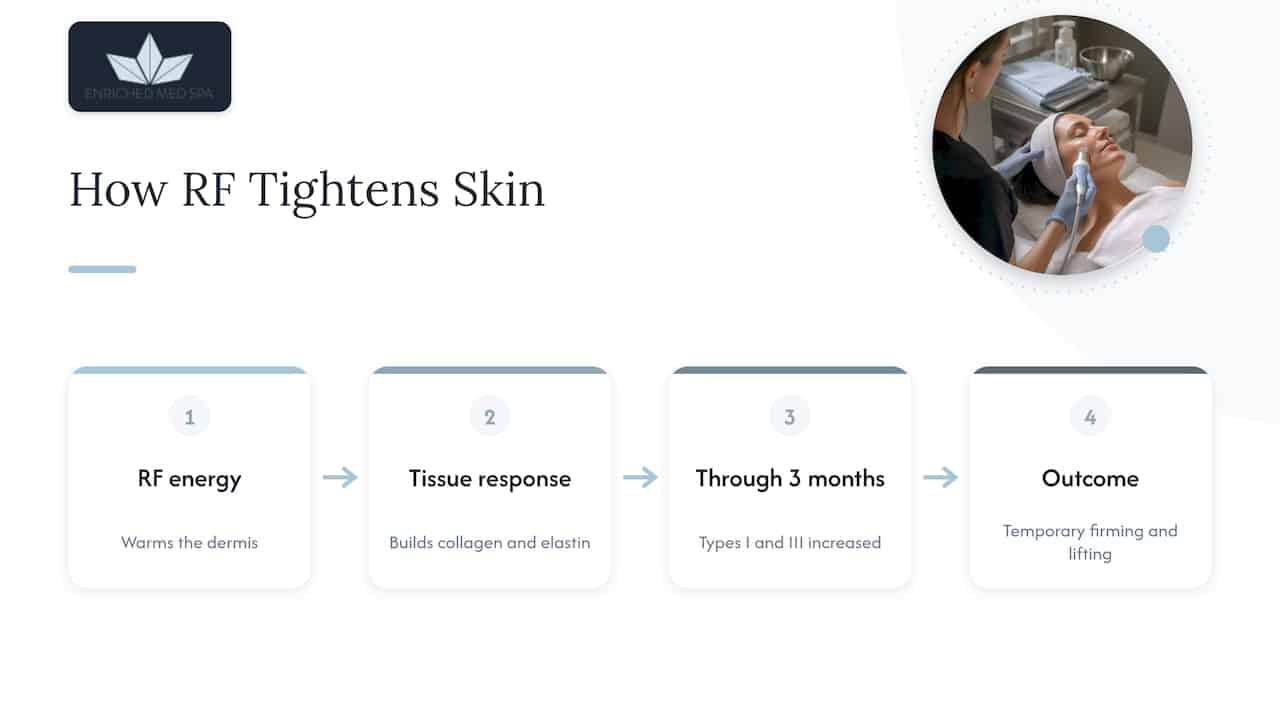
RF devices deliver controlled energy that warms the dermis, the layer under the surface. That heat prompts your body to build new collagen and elastin and to renew skin cells. Cleveland Clinic describes the outcome as temporary firming and lifting, not a permanent facelift.
The biology has been checked directly. In a peer-reviewed histologic study, collagen types I and III increased through three months, alongside clinical improvement in tightening, texture and wrinkles. That is why the best results arrive well after the appointment, not on the way out the door.
Many clients come to us noticing early signs of aging: a softer jawline, a little heaviness around the mouth, or skin that looks tired even when they feel well. That pattern is where RF tends to make the most sense. If you’d like the full mechanics, we cover them in our guide to how radiofrequency skin tightening works.
What the research shows about results
No single study answers every question, so it helps to read several together.
- Large review. A 2025 systematic review covering 15 studies and 1,230 participants reported skin-texture improvement in 71% to 100% of patients, firmness improvement in 52.9% to 100%, and satisfaction in 82% to 100%. The wide ranges reflect different devices, protocols and ways of measuring. The authors also rated their confidence as moderate.
- One treatment, 24 weeks. In a 2024 study of 20 women who received a single monopolar RF facial treatment, dermatologist-rated improvement in the jowls and nasolabial folds became significant at 12 weeks and stayed significant at 24 weeks. Cheek firmness improved from week 4 through week 24. Pores, fine wrinkles and tone improved gradually but not by a statistically significant amount.
- Real-world use. A 2026 evaluation of a sequential monopolar-bipolar device reported improvement in every patient. Providers rated 56% as moderate, 24% as marked and 20% as slight. Photographs showed better lower-face contour and softer lines around the mouth and mid-face.
- Patient-reported change. In a 2024 patient survey study, 82% were satisfied after monopolar RF. The change people noticed most was laxity (52.9%), then texture (17.6%) and tone (11.7%), and most noticed it within one to two months.
The pattern is consistent: modest, real improvement in firmness and texture, building over time, with variation between people. Notice the word “moderate” in the real-world ratings. That is an honest description of what most people should expect.
Reading before-and-after photos honestly
Before-and-after photos are what most people look at first, and they are useful when you know what to check.
- Same lighting, angle and expression. A slight head tilt or a relaxed smile can change how a jawline looks. Compare photos taken the same way.
- The time gap. Because collagen builds gradually, a photo taken the day after treatment shows something different from one taken at three months. In one small facial study, patient-rated improvement at the end of treatment was 35% to 40% for tightening, then rose to 70% to 75% at three months.
- The area treated. Jowls, the mid-face and the lines around the mouth tend to show the clearest change in published photographs. Pores and tone are usually subtler.
- Combined treatments. Some published photos come from RF paired with microneedling or other treatments. That is a different procedure from non-invasive RF alone, so the result belongs to the combination.
When you look at any clinic’s photos, ask what treatment was used, how many sessions, and how long after the last session the photo was taken. We encourage this question at consultations because it helps you set expectations that match your own skin.
When results appear and how long they last
Here is a realistic timeline, based on the sources above.
| Stage | What you may notice |
|---|---|
| Right after treatment | Mild warmth or redness that typically settles quickly. Some people see a short-lived glow. |
| 1 to 2 months | Early firmness or smoother texture, as most participants in one study reported. |
| 3 to 6 months | Collagen remodelling continues. Dermatologist-rated improvement in the jowls and nasolabial folds was significant at 12 weeks in the 2024 single-session study. |
| 1 to 3 years | Cleveland Clinic says effects may last one to three years with proper skin care. |
Skin keeps aging, so maintenance matters. Daily broad-spectrum SPF, gentle exfoliants as your skin tolerates them, and good hydration all help protect what the treatment builds. Your skin needs consistency more than complicated routines.
How many sessions you may need
Cleveland Clinic notes that some people need two to six treatments. The right number depends on your starting point, the device, your goals and how your skin responds. A person in their late thirties with early softening may be well served by a short series. Someone with more laxity may see a gentler improvement and want a longer plan, or a different treatment altogether.
We plan this at consultation, and we’d rather start conservatively and adjust than promise a fixed number. Our step-by-step skin tightening process guide shows what a typical series looks like.
RF for the face: where it works best
RF is used for facial laxity, wrinkles and texture. In our experience, the areas clients ask about most are:
- Jawline and jowls. Softening early laxity along the lower face. Health Canada has published guidance relevant to this area, which we cover in our piece on radiofrequency for the jowls and clinic protocols.
- Mid-face and cheeks. Firmer-feeling skin and a more even texture.
- Around the mouth and eyes. Softer fine lines, especially when skin is thin and crepey rather than deeply creased.
- Neck. Often treated alongside the face so the two look balanced.
Some concerns are better matched to other treatments. Lost volume, deep folds and static lines are usually handled with dermal filler or neuromodulators like Botox, Nuceiva or Xeomin. Pigmentation and redness respond to light-based treatments. Surface texture and acne scarring are often addressed with microneedling or peels. A good plan frequently layers these in a sensible order. For a broader view, see our overview of RF and MFU skin tightening without surgery.
Lighter treatments versus advanced options
It helps to think in steps.
- Facials and peels. Best for glow, congestion and surface texture. They do not tighten deeper tissue.
- Microneedling and resurfacing. Support collagen and refine texture and scarring, with more downtime than a facial.
- Radiofrequency. Works deeper to firm and lift mild to moderate laxity, usually with little downtime.
- Injectables. Relax muscle-driven lines or restore lost volume, with effects that are quicker to see.
Many people start at step one and add more as they learn what their skin responds to. If your main goal is glow before an event, a lighter treatment may be the better first choice. If you are noticing early laxity, RF is worth a conversation.
RF versus RF microneedling
These are often confused, and the difference matters for safety. According to Health Canada’s January 2026 InfoWatch, RF microneedling combines needles with RF energy, and licensed RF-microneedling devices in Canada are Class III medical devices. Because it deliberately creates micro-injuries while delivering energy deeper into the skin, its risk profile differs from non-invasive RF. The same notice highlights possible risks including burns, scarring, fat loss, disfigurement and nerve damage, and asks Canadian health professionals to report suspected incidents.
That is a reason to choose your provider and device carefully, not a reason to avoid care. Ask which device will be used, who will perform the treatment and what their training is. Our microneedling is a separate service, and we’re glad to explain how it differs from RF at your consultation.
Side effects and who should be cautious
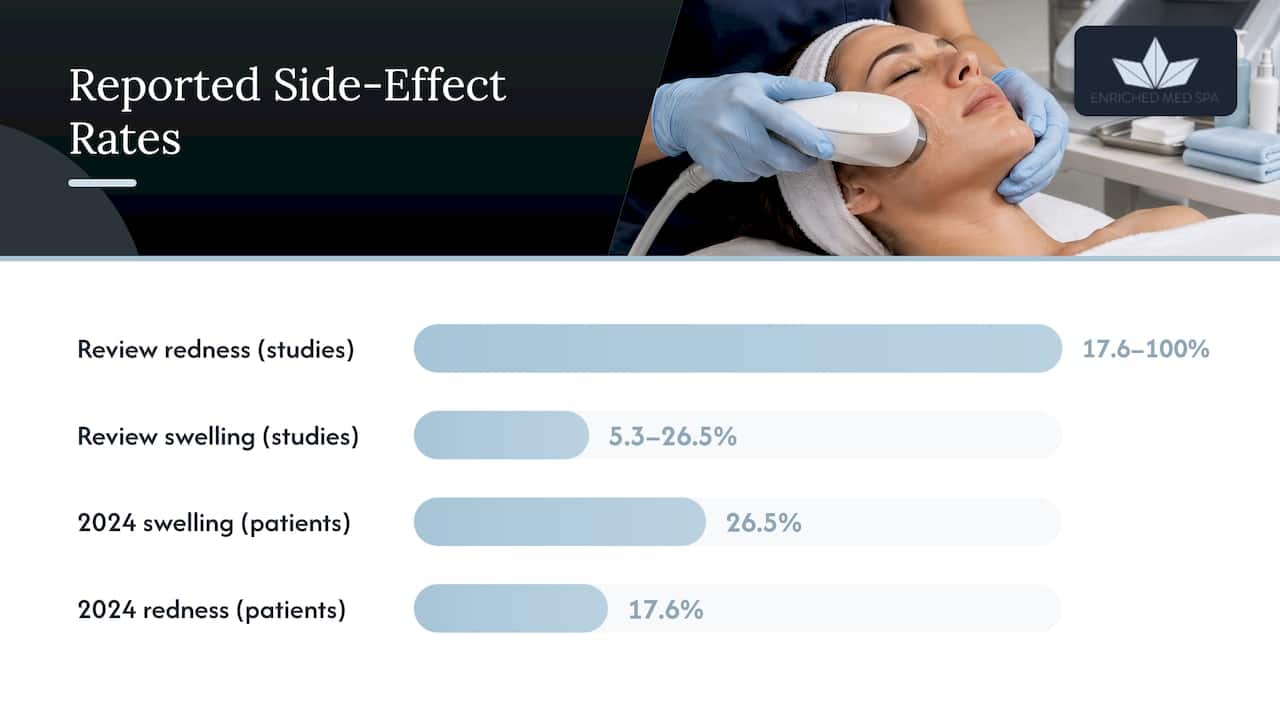
Most side effects reported in studies are mild and short-lived. The 2025 systematic review found erythema (redness) in 17.6% to 100% of reporting studies and edema (swelling) in 5.3% to 26.5%, generally mild and transient, with no serious complications reported. In the 2024 patient study, swelling occurred in 26.5% and redness in 17.6%, most resolved within a week, and average treatment pain was 1.94 out of 10.
Rarer events do occur. A peer-reviewed follow-up of 290 patients and 757 older-generation monopolar RF treatments reported second-degree burns in 2.7% of sessions. Technique, temperature control and device design have developed since, but it is one reason an experienced, properly trained provider matters. Health Canada also requires thermal-risk evidence for relevant device licence applications.
A dermatology review lists situations that call for avoidance or caution:
- A pacemaker or defibrillator
- Active dermatologic or autoimmune conditions
- Skin that has been radiated
- A tendency toward herpetic outbreaks (cold sores)
A 2026 review of RF microneedling complications also lists active infection, inflammatory skin disease and pregnancy as absolute contraindications, and notes that post-inflammatory hyperpigmentation is a particular concern in darker skin types. Tell your provider about any of these, and about your medical history and medications, before treatment. If you have an implanted device, check with your cardiologist first.
Supporting your results at home
What you do between sessions helps your skin hold its gains. Use a broad-spectrum SPF every morning, keep your skin hydrated and avoid harsh exfoliation for a few days after treatment. Gentle, well-formulated products can complement a treatment plan. Some clients also explore Korean NMN and PDRN skincare for firming and hydration at home. Introduce new products one at a time so you can tell how your skin reacts.
How much does RF skin tightening cost?
Prices vary by device, treatment area, provider and how many sessions your plan includes. We don’t publish a price for our radiofrequency skin tightening (TriPollar), because the right plan depends on your skin and goals. At your consultation, we assess your skin, explain the number of sessions we recommend, and give you a clear quote before you decide. When comparing quotes anywhere, ask whether the figure is per session or for a series, and which area it covers.
Perspective
At Enriched, the most common thing we say in consultations is that tightening is a process, not a moment. Many clients arrive hoping one visit will change everything, and we understand why. What we see, and what the research describes, is steady improvement as collagen rebuilds.
That is why we pair a thorough assessment with a conservative plan. RF can be a very good fit for early to moderate laxity, especially when you want to look refreshed rather than different. When another treatment would serve you better, we’ll say so and map the order that makes sense, whether that is a peel first, injectables for specific lines, or RF for overall firmness.
Our nurse-level injectors and aestheticians take the time to explain pre- and post-care, so you feel informed at every step.
Felix
Book a skin tightening consultation
If you’re in Woodbridge, Vaughan or East Gwillimbury and want to know whether RF is right for you, we’d be glad to look at your skin and talk through your options. You can see our full range of skin treatments, including radiofrequency skin tightening, or visit Enriched Med Spa to get started. If you’re comparing it with a resurfacing approach, our microneedling service is listed at $359.
FAQ
Does RF skin tightening work?
For mild to moderate facial laxity, the evidence says it can. A 2025 systematic review of 1,230 participants reported high satisfaction and a favourable safety profile, though the authors rated their confidence as moderate. The result is a temporary, nonsurgical lift, not a permanent one.
How many RF treatments do I need on my face?
Cleveland Clinic says some people need two to six treatments. Your number depends on your skin, your goals and the device. We recommend a plan after assessing your skin in person.
How long do RF results last?
Effects may last one to three years with proper skin care, according to Cleveland Clinic. Aging continues, so many people schedule occasional maintenance. Daily SPF and good skin care help preserve results.
Is there downtime after RF skin tightening?
Studies describe mostly mild, temporary redness and swelling, and most reported complications resolved within a week. The 2025 review notes that downtime was not systematically measured, so individual experience varies. We’ll explain exactly what to expect for your treatment.
Sources
- Cleveland Clinic: Radio Frequency (RF) Skin Tightening
- Radiofrequency facial rejuvenation: Evidence-based effect (2011)
- Radiofrequency-Based Treatments for Facial Rejuvenation: A Systematic Review (2025)
- Efficacy and Safety of Monopolar Radiofrequency (2024)
- Real-World Evaluation of Sequential Monopolar-Bipolar RF (2026)
- Subjective evaluation of monopolar radiofrequency treatment (2024)
- Health Canada InfoWatch, January 2026
- Health Canada: Risk of thermal harm notice
- Adverse reactions after nonablative radiofrequency (2007)
- Complications of radiofrequency microneedling (2026)
- Radiofrequency in Cosmetic Dermatology: A Review (2012)