
Exosome hair therapy uses tiny signalling particles, applied to the scalp with microneedling or injections, to encourage thinning follicles to behave more actively. The early research is encouraging, but it is early, and in Canada the products involved are not authorized by Health Canada. This guide walks through what exosomes are, what results people can realistically expect, what the risks are, and how the treatment compares with PRP, so you can decide with clear eyes.
TL;DR
- Exosomes are small membrane-bound particles that carry proteins and genetic messages between cells. In hair therapy, they are used to signal follicles to become more active.
- A 2025 systematic review found improvement in at least one hair measure in all 11 studies, but only two were randomized trials. Promising, not proven.
- Health Canada has not authorized exosome products for injection or microneedling use, so ask any clinic exactly what it uses and where it comes from.
- Reported side effects are mostly mild: redness, swelling, itching and tenderness at the treated sites.
- Results, when they come, build over months. A consultation should confirm the cause of your hair loss first.
Table of Contents
- What are exosomes, and how do they relate to hair?
- Does exosome therapy work for hair loss?
- What results and timeline can you expect?
- Who is a reasonable candidate?
- Are exosome hair treatments authorized in Canada?
- Side effects and risks
- Exosomes versus PRP: which is better?
- Our perspective at Enriched Med Spa
- Hair restoration options at our Woodbridge clinic
- How to prepare for a consultation
- FAQ
- Sources
What are exosomes, and how do they relate to hair?
Exosomes are a type of extracellular vesicle: small, membrane-wrapped packets that cells release. They carry proteins, lipids and genetic material, and they act as a messaging system between cells. Researchers have been studying their role in skin repair and hair follicle activity because those messages can influence how neighbouring cells behave.
In hair therapy, the idea is simple. Thinning hair often involves follicles that have shrunk or slowed down. Exosomes are meant to deliver signals that nudge those follicles back toward a growth phase. Unlike PRP, which uses your own blood plasma, exosome products are prepared in a lab from a source cell type. The source varies by product, and it matters.
Health Canada’s own definition is broad: exosomes are membrane-bound extracellular vesicles that may come from human, animal, plant or synthetic sources. That is why “exosome hair therapy” on a menu tells you very little until you ask what is actually in the vial.
Does exosome therapy work for hair loss?
The honest answer is that it may, and we do not yet know how well or for how long.
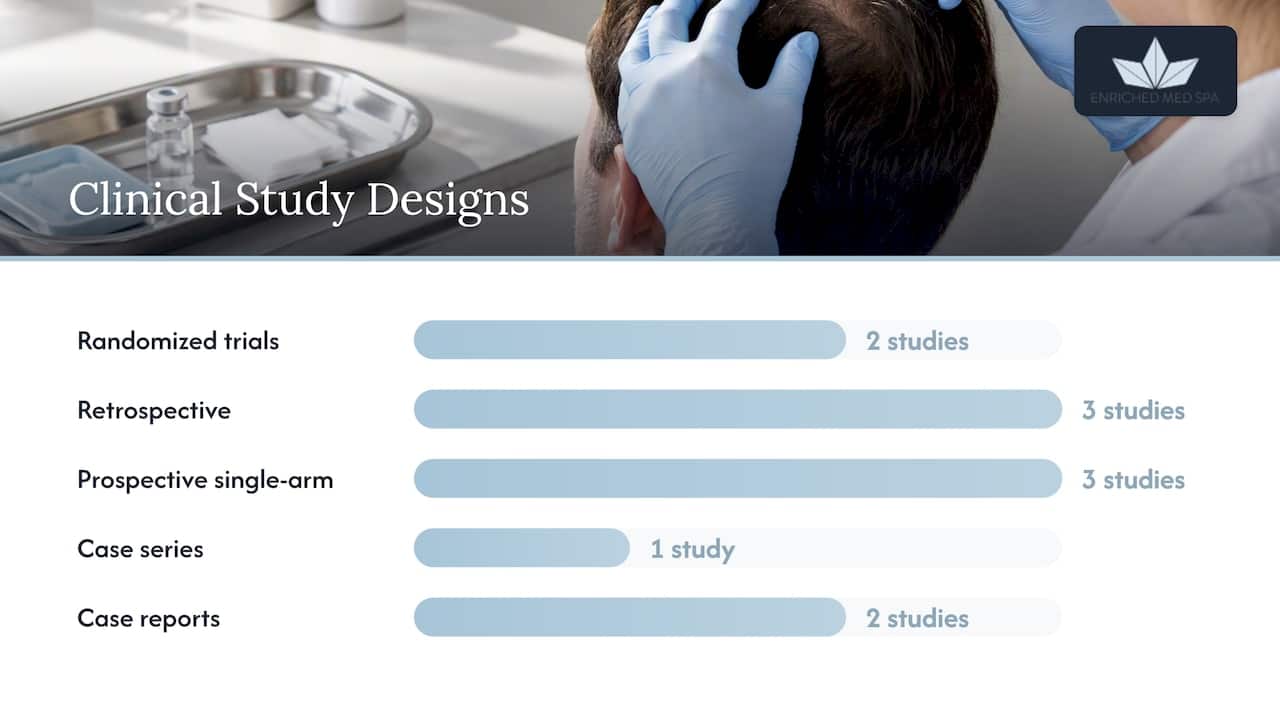
A 2025 systematic review identified 11 clinical studies: two randomized controlled trials, three retrospective studies, three prospective single-arm studies, one case series and two case reports. All 11 reported improvement in at least one hair measure. But the studies differed substantially in products, protocols and follow-up, and most were not the kind of controlled design that settles the question. Earlier dermatology reviews found only preclinical evidence, which shows how recently human data has started to appear.
One of the more specific findings comes from a placebo-controlled study described in a 2025 review of regenerative therapies. Three microneedle-assisted sessions of adipose-derived exosomes, four weeks apart, produced a mean density gain of 35 hairs/cm² at week 12, compared with 3 hairs/cm² for saline. Hair thickness improved by 13.0 micrometres versus 1.8. That is a meaningful signal, but it is one study with a particular product and protocol. It does not tell you what a different product will do.
We would summarize it this way: the direction is encouraging, the sample sizes are small, and anyone promising a guaranteed outcome is going beyond the evidence.
What results and timeline can you expect?
Many clients come in hoping to see a dramatic before and after within weeks. Hair does not work that way. Follicles cycle slowly, so any change in density or thickness usually takes months to show, and the trial above measured at 12 weeks for a reason.
A realistic picture looks like this:
- First weeks: Little visible change. Some people notice less shedding, though this is not consistent.
- Around three months: Early changes in thickness or density may be measurable, particularly with close-up photos taken under the same lighting.
- Six months and beyond: This is where you and your clinician can judge whether the treatment is worth continuing.
Maintenance is an open question. The studies differ in follow-up, so there is no reliable evidence for how long benefits last after a course ends. For a general sense of how hair restoration stages unfold, this hair restoration treatment timeline is a helpful companion.
A note on before-and-after photos, including ours or anyone else’s: they only mean something when the angle, lighting, hair length and parting are identical, and when the treatment is the only thing that changed. Ask what else the person was using.
Who is a reasonable candidate?
Exosome therapy is generally discussed for gradual thinning, such as early androgenetic alopecia (pattern hair loss), where follicles are weakened but still present. It cannot revive follicles that have been gone for years, and it is not a substitute for a diagnosis.
Before any treatment, we want to know why you are losing hair. Sudden shedding can follow illness, stress, childbirth or a change in medication. Iron or thyroid problems can also be involved. Patchy loss, scarring or an inflamed scalp need a physician’s assessment first. If your family doctor or a dermatologist has not looked at it, that is the better first step. A 2025 Canadian consensus on androgenetic alopecia lays out how this condition is approached and managed in Canadian practice, and it is a reminder that established options exist alongside newer ones.
Treatment may not be suitable if you have an active scalp infection or skin condition, are pregnant or breastfeeding, or have a condition that affects healing. Tell us everything you take, including supplements.
Are exosome hair treatments authorized in Canada?
This is the question we most want you to ask any clinic, including ours.
Public Health Ontario reported in April 2025 that, as of April 2, 2025, Health Canada had not approved or authorized any exosome-based products for use in Canada. The same presentation notes that drug-classified products require authorization and that a cosmetic notification is not an approval.
Health Canada’s August 2025 notice goes further on how products are classified. It states that a product applied by injection or intended to penetrate through microneedling is not a cosmetic. Drug products need authorization before sale, supported by a Notice of Compliance and a Drug Identification Number. The notice also warns that unauthorized therapeutic exosome products may involve unsubstantiated claims, potential toxic effects and risks tied to human-origin material, including transmission of infectious diseases.
What this means for you in practice:
- Ask what the product is, who makes it, and what its source cells are.
- Ask how the clinic describes its regulatory status, and whether it is represented as a cosmetic or a drug.
- Ask what is applied: topically, or with microneedling.
- Ask who performs the treatment and what their training is.
- Be cautious of any claim of approval, cure or guaranteed regrowth.
A clinic that welcomes these questions is a good sign. One that dodges them is not.
Side effects and risks
In the 2025 review, no serious adverse events were reported. The effects that did appear were mainly transient: irritation, redness, swelling, itching, pain at injection sites and occasional headaches. Most people should expect the scalp to feel a little tender or pink for a short time after microneedling.
The larger uncertainty is not the procedure itself but the product. Short-term trial data cannot tell us about long-term safety, and products vary in how they are made and tested. That is the point of Health Canada’s caution about human-origin material, and it is why we encourage you to ask about source and quality rather than assume.
Contact a clinician promptly if you notice spreading redness, warmth, pus, fever or pain that is getting worse rather than better.
Exosomes versus PRP: which is better?
PRP (platelet-rich plasma) is prepared from a small sample of your own blood. The platelets are concentrated and applied to the scalp, delivering your own growth factors. Exosomes are a lab-prepared product made of vesicles rather than whole platelets.
On evidence, one systematic review comparing the two suggested exosome therapy showed the most promising results, followed by PRP, and called for more research. It also noted that differences in study design, outcome measures and methods prevented the findings from being pooled. There is a completed randomized trial registered on ClinicalTrials.gov comparing one intradermal exosome session with two PRP sessions a month apart, followed to six months, which should add useful data as it is reported.
| PRP | Exosome therapy | |
|---|---|---|
| Source | Your own blood plasma | Lab-prepared vesicles from source cells |
| Blood draw | Yes | No |
| Evidence base | Larger, with more studies | Newer, smaller, more varied |
| Canadian regulatory picture | Uses your own blood | No authorized exosome products |
| Main question to ask | How is it prepared and how many sessions? | What is it, and where does it come from? |
Neither is a guarantee. Many clients ask which is stronger. Our answer is that it depends on your type of hair loss, your goals and your comfort with a newer, less-studied option. If you want to read more about the PRP side, we have a guide on how long PRP lasts for hair and one on PRP for female hair loss.
Our perspective at Enriched Med Spa
We see two kinds of people asking about exosomes. Some have noticed a wider part or a thinner ponytail and want to act early. Others have tried a few things and are looking for what is next. Both deserve a plain conversation, not a sales pitch.
Our approach is the same one we take with injectables and skin treatments: consultation first, a conservative plan, and realistic expectations about timing and maintenance. Our treatments are performed by experienced, nurse-level injectors and aestheticians, and we put thorough pre- and post-care guidance in writing so you know what to do at home.
On exosomes specifically, we think the science is interesting and the regulatory picture matters. We would rather you walk in knowing the questions to ask than walk in believing a promise. If a different option suits your hair better, we will say so. For many clients that starts with a proper look at the cause of the loss, and sometimes with a physician rather than with us.
— Felix
Hair restoration options at our Woodbridge clinic
If you are exploring options for thinning hair in Woodbridge, Vaughan or East Gwillimbury, our hair restoration page lists what we offer. Current published prices are $800 for PRP Hair Restoration and $950 for DERIVE Exosomes Hair Restoration. Book a consultation and we will go through your history, your goals, what the evidence does and does not say, and the product details for whichever option you are considering, before anything is booked.
How to prepare for a consultation
A few things make the first conversation more useful:
- Note when you first noticed thinning and whether it was gradual or sudden.
- List any medications, supplements and recent illnesses.
- Bring photos from a year or two ago, if you have them.
- Write down what you already use, such as minoxidil or finasteride, since these are established approaches and can sit alongside other treatments.
- Write down your questions about product source, number of sessions, total cost and what follow-up looks like.
We would also suggest taking baseline photos of your scalp under the same lighting before starting anything. It is the only fair way to judge progress months later.
FAQ
Do exosomes regrow hair?
They may help some people grow thicker or denser hair, but the evidence does not yet support calling it regrowth for everyone. In the 2025 review, every included study showed improvement in at least one hair measure, yet only two were randomized trials. Treat it as a promising option, not a proven cure.
What is the dark side of exosome therapy?
The main concerns are regulatory and quality-related rather than dramatic side effects. Health Canada warns that unauthorized products can involve unsubstantiated claims and human-origin risks such as infectious disease transmission. Ask any provider about the product’s source and status.
Are exosomes available in Canada?
Some clinics offer them, but as of April 2025 Public Health Ontario reported that Health Canada had not approved or authorized any exosome-based products. Health Canada also says a product injected or intended to penetrate through microneedling is not a cosmetic. Check the current position on Health Canada’s website before you book.
What side effects should I expect?
Most reported effects are short-lived: redness, swelling, itching, tenderness and occasionally a headache. No serious adverse events were reported in the 2025 review. Call a clinician if redness spreads, pain worsens or you develop a fever.
Sources
- Exosomes and Hair Regeneration: A Systematic Review (2025)
- Promises and Pitfalls of Regenerative Therapies for Hair Loss (2025)
- Health Canada notice on topical products containing human-derived exosomes
- Public Health Ontario: Novel Aesthetic Treatments, Introduction to Exosomes
- From Cells to Strands: A Systematic Review Comparing Hair Loss Therapies
- ClinicalTrials.gov: Exosomes Versus Platelet Rich Plasma
- The Role of Extracellular Vesicles in Cutaneous Remodeling and Hair Follicle Dynamics
- A Canadian Consensus on Androgenetic Alopecia