
The fine vertical lines above the upper lip are usually softened with a combination of treatments, not a single one. Filler restores support under the groove, a small amount of neuromodulator (Botox, Nuceiva or Xeomin) relaxes the muscle that keeps creasing it, and skin treatments such as microneedling, peels or laser improve texture. Lines rarely vanish completely, and they do not reliably fade on their own, even if you have never smoked. Here is how each option works, what results to expect, and how we decide with clients which path makes sense.
TL;DR
- “Smoker’s lines” (also called lip lines or perioral lines) come from repeated muscle movement, sun exposure and falling collagen. Smoking is one cause, not the only one.
- Filler, a low dose of neuromodulator, and collagen-stimulating skin treatments each handle a different part of the problem. Most people do best with a combination.
- Treatment usually softens lines rather than erasing them. Visible improvement can take months, and maintenance is part of the plan.
- Treat the lip area only with a trained, regulated injector in a medical setting, and book an assessment first. Any rough, crusty or non-healing patch on the lip should be checked by a health professional before cosmetic work.
Table of Contents
- What smoker’s lines actually are
- Do smoker’s lines go away?
- Treatment options, from light to advanced
- Which treatment fits which type of line?
- Realistic timelines and maintenance
- Risks and safety around the mouth
- Our perspective
- Booking a consultation at Enriched Med Spa
- FAQ
- Sources
What smoker’s lines actually are
Smoker’s lines are the thin vertical creases that radiate from the lips into the skin above and, less often, below them. Many clients come in saying their lipstick “bleeds” into these lines, or that their mouth looks tight and tired in photos even when the rest of the face looks rested.
The name suggests one cause, but the picture is wider. A 2025 peer-reviewed review of lip ageing explains that speaking, chewing, facial expression and smoking repeatedly activate the muscle ring around the mouth (the orbicularis oris). As skin loses elasticity with age, grooves that once appeared only in motion become permanent wrinkles.
Smoking adds its own damage. According to ASH’s review of how smoking affects appearance, tobacco smoke promotes collagen breakdown and narrows the small blood vessels near the skin’s surface, which reduces oxygen and nutrient delivery. Puckering around a cigarette, and squinting against the smoke, add repetitive-motion wrinkles around the mouth and eyes.
Sun matters too. The Canadian Dermatology Association notes that ultraviolet exposure causes premature skin ageing, and that on the lips, heavy sun damage can contribute to wrinkles around the mouth and deeper creases.
So if you have never touched a cigarette and still see these lines, that is common. Using straws, playing a wind instrument, whistling, pursing your lips while concentrating, and simply ageing all contribute.
Do smoker’s lines go away?
This is the question we hear most, and the honest answer has two parts.
First, stopping the habit that is making things worse helps, but it does not erase lines that are already etched in. Once collagen has thinned and a crease has become fixed, the skin does not usually rebuild itself back to smooth. Quitting smoking is still worth doing, for far bigger reasons than your upper lip, and it gives any treatment a healthier base to work on.
Second, treatment can soften them. A dermatologist quoted in a 2023 Medical News Today review describes treatment as softening rather than erasing smoker’s lines. The same article suggests that when lasers are part of a multi-step plan, visible improvement may take around six months, while lip discolouration may improve in about three months, with results depending on how deep the lines are.
That same dermatologist’s view is that these lines are hard to treat and usually need ongoing, combined interventions rather than one miracle procedure. We agree, and we would rather tell you that at the consultation than after your first appointment.
Treatment options, from light to advanced
The Canadian Dermatology Association lists botulinum toxin, dermal fillers, laser treatment, dermabrasion, chemical peels and retinoid preparations as options for visible photoageing, and recommends an assessment to choose the right regimen (CDA). The table below shows how we think about them for the upper lip.
| Approach | What it does | Best for | Typical expectation |
|---|---|---|---|
| Dermal filler | Adds soft support under the crease | Lines visible at rest | Softening; needs top-ups over time |
| Neuromodulator (Botox, Nuceiva, Xeomin) | Relaxes muscle that folds the skin | Lines that deepen when you pucker | Gradual softening; repeat treatments |
| Microneedling | Stimulates collagen through tiny controlled channels | Fine texture, early lines | A series; gradual change |
| Chemical peels | Resurface the top layers of skin | Fine lines, uneven tone | Often a series |
| Laser or light-based resurfacing | Stimulates collagen, improves texture and pigment | Moderate lines, sun damage | Months to see full effect |
| Radiofrequency skin tightening | Heats deeper tissue to support firmness | Mild laxity around the lower face | Gradual, builds over a series |
| Skincare (SPF, retinoid, moisturizer) | Protects and slowly improves skin quality | Everyone, at every stage | Weeks to months |
Dermal filler
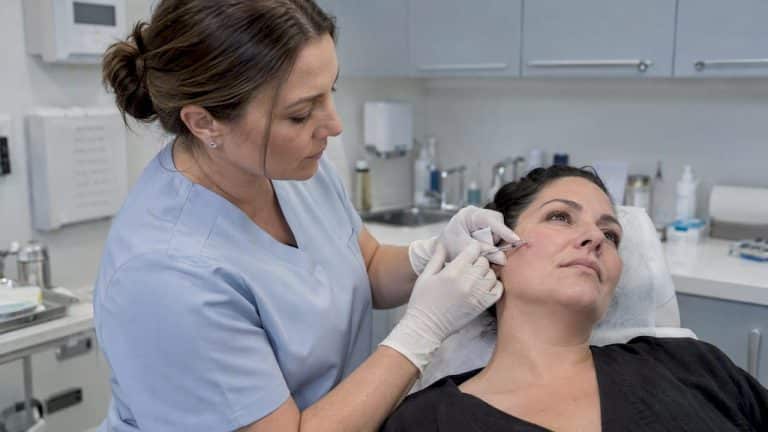
For lines that are still visible when your face is relaxed, a soft hyaluronic acid filler placed very precisely can lift the floor of the crease. The goal is not to make the lip bigger. In this area, we use small amounts, often spread out, because too much product looks stiff and unnatural.
The Medical News Today review notes that hyaluronic acid fillers restore fullness in the area. If you want to understand the process before you book, our guides on how dermal filler appointments work from consultation to results and how long dermal fillers last cover timing and upkeep in more detail. Longevity depends on the product, the area and your own metabolism, so we give an individual estimate rather than a promise.
Botox, Nuceiva or Xeomin
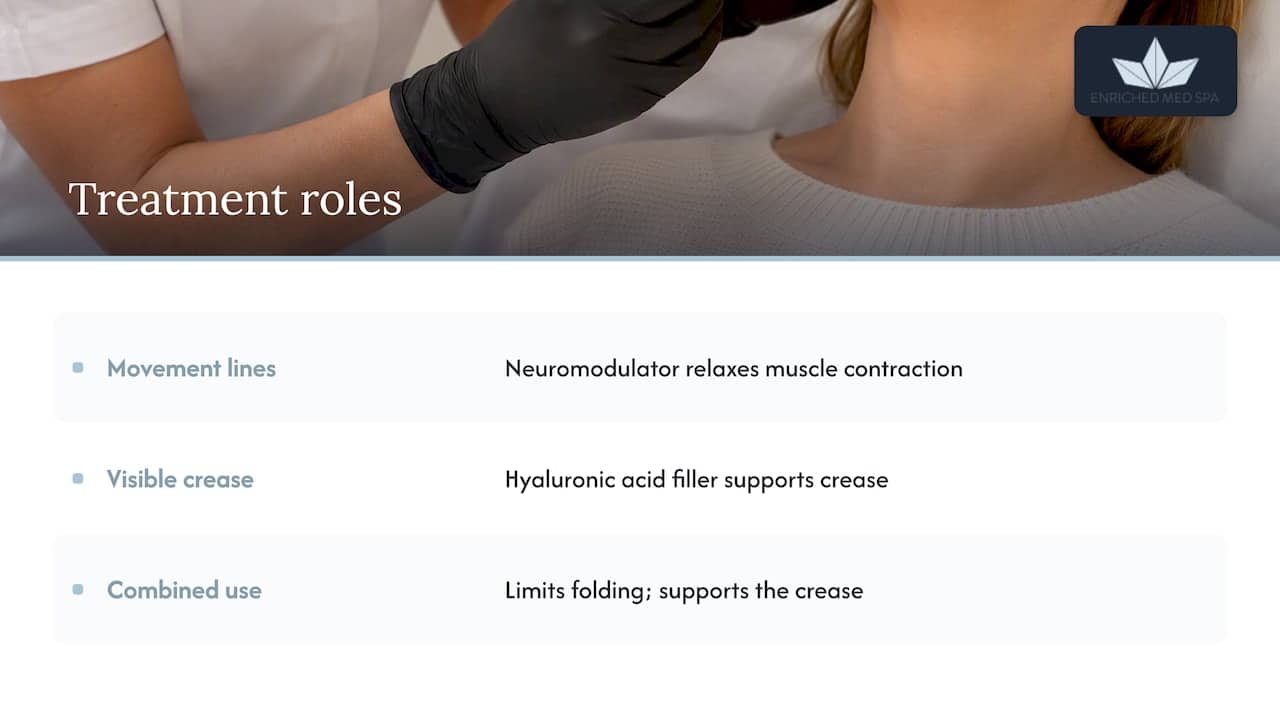
Does Botox work on smoker’s lines? It can, for a particular type of line. A neuromodulator relaxes repeated contraction of the perioral muscle, so the skin folds less each time you pucker. The lines that come mainly from movement respond best.
The dose here is small and the placement shallow. Too much can affect how you smile, drink through a straw or pronounce certain sounds, which is why this is a treatment for an experienced, conservative hand. We often pair a few units with filler, because the two work on different parts of the problem: one limits the folding, the other supports the crease. If you are weighing options, Dermal Fillers vs. Botox lays out the difference, and Xeomin vs Botox explains how the neuromodulators compare.
Microneedling
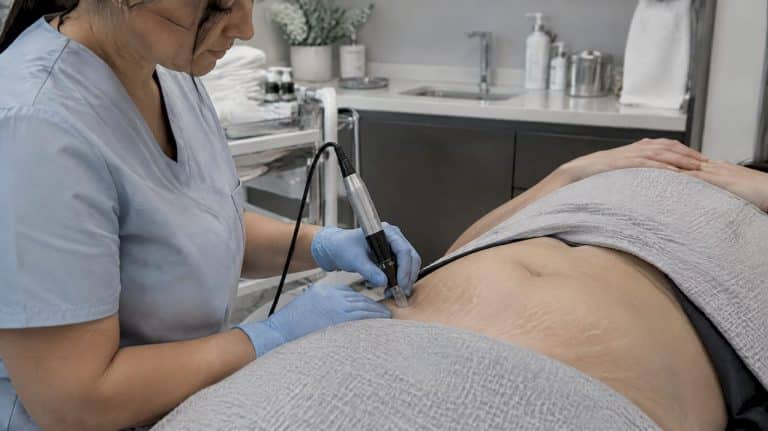
Microneedling creates tiny controlled channels in the skin, which prompts a repair response and collagen production. Medical News Today’s review points out that it can increase collagen with less downtime than some other procedures. It suits fine lines and crepey texture best, and it is a gentler first step than laser for many first-time patients. Our microneedling treatment is listed at $359 per session. Because collagen remodelling takes time, plan on a series rather than a single visit, and expect to judge results over weeks and months.
Chemical peels and laser resurfacing
Peels remove damaged surface layers and encourage fresh skin. The Medical News Today review notes they may need to be done as a series. Lighter peels have little downtime and suit fine lines and uneven tone; deeper options go further but need more recovery. We offer several peel and light-based options, which you can see on our services page, and we will tell you plainly if a lighter treatment is unlikely to give you what you want.
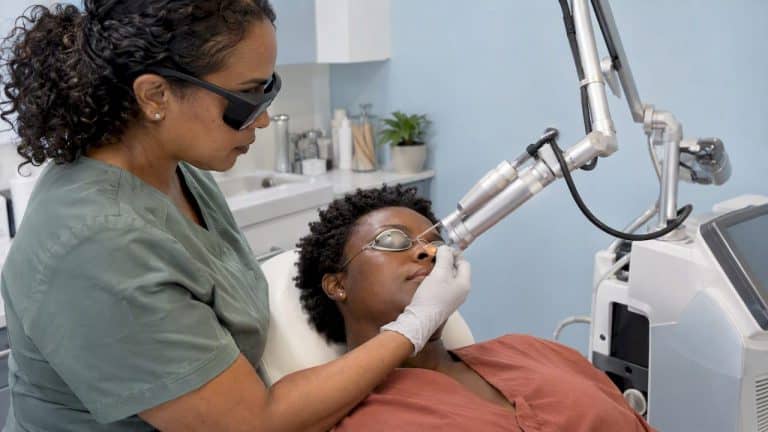
Laser resurfacing can stimulate collagen and improve texture and pigment. The area around the mouth is delicate, so settings and the number of sessions are chosen carefully, and the plan is built around your skin type and downtime tolerance.
Radiofrequency skin tightening
If lines come with a general softening of the lower face, radiofrequency can help firm the tissue gradually. It does not fill or relax, so on its own it will not fully address a deep vertical crease. We tend to use it as one part of a wider plan. Our guides on skin tightening without surgery explain what to expect.
Skincare that supports treatment
None of the above works as well on sun-damaged, dry skin. Mayo Clinic’s wrinkle guidance recommends daily broad-spectrum SPF 30 sunscreen, moisturizing, avoiding smoking, and considering retinol, niacinamide or vitamin C. It also cautions that retinoids should not be used during pregnancy and that improvement can take weeks or months. Some people also look at oral collagen supplements as a supporting step. If you are curious, you can read about collagen peptide trial results alongside advice from your own clinician. Supplements do not replace the in-clinic treatments above.
Which treatment fits which type of line?
A simple way to think about it is to ask when the line shows.
- Only when you pucker or talk: these are dynamic lines. A neuromodulator, sometimes with skin treatments, is often the starting point.
- Visible at rest, but fine: the skin has lost some support. Microneedling, a peel or a gentle laser, with or without a little filler, is a reasonable plan.
- Visible at rest and deep: a fixed crease usually needs filler for support plus collagen-building treatments. Expect a longer plan and more than one visit.
- Lines with blotchy tone or sun spots: pigment and texture treatments come first, so the skin quality improves before anything is placed beneath it.
This is the reason we do not quote a treatment before assessing your face. Two people with the same complaint can need very different plans.
Realistic timelines and maintenance
Here is what we tell clients at consultation:
- Neuromodulator: the effect builds over days and fades over months, so the treatment is repeated on a schedule.
- Filler: softening is visible soon after treatment, once swelling settles, and it is topped up as the product gradually breaks down.
- Microneedling and peels: change is gradual and builds across a series of sessions.
- Laser and radiofrequency: collagen remodelling continues for months, so final results are judged later than you might expect.
Maintenance is not a failure of the treatment. Your lip muscles keep moving and your skin keeps ageing, so the plan is to keep the lines softer than they would be without help. Sun protection is the easiest maintenance step. The CDA advises daily broad-spectrum SPF 30 or higher, an SPF 30 lip balm, shade and protective clothing, and avoiding tanning, and it considers prevention preferable to correcting established photoageing (CDA).
Risks and safety around the mouth
The lip area is vascular and mobile, so it deserves respect. Common filler effects are bruising, redness, swelling, tenderness and itching. The FDA says swelling and bruising often settle within days to weeks, and that accidental injection into a blood vessel is uncommon but can cause tissue death, stroke or blindness (FDA consumer update). That is why the injector’s training and technique matter more than the brand on the syringe.
In Canada, regulation is set by each province’s college of physicians and surgeons. As examples, Manitoba’s office-procedure standard requires Health Canada-approved substances, procedure-specific training, injections performed in a medical clinic and appropriate antidotes on hand. British Columbia’s physician standard requires relevant training and, when a nurse injects, a responsible physician present and immediately available. Ontario has its own rules, so ask any clinic who will inject you, what their training is, and what happens if something goes wrong.
If you have deeper skin tones, tell your injector. A review in Canadian Dermatology Today notes that temporary hyperpigmentation can occur after injectables, that fewer punctures may lower the risk, and that superficial filler placement should be avoided.
Before booking, read our article on whether lip fillers are safe, and our notes on recovery after filler and looking after your skin afterwards.
When to see a doctor before any cosmetic treatment
Not every change on the lips is a wrinkle. The Canadian Dermatology Association says a persistently rough patch on the lower lip can be actinic keratosis, a precancerous lesion that may turn into squamous cell carcinoma if untreated (CDA). The Public Health Agency of Canada advises having crusty spots, changes in mouth or lip tissue, and sores or patches that do not heal within two weeks assessed by a health professional (Canada.ca). If that describes you, see your family doctor or a dermatologist first. We will not treat over something that needs a medical diagnosis.
Our perspective
When clients ask us about smoker’s lines, they are usually not asking for fuller lips. They want to look less tense and less tired, and they are often worried about looking “done”. Our approach is to start with the smallest plan that can plausibly help, and to build from there.
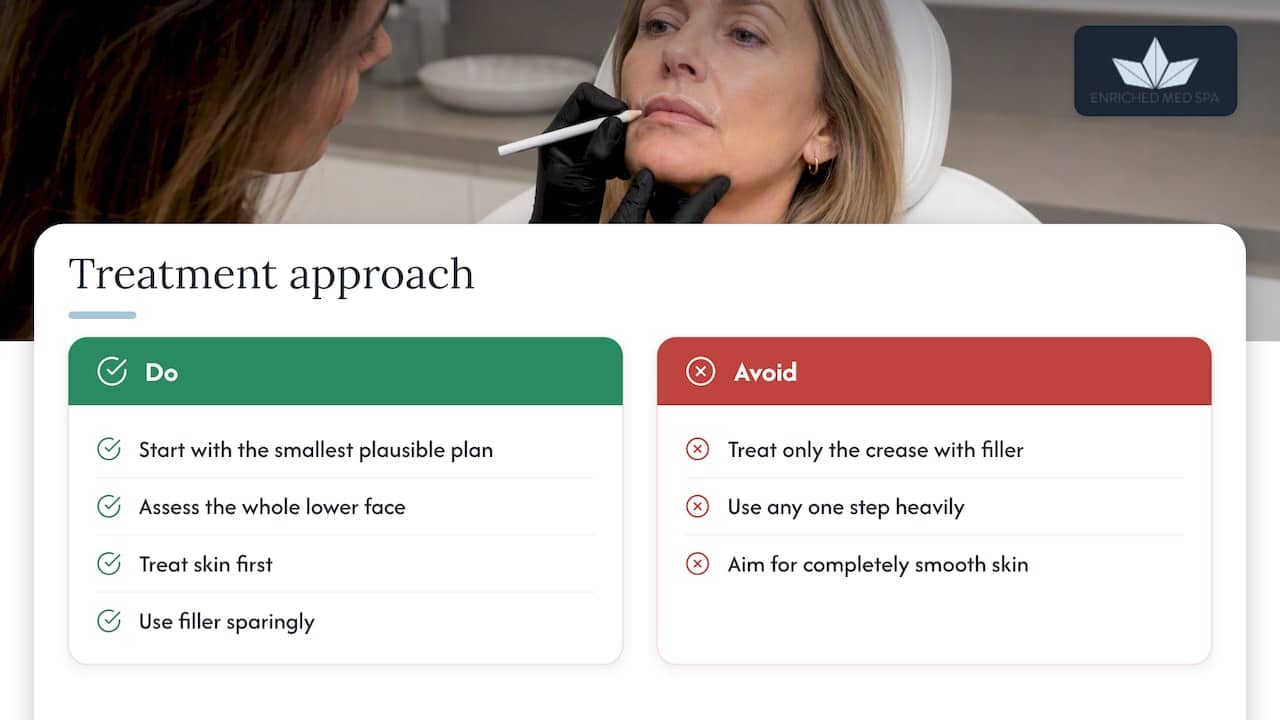
We look at the whole lower face. Often the lines are one part of a pattern: thinner skin, some sun damage, a little volume loss. Treating only the crease with filler can miss the cause. Treating the skin first, adding a few units of neuromodulator, and using filler sparingly tends to look more natural than any one step done heavily.
We also talk through what we will not do. If your expectations are for completely smooth skin, we will explain that softening is the realistic goal, and that maintenance is part of the plan. Our treatments are performed by experienced nurse-level injectors and aestheticians, and we spend time on aftercare so you know what to do and what to watch for.
— Felix
Booking a consultation at Enriched Med Spa
If you live in Woodbridge, Vaughan or East Gwillimbury and want a plan for the lines around your mouth, we would start with a consultation. We will look at the lines at rest and in motion, review your skin and your history, and suggest a staged plan. You can read about our dermal filler service or our Botox, Nuceiva and Xeomin treatments, then book through our site. Pricing for injectables is discussed at the consultation, once we know how much treatment you actually need.
FAQ
Do smoker’s lines go away on their own?
Usually not completely. Once lines are fixed in the skin, they tend to stay or deepen with age, although quitting smoking and protecting your skin from the sun can slow further damage. Treatment can soften them, but it typically needs repeating.
Does Botox work on smoker’s lines?
It can help lines that deepen when you pucker, because it relaxes the muscle that creases the skin. It works less well on lines that are already etched in at rest, which is why it is often combined with filler or skin treatments. The dose has to be small to protect your smile and speech.
What is the best treatment for lip lines?
There is no single best option. Filler supports the crease, a neuromodulator reduces the movement, and microneedling, peels or laser improve skin quality. The right mix depends on how deep your lines are, your skin type and how much downtime you can accept.
Can lip wrinkles be reversed?
They can be softened, sometimes noticeably, but full reversal is not a realistic promise. Results vary with the depth of the lines and the number of treatments, and maintenance is needed to keep them. Sun protection and not smoking help hold results.
Do I need to have smoked to get these lines?
No. Repeated lip movement, sun exposure, genetics and ageing all contribute, so many non-smokers develop them.
Sources
- Aging of the Human Lip: Current Knowledge and Clinical Implications
- How Smoking Affects the Way You Look, ASH
- Photoaging, Canadian Dermatology Association
- Smoker’s lips: What it is and how to treat, Medical News Today
- Wrinkles, Mayo Clinic
- Dermal Filler Do’s and Don’ts, FDA
- Standard of Practice: Office Based Procedures, CPSM
- Injection of Botox, Dermal Fillers and Sclerotherapy, CPSBC
- Cosmetic Injectable Treatments in Skin of Colour, Canadian Dermatology Today
- Actinic Keratoses, Canadian Dermatology Association
- Oral Cancer, Canada.ca