

Xeomin and Botox are both FDA-approved botulinum toxin type A neuromodulators used to temporarily relax facial muscles and reduce the appearance of wrinkles. Understanding Xeomin vs Botox starts with recognising that these two treatments share the same active mechanism but differ in formulation, storage, and how your body may respond over time. Many clients come in having heard of Botox for years but feeling curious about Xeomin as an alternative. This guide gives you a clear, unbiased comparison so you can have a more informed conversation with your provider.
What are the formulation differences between Xeomin and Botox?
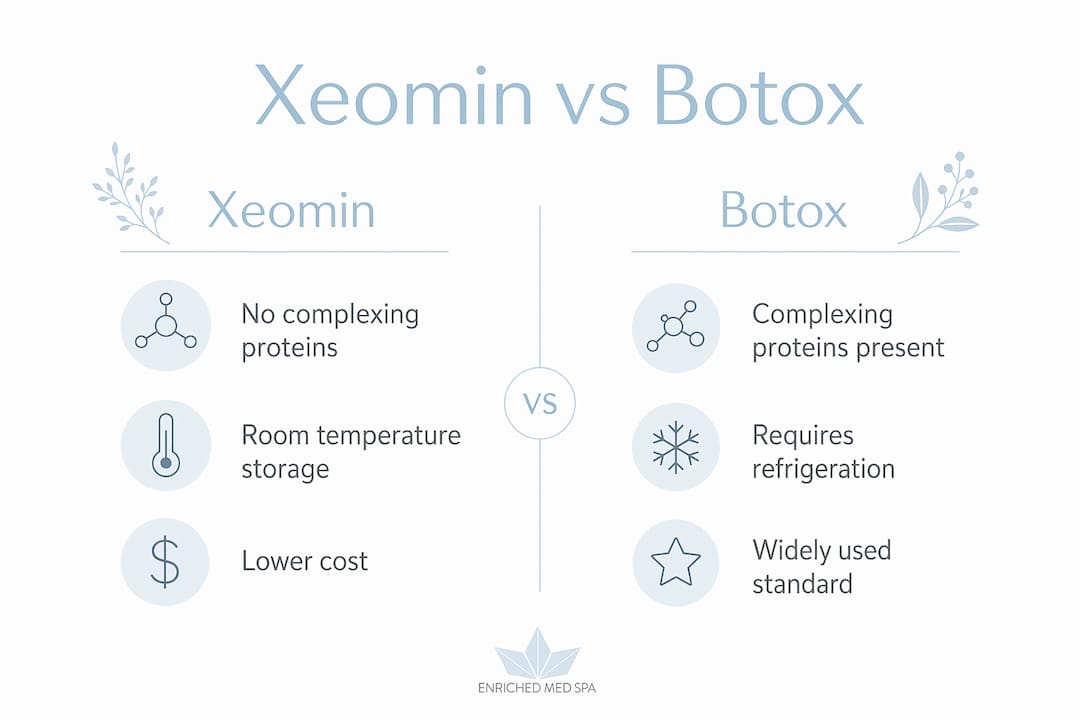
The most clinically significant difference between these two products is what surrounds the active toxin. Xeomin uses XTRACT Technology to remove accessory complexing proteins, leaving only the purified botulinum toxin. This is why Xeomin is often called the “naked neurotoxin.” Botox, by contrast, contains a 900 kDa protein complex that stabilises the toxin but also introduces additional proteins your immune system may recognise over time.
Why does this matter? The presence of complexing proteins in Botox is linked to a theoretical risk of antibody formation. Immunogenicity risk is lower with Xeomin due to the absence of these proteins, though clinical data show the difference in average patient outcomes is minimal. For most people, this distinction will never affect their results. For patients who have had many Botox treatments over several years and feel their results are weakening, Xeomin becomes a genuinely interesting option to discuss with their provider.
There is also a practical difference in storage. Xeomin is stable at room temperature, while Botox requires refrigeration. This affects provider logistics, particularly for mobile injectors, but has no impact on patient safety or the quality of your treatment.
| Feature | Xeomin | Botox |
|---|---|---|
| Active ingredient | Botulinum toxin type A | Botulinum toxin type A |
| Complexing proteins | None (purified) | Yes (900 kDa complex) |
| Storage requirement | Room temperature | Refrigeration required |
| Immunogenicity risk | Theoretically lower | Slightly higher (minimal clinical difference) |
| Regulatory approval | FDA-approved | FDA-approved |
Pro Tip: If you have been receiving Botox treatments for more than three years and notice your results seem to fade faster than they used to, mention this to your injector. Switching to Xeomin may be worth exploring.
How do Xeomin and Botox compare in onset and duration?
From a patient’s perspective, the day-to-day experience of Xeomin and Botox is very similar. Both treatments show visible results within 3–7 days, with the full effect typically settling in by day 14. You will not walk out of your appointment looking dramatically different. The change is gradual, which is part of what makes these treatments feel natural.
Duration commonly runs 3–4 months for both products, though individual variation is real. Factors like muscle strength, metabolism, how active you are, and how many units were used all influence how long your results last. Some clients find their results hold closer to four months; others notice softening at around ten weeks.
A few nuances are worth knowing:
- Onset: Some providers observe that Xeomin may take a day or two longer to show initial results in some patients. This is not universal, but it is worth setting expectations before your appointment.
- Expressiveness: Xeomin is favoured by some patients for a subtler, more natural-feeling result. This is a subjective observation, not a guaranteed clinical outcome.
- Consistency: Both products deliver consistent results when administered by an experienced injector using the correct dosage for your anatomy.
- Maintenance: Plan for a follow-up appointment every 3–4 months to maintain your results with either product.
The clinical equivalence between the two is well established. The differences in patient experience tend to be subtle and highly individual.
Cost and treatment logistics: what to expect
Xeomin is typically priced 15–25% lower per unit than Botox. That said, total treatment cost depends on the number of units your provider recommends, which varies based on the area being treated and your muscle activity. A lower per-unit cost does not automatically mean a lower total bill.
One practical advantage when switching between the two products is that Xeomin and Botox use a 1:1 unit conversion ratio. Your provider does not need to recalculate your dosage when transitioning from one to the other. This makes the switch straightforward from a clinical standpoint.
A few things to keep in mind when thinking about cost and logistics:
- Unit count matters more than brand. Forehead lines may require 10–30 units depending on your anatomy. The brand is a secondary cost factor.
- Provider pricing varies. Some clinics charge a flat fee per area rather than per unit. Ask your provider how they price treatments before booking.
- Switching timing. Wait 3–4 months after your last neuromodulator treatment before switching products. This allows full clearance so your provider can accurately assess how you respond to the new product.
- Package options. Some clinics, including Enrichedmedspa, offer Botox package pricing that can reduce the per-unit cost over time.
Pro Tip: Ask your provider to walk you through the unit estimate before your treatment begins. Knowing the expected unit count helps you compare costs accurately across clinics and products.
Who should consider Xeomin vs Botox?
Choosing between these two products is less about which one is objectively better and more about which one suits your history, goals, and preferences. Here is a practical framework for thinking it through.
-
You are new to neuromodulators. Botox has a 24-year clinical history and is the product most providers know best. Starting with Botox gives you a well-documented baseline and access to the broadest range of provider experience.
-
You have had many Botox treatments and feel results are fading faster. This pattern can suggest antibody formation. Xeomin’s protein-free formulation makes it a logical next step to discuss with your provider.
-
You prefer a cleaner formulation. Some patients are simply more comfortable with a product that contains fewer additives. Xeomin’s purified structure appeals to those who prioritise minimal protein exposure.
-
You want natural-looking results. Both products can deliver natural results, but the outcome depends far more on injector skill and technique than on the brand. Understanding facial anatomy for injectables is what separates a skilled provider from an average one.
-
You are managing a specific concern like crow’s feet or forehead lines. Both products are approved for these areas. Your provider’s familiarity with the treatment zone and your individual muscle anatomy matters more than the product label.
-
You are cost-conscious. If budget is a factor and your provider offers Xeomin, the lower per-unit cost may make it the more accessible option without compromising results.
The honest answer is that there is no universally better neuromodulator. The right choice is the one that fits your body, your history, and the expertise of the person holding the syringe.
Key takeaways
Both Xeomin and Botox are clinically effective botulinum toxin type A neuromodulators, and the quality of your results depends more on your injector’s skill and your individual anatomy than on which brand is used.
| Point | Details |
|---|---|
| Same active mechanism | Both use botulinum toxin type A to relax muscles and reduce wrinkles. |
| Key formulation difference | Xeomin is protein-free; Botox contains a 900 kDa complexing protein. |
| Similar clinical outcomes | Onset is 3–7 days and duration is 3–4 months for both products. |
| Cost advantage with Xeomin | Xeomin is typically 15–25% less per unit, with a 1:1 dosage conversion from Botox. |
| Injector skill is decisive | Natural results depend on technique and anatomy knowledge, not brand choice. |
What I have learned from watching clients choose between these two
The question I hear most often is some version of: “Which one is better?” My honest answer is that the question itself is slightly off. After watching many clients go through both products, the pattern I notice is this: the clients who are happiest with their results are the ones who had a thorough consultation, not the ones who picked the “right” brand.
That said, Xeomin deserves more credit than it typically gets. Many clients who switch to it after years on Botox report that their results feel slightly more natural and expressive. That is not a placebo. The purified formulation genuinely behaves differently in some people. I would not call it better, but for the right patient, it is a meaningful upgrade.
My practical advice: if you are new to injectables, start with Botox. The clinical track record is longer, and most providers have more hands-on experience with it. If you have been at this for a few years and feel like something has shifted, Xeomin is worth a real conversation. And if you are ever unsure, read up on natural-looking Botox results before your appointment. Knowing what to ask for makes a bigger difference than most people realise.
— Felix
Xeomin and Botox treatments at Enrichedmedspa
Enrichedmedspa serves clients in Woodbridge and East Gwillimbury, Ontario, offering both Xeomin and Botox as part of a broader menu of cosmetic injectables. The team is trained in facial anatomy and injectable technique, which means your treatment plan is built around your specific muscle activity and aesthetic goals, not a one-size approach. If you are weighing your options, a consultation is the most useful first step. You can also review the differences between neuromodulators and fillers to get a fuller picture of what each treatment can and cannot do. Enrichedmedspa’s patient-first approach means you leave with clarity, not just a booking.
FAQ
What is Xeomin and how does it differ from Botox?
Xeomin is a purified botulinum toxin type A neuromodulator that contains no accessory complexing proteins, unlike Botox which includes a 900 kDa protein complex. Both relax facial muscles to reduce wrinkles, but Xeomin’s cleaner formulation may lower the theoretical risk of antibody formation over time.
How long does Xeomin last compared to Botox?
Both Xeomin and Botox typically last 3–4 months, with individual variation based on muscle activity, metabolism, and the number of units used.
Is Xeomin cheaper than Botox?
Xeomin is generally priced 15–25% lower per unit than Botox, though total treatment cost depends on the number of units required for your specific treatment area.
Can I switch from Botox to Xeomin?
Yes. Xeomin and Botox use a 1:1 unit conversion ratio, making the switch straightforward. Providers recommend waiting 3–4 months after your last treatment to allow full clearance before switching products.
Which neuromodulator gives more natural-looking results?
Natural results depend primarily on injector technique and anatomy knowledge, not the brand. Some patients report feeling Xeomin allows slightly more natural expressiveness, but this varies by individual.
Recommended
- Juvéderm vs. BOTOX: Which is better for smoothing deep wrinkles? – Botox Laser Hair Removal OxyGeneo Medi Facial Microneedling – Enriched Med Spa – Vaughan Woodbridge Maple Vellore Village
- Botox vs. Fillers: Which One is Right for You? – Botox Laser Hair Removal OxyGeneo Medi Facial Microneedling – Enriched Med Spa – Vaughan Woodbridge Maple Vellore Village
- Enriched Med Spa | Botox Near Me & Cosmetic Injections in Woodbridge
- Botox vs. Juvéderm: Which Treatment Is Better for You? – Botox Laser Hair Removal OxyGeneo Medi Facial Microneedling – Enriched Med Spa – Vaughan Woodbridge Maple Vellore Village