

Your first aesthetic consultation is primarily a safety assessment and information-gathering conversation. You are not required to have any treatment that day. Understanding this from the start removes most of the anxiety that brings people to the door already second-guessing themselves.
In Canada, the framework protecting you as a patient operates on two levels. Health Canada regulates the devices and products used in cosmetic procedures, including dermal fillers, which are classified as Class III or IV medical devices requiring premarket evidence of safety and effectiveness before licensing. At the practice level, provincial bodies such as the College of Nurses of Ontario publish guidelines covering informed consent, documentation and complication management. Enrichedmedspa, which serves Woodbridge and East Gwillimbury, Ontario, structures its consultation process around these same standards.
What you need to know before you book:
A reputable clinic will spend the first appointment understanding your goals and medical history before recommending anything. If a clinic skips the medical intake and moves straight to a treatment menu, that is a red flag.What will happen: intake forms, skin assessment, goal-setting conversation, treatment options with realistic timelines and costs.
What to bring: medication list, skincare product names, prior treatment dates, 2–3 recent photos, and any upcoming event dates.
Top three red flags: pressure to book treatment the same day, no written consent form, inability to name who will perform the procedure and what their credentials are.
Table of Contents
- How do you prepare for your first aesthetic consultation?
- What happens during your first consultation, step by step?
- Which beginner-friendly treatments are worth knowing about?
- What side effects and recovery should you realistically expect?
- When do results appear, and what does maintenance look like?
- What does Canada’s regulatory framework mean for your safety?
- How do you choose a practitioner and what should you ask?
- Key takeaways
- A perspective on what actually matters for first-time patients
- Ready to book your first consultation at Enrichedmedspa?
- Useful sources and further reading
How do you prepare for your first aesthetic consultation?
Arriving prepared makes a short clinical appointment significantly more productive. Most consultations run around half an hour to an hour, and a practitioner who spends the start reconstructing your medical history has less time to discuss what actually matters to you.
What to collect before you go:
- A complete list of prescription medications, over-the-counter supplements, and blood thinners (including aspirin, fish oil, and vitamin E), since several affect bruising risk with injectables
- Names of your current skincare products, particularly any retinoids, chemical exfoliants, or prescription actives
- Dates of any prior cosmetic treatments, including injectables, laser, or peels
- Upcoming event dates, since some treatments require 2–4 weeks of lead time for swelling to resolve
- 2–3 recent photos taken in natural light from the front and both sides
Medical history to disclose: pregnancy or breastfeeding, a history of cold sores (relevant for filler near the lips), known allergies, bleeding disorders, autoimmune conditions, and any recent use of isotretinoin (Accutane), which typically requires a waiting period before certain skin treatments.
On the day itself, arrive with a clean face and avoid applying strong actives such as retinol or AHAs the night before, unless your clinic advises otherwise. For neuromodulator appointments specifically, review the Botox preparation checklist for medication-specific guidance.
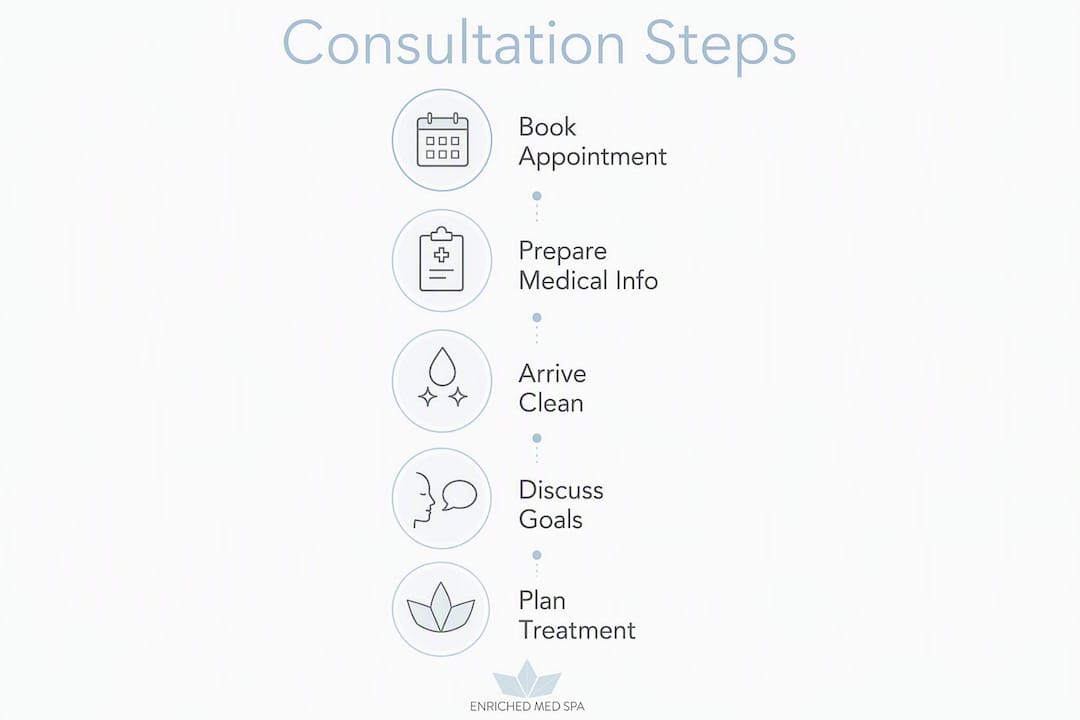
When booking, confirm three things: who will perform the procedure (not just who will consult), whether the consultation fee is credited toward treatment, and how long to set aside for the appointment.
Pro Tip: Ask at booking whether the consultation fee applies to your first treatment. Many Canadian clinics credit it as a deposit, which removes friction and signals that the clinic respects your time.
What happens during your first consultation, step by step?
Knowing the sequence helps you stay calm and ask questions at the right moments. Here is the typical flow at a well-run medical aesthetics clinic:
- Administrative intake. You complete a detailed medical history form covering medications, allergies, prior procedures and relevant health conditions. This is not optional paperwork — it is the clinical foundation for everything that follows.
- Consent documentation. Before any assessment begins, you will be asked to sign an informed consent form. Read it. A reputable clinic will walk you through it rather than hand you a clipboard and walk away.
- Skin and anatomy assessment. The practitioner examines your skin in good lighting, sometimes with a magnification device. For injectable consultations, facial anatomy, muscle movement and tissue volume are assessed. Photos are typically taken for your clinical record.
- Goal-setting conversation. This is where you describe what you have noticed and what outcome would feel right. Many clients arrive noticing early signs of ageing, tired-looking skin, or specific concerns like fine lines or uneven texture. A good practitioner listens before recommending.
- Treatment planning. The practitioner outlines options suited to your goals, explains sequencing (some treatments work better in a particular order), discusses realistic timelines, typical downtime and costs. You receive this information to consider — there is no obligation to proceed.
- Decision point. Same-day treatment is sometimes appropriate for straightforward procedures when the medical history is clear and the patient is ready. It should be deferred when more planning is needed, when contraindications require clarification, or when you simply want time to think.
Which beginner-friendly treatments are worth knowing about?
Most first-time patients benefit from understanding a handful of common starter options before the consultation. That way, the clinical conversation is a dialogue rather than a one-sided presentation.
| Treatment | What it addresses | Typical session time | Typical downtime range |
|---|---|---|---|
| Medical-grade facial | Congestion, dullness, mild texture | About an hour or so | Minimal or none |
| Light chemical peel | Uneven tone, fine lines, mild acne | Less than an hour | A few days of peeling possible |
| Microneedling | Texture, scarring, early laxity | About an hour | A couple of days of redness possible |
| Laser hair removal | Unwanted hair | Variable, often brief | Minimal |
| Laser/IPL (pigment, redness) | Sun damage, rosacea, vessels | Around half an hour | Several days of skin response possible |
| Neuromodulators (Botox, Nuceiva, Xeomin) | Dynamic lines, brow position | Brief | Minimal, bruising possible |
| Dermal fillers (Juvederm, Teosyal) | Volume loss, lip definition, contour | Typically under an hour | Several days of swelling possible |
| Radiofrequency (RF) skin tightening | Skin laxity, jawline definition | About half an hour | Minimal |
Medical-grade facials are the lowest-commitment starting point. They improve circulation, hydration and mild congestion without any recovery period, and they give the practitioner a baseline read of your skin’s behaviour.
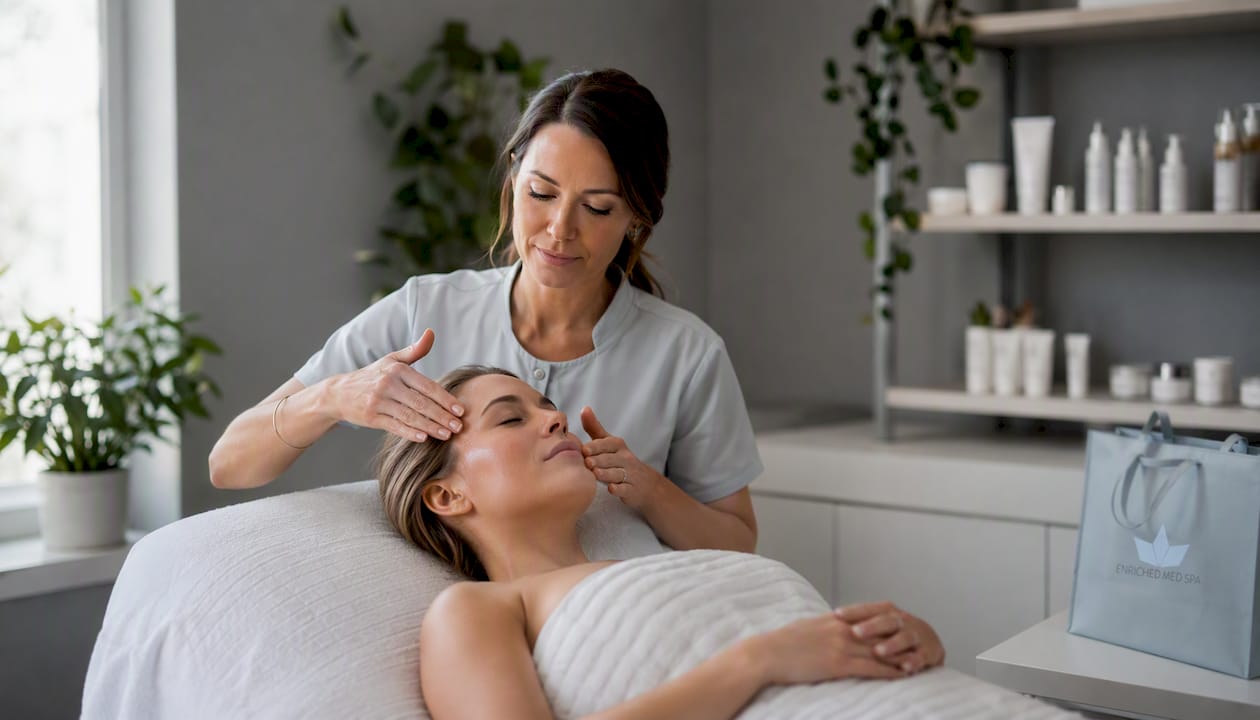
Chemical peels at the light end of the spectrum (lactic, mandelic, low-percentage glycolic) address uneven tone and early fine lines. Expect some peeling for a few days. Deeper peels require more planning and are rarely a first-visit treatment.
Microneedling uses fine needles to stimulate collagen production. It suits most skin tones and is often recommended for texture, mild scarring and early laxity. Results are cumulative, typically across 3–6 sessions spaced 4–6 weeks apart. It is not suitable during active skin infections or within six months of isotretinoin use.
Neuromodulators such as Botox, Nuceiva and Xeomin relax the muscles responsible for dynamic expression lines. Results appear within 3–14 days and typically last 3–6 months. They are not appropriate during pregnancy or breastfeeding. For a detailed comparison of neuromodulators versus fillers, the Botox vs. fillers guide covers the key differences clearly.
Dermal fillers restore volume and define contour. Results are visible immediately, though some swelling is expected for the first few days. The dermal fillers service page outlines aftercare and what to expect in the days following treatment. Practitioners who prioritise natural-looking results typically start conservatively and build from there, which is the approach worth asking about at your consultation.
What side effects and recovery should you realistically expect?
No aesthetic treatment is without some degree of response. The question is whether that response is expected and manageable, or a sign that something needs attention.
Common transient effects by category:
- RF skin tightening: — warmth during treatment, mild redness for a few hours. Minimal visible downtime.
Signs that warrant contacting your clinic promptly: significant asymmetry developing after fillers, skin blanching or colour change at an injection site, severe or worsening pain, signs of infection (increasing redness, warmth, discharge), or vision changes after any facial injectable treatment.
Reputable clinics manage risk through patch testing where appropriate, thorough medication reviews, conservative initial dosing, photographic records and documented informed consent, as required under Canadian practice standards for nurses in medical aesthetics.
| Treatment | Immediate | First week | First month |
|---|---|---|---|
| Neuromodulators | Mild redness, possible bruising | Bruising resolves; results begin | Full effect visible by day 14 |
| Dermal fillers | Swelling, possible bruising | Swelling settles by day 5–7 | Final result visible at 2–4 weeks |
| Light chemical peel | Redness, tightness | Peeling days 2–5 | Tone and texture improvement |
| Microneedling | Redness, sensitivity | Skin normalises by day 3–4 | Collagen remodelling begins |
| Laser/IPL | Redness, warmth | Pigment darkens then flakes | Clearer tone emerging |
When do results appear, and what does maintenance look like?
Results vary considerably by treatment type, and setting realistic expectations here prevents disappointment.
Fillers deliver the most immediate visible change. You will see the difference the same day, though the final result settles once swelling resolves, usually within 2–4 weeks. Longevity depends on the product and the area treated; most hyaluronic acid fillers last 6–18 months. The dermal fillers longevity guide breaks this down by product and placement.
Neuromodulators take 3–14 days to show their effect. Most patients return every 3–6 months, though some find results last closer to 4–6 months once they have had a few treatments. Timing your first appointment 3–4 weeks before an important event gives the result time to settle.
Skin treatments (microneedling, peels, laser) work cumulatively. A single session produces some improvement, but meaningful results typically require a series. A common starting plan for microneedling is three sessions spaced 4–6 weeks apart, followed by maintenance every 3–6 months.
A realistic maintenance sketch for a first-time patient might look like this: one consultation, one or two skin treatment sessions in the first three months, a neuromodulator appointment at month three or four, and a reassessment at six months to evaluate progress and adjust the plan. Ask your clinic for per-session or per-unit pricing and whether package pricing is available, since bundled sessions often reduce the per-visit cost.
What does Canada’s regulatory framework mean for your safety?
Canada has one of the more structured regulatory environments for medical aesthetics, and knowing what to look for protects you.
Health Canada classifies dermal fillers as Class III or IV medical devices. This means manufacturers must submit premarket evidence of safety and effectiveness before a product can be licensed for use in Canada. When a clinic uses licensed, Health Canada-approved products, you have a baseline assurance that the product has been reviewed. Ask which specific product will be used and confirm it is Health Canada-licensed.
At the practice level, provincial nursing colleges set the standards for how regulated health professionals deliver aesthetic services. The College of Nurses of Ontario’s practice guideline covers informed consent, documentation and complication management. The Canadian Society of Aesthetic Nursing has also published national practice standards for nurses in medical aesthetics. These documents are publicly available and worth knowing about.
Credential checklist to confirm before your appointment:
- Who will perform the procedure (not just consult) and what their regulated health professional designation is
- Whether licences are displayed or available on request
- Whether the clinic holds current ACLS or first-aid certification where relevant to the procedures offered
- Whether written informed consent is obtained before treatment
- Whether the clinic documents product lot numbers and post-procedure photos in your patient file
Pro Tip: Before you sign consent, ask the clinic how they manage complications. A confident, specific answer (“we have a complication protocol and access to hyaluronidase for filler reversal”) is a positive signal. Vagueness is not.
How do you choose a practitioner and what should you ask?
The practitioner matters more than the clinic’s décor or its social media following. Here is how to assess them objectively.
Selection criteria that actually count:
- Formal clinical credentials (RN, NP, MD, or equivalent regulated designation) with verifiable registration
- Documented experience with the specific procedure you are considering, not just injectables in general
- A visible before-and-after portfolio showing results consistent with natural-looking outcomes
- Clear, written pricing with no hidden fees
- A follow-up policy that includes at least one post-treatment check
Red flags at booking or during the consult: pressure to commit to treatment before you have had time to think, credentials that cannot be verified or are not displayed, no written consent process, an inability to answer direct questions about risks or complication management, and upselling multiple treatments in a first appointment before your skin has even been assessed.
Questions to ask during your consultation:
- “How many times have you performed this specific procedure?”
- “What result is realistic for my anatomy and skin type, and what would not be achievable?”
- “What is the recovery like, and what should I avoid afterward?”
- “What happens if I am not happy with the result, or if there is a complication?”
- “Is the consultation fee credited toward treatment?”
- “What is the per-unit or per-session cost, and are there package options?”
Understanding facial anatomy for injectables is one marker of practitioner depth. A clinician who can explain why a particular injection point suits your anatomy is demonstrating the kind of knowledge that separates safe practice from guesswork.
Key takeaways
A first aesthetic consultation is a safety and goal-setting conversation, not a commitment to treatment, and verifying your practitioner’s credentials and the clinic’s Health Canada-compliant product sourcing is the single most protective step you can take.
| Point | Details |
|---|---|
| Consultation is not a commitment | You are there to gather information and assess the clinic; no obligation to proceed the same day. |
| Verify credentials and products | Confirm the practitioner’s regulated designation and that products are Health Canada-licensed before consenting. |
| Prepare your medical history | Bring a medication list, skincare product names, prior treatment dates, and 2–3 recent photos. |
| Expect realistic timelines | Fillers show results within days; neuromodulators take 3–14 days; skin treatments work cumulatively over weeks to months. |
| Enrichedmedspa’s approach | Enrichedmedspa structures consultations around patient goals and safety, with clear informed consent and conservative treatment planning. |
A perspective on what actually matters for first-time patients
Most first-time patients worry about the wrong things. They spend time researching which filler brand is best or whether Botox will freeze their face, when the more consequential question is whether the person holding the needle has the training, the anatomy knowledge, and the clinical judgment to stop when stopping is the right call.
The consultation is where that judgment becomes visible. A practitioner who listens before recommending, who explains contraindications without being asked, and who is comfortable saying “this treatment is not right for you yet” is demonstrating exactly the kind of clinical discipline that produces good long-term outcomes. A practitioner who leads with a treatment menu is not.
There is also a tendency in the industry to frame aesthetics as a series of isolated fixes. A line here, some volume there. The patients who tend to be happiest over time are the ones who approach it as skin health first, with treatments layered in gradually and purposefully. Starting with a medical-grade facial or a light peel before committing to injectables is not timid. It gives the practitioner a baseline, gives you time to build trust, and gives your skin a chance to respond before anything more involved is introduced.
The regulatory framework in Canada, including Health Canada’s device licensing requirements and provincial nursing college standards, gives you real tools to verify a clinic’s legitimacy. Use them. Ask for the product name and lot number. Ask who holds the regulated designation. Ask what happens if something goes wrong. A clinic that answers those questions clearly and without defensiveness is one worth returning to.
Ready to book your first consultation at Enrichedmedspa?
Enrichedmedspa offers first-time patients in Woodbridge and East Gwillimbury a structured consultation experience built around your goals, your medical history, and your comfort level. There is no pressure to commit to treatment at the first appointment. The team works through a thorough skin assessment, discusses realistic options across cosmetic injectables, medical-grade facials, microneedling, chemical peels, and laser skin treatments, and provides written aftercare and pricing before you decide anything.
If you are considering neuromodulators or fillers for the first time, the clinic’s conservative, anatomy-informed approach means you will leave with a clear plan rather than a rushed result. Book a consultation directly through the Enrichedmedspa website to confirm availability, ask about consultation fee credits, and take the first step at a pace that feels right for you.
Useful sources and further reading
- Health Canada: Cosmetic procedures and medical devices
- Health Canada: Guidance document for dermal filler licence applications
- New Brunswick Association of Nurses: Practice guideline — medical aesthetics
- Enrichedmedspa: Cosmetic treatment consultation process
- Enrichedmedspa: What is medical aesthetics? A 2026 patient guide
- Enrichedmedspa: How to prepare for skin treatments
- Enrichedmedspa: How to prepare for Botox
Recommended
- Cosmetic treatment consultation process: what to expect
- What to Expect During Your First Facial: A Beginner’s Guide – Botox Laser Hair Removal OxyGeneo Medi Facial Microneedling – Enriched Med Spa – Vaughan Woodbridge Maple Vellore Village
- What is medical aesthetics? a 2026 patient guide
- What to expect after fillers: your recovery guide