
If your chin looks bumpy or “orange-peel” textured when you talk, smile or push your lower lip up, the cause is usually an active chin muscle called the mentalis. Botox relaxes that muscle, so the skin over it can lie smoother. At Enriched Med Spa in Woodbridge, Botox, Nuceiva and Xeomin are given by experienced, nurse-level injectors after a consultation, because the chin is a small area where placement and dose matter more than anything else.
Below, we walk through what causes chin dimpling, who is a good candidate, what the appointment involves, how long results take and last, and when filler or skin treatments belong in the plan.
TL;DR
- Chin dimpling (often called a “pebble” or “cobblestone” chin) is most often driven by an overactive mentalis muscle, sometimes combined with age-related loss of fat and collagen.
- Botox softens the muscle’s pull rather than freezing it. The goal in the lower face is a relaxed, natural movement.
- Effects typically begin within a few days, settle by about two weeks and last roughly three to four months.
- Where dimpling comes from lost volume, filler may be added to the plan. Singers, public speakers and anyone with swallowing or breathing conditions need a careful conversation first.
- Placement matters: too low, too wide or too high can affect your lip contour or smile, which is why an experienced injector matters.
Table of Contents
- What causes a dimpled or pebbly chin
- How Botox smooths chin dimpling
- What happens at the appointment
- Results, timeline and maintenance
- Risks and side effects, and what to do if something feels wrong
- When filler or skin treatments belong in the plan
- How to get a natural-looking result
- Book a chin assessment in Woodbridge
- FAQ
- Sources
What causes a dimpled or pebbly chin
The mentalis is the main muscle of the chin. It sits at the front of the jaw and pulls the chin skin upward when you pout, frown or press your lips together. A Canadian dermatology review by a Toronto dermatologist explains that, with maturity, mentalis overactivity combined with a loss of fat and collagen can create a cobblestone, orange-peel look. It is sometimes nicknamed “chin cellulite,” though it has nothing to do with body fat.
A 2023 anatomy review adds the reason the texture shows on the surface: the muscle inserts fibres into the skin of the chin. When it contracts strongly, the skin dimples with it.
Many clients tell us the same story. They notice the texture in photos or video calls, or when they rest their chin on a hand, and it often appears alongside early signs of aging or a tired, tense lower face. Stress habits, such as clenching and pushing the lip up, can make the muscle more visible.
Is it a dimple, a cleft or a pebble chin?
These are different things, and the right treatment depends on which you have:
- Pebble or cobblestone chin: the texture shows or deepens when the muscle moves. This is the type Botox is aimed at.
- Cleft or true chin dimple: a fixed groove, often inherited, that is there at rest. Muscle relaxation does not change a structural cleft in the same way, so this is a different conversation.
- Volume-related dimpling: a flatter or softer chin with a crease just below the lower lip. Here the issue is often lost volume as well as muscle pull.
Can a chin dimple go away by itself? A muscle-driven pebble chin can look better or worse with tension, expression and age, so it may come and go in intensity. An inherited cleft is built into the shape of the chin and generally stays. An in-person assessment is the quickest way to tell which one you have.
How Botox smooths chin dimpling
Botox (onabotulinumtoxinA) blocks the signal from nerve to muscle, so the muscle contracts less forcefully. The 2023 anatomy review describes the effect on the mentalis as relaxing the muscle so the chin can sit more refined and less bunched. Because it is a gentle release rather than a full stop, you still talk, eat and smile normally.
That gentleness is deliberate. Lower-face injecting aims to soften creasing through relaxation, not complete paralysis, and the same research recommends lower initial doses with precise anatomical placement. Nuceiva and Xeomin work on the same principle, and your injector will talk you through which product suits you.
The suitability check
At a consultation, your injector will usually ask you to push your lower lip upward and watch how your chin behaves. If the skin dimples strongly, the mentalis is likely the driver. If it doesn’t, Botox has little to treat, and we would tell you so and look at other options.
We also look at:
- how your lips and smile move at rest and in speech
- whether the chin looks flat or recessed, which can point toward filler
- your history with injectables, medications and any neurological, swallowing or breathing conditions
Who needs extra care
The lower face is more sensitive to over-treatment than the forehead. Musicians, singers and public speakers who rely on precise enunciation need an especially careful discussion, since a lower-face neuromodulator chapter notes they are not ideal candidates for perioral toxin. Some clinicians also decline people with weak muscles around the mouth, because of the risk of an uneven smile or trouble speaking or eating.
Health Canada says that cosmetic injectables should be used with extreme caution if you have an underlying neurological disorder, swallowing difficulties or breathing problems, and not at all if you have inflamed or infected skin or a hypersensitivity to any ingredient. Tell your injector about any medications or recent procedures, and check with your doctor about interactions if you are unsure.
What happens at the appointment
The treatment itself is short. After the consultation, the area is cleaned and your injector places a small number of injections into the chin muscle. Published techniques vary, but two patterns are common: a single midline injection, or two small injections, one on each side of the chin.
For reference, the Toronto dermatology review describes a total of 4 to 10 units for the chin, placed either at one midline point about 0.5 to 1.0 cm above the lowest point of the chin, or at two lateral points directed inward. Another review of the technique describes 2 units per muscle belly or about 5 units in one midline injection. Your own dose is set by your anatomy and muscle strength, not by a number you read online.
Two details explain why experience matters here:
- Depth and direction. The 2023 review describes injecting deep, near the bone, with a small superficial amount, slowly and gently to limit spread.
- Spacing. Injections that are too wide can affect the depressor labii inferioris, which shapes your lower-lip contour. Injections that are too high can reach the muscle that circles the mouth, which can affect speech, suction and your smile, according to the lower-face chapter.
Most clients are in and out quickly. You can usually return to your day, with some simple aftercare: skip rubbing the area, avoid hard workouts and heat for the rest of the day, and follow the instructions we give you.
Results, timeline and maintenance
Botox doesn’t work instantly. Effects of botulinum toxin generally begin at 24 to 48 hours, peak around 7 to 14 days and last about 3 to 6 months, averaging three to four months. Health Canada likewise says the effects of Botox Cosmetic generally last three to four months. For the chin specifically, one medical dermatology review puts clinical results at about three months.
Here is a realistic way to think about it:
| Stage | What you may notice |
|---|---|
| Days 1 to 3 | Possible tiny marks or mild tenderness. Little change in texture. |
| Days 4 to 14 | The chin gradually relaxes and the pebbly look softens. |
| Around week 2 | Full effect. This is the right time to judge the result and book a review if needed. |
| Months 3 to 4 | Movement returns gradually and the texture may re-emerge. |
You may notice a softer result than you pictured, and that is intentional. If your chin still looks active at the two-week point, a small adjustment can be made at a review. We would rather build up than overshoot.
Health Canada notes that Botox Cosmetic injections should be spaced no closer than every two months, per the product monograph. Over the long term, the 2023 review also notes that repeated, closely spaced injections can lead the body to form antibodies that reduce results, so a steady schedule, not frequent top-ups, serves you best. Our guides on how long Botox lasts and when to touch up and how soon results appear go into more detail.
Risks and side effects, and what to do if something feels wrong
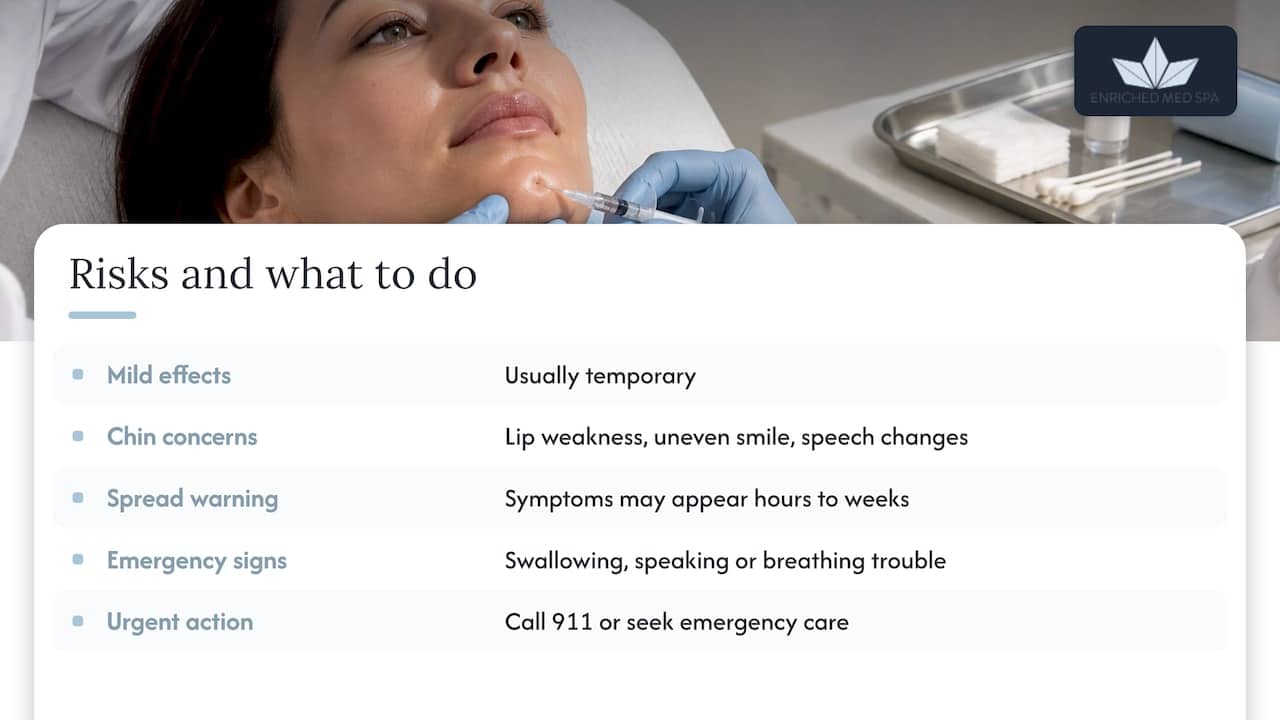
Most side effects are mild and temporary. Health Canada lists pain or bruising at the injection site, headache, face pain, eye swelling, rash or allergic reaction, and local muscle weakness of the face. These are generally temporary but can last several months.
In the chin, the practical concerns are the ones a skilled injector plans around: a flattened lower-lip contour, a lopsided smile, lip weakness or a change in how you speak or sip. The 2023 review names lower-lip ptosis (a drooping lip) and trouble closing the mouth as complications to avoid with precise, conservative dosing.
There is also a rare but serious reaction. The Canadian Botox Cosmetic product monograph carries a boxed warning for spread of the toxin’s effect to other parts of the body, with symptoms reported from hours to weeks after injection. Swallowing or breathing difficulty can be life-threatening. If you develop muscle weakness away from the injection site, or any trouble swallowing, speaking or breathing, seek immediate medical care by calling 911 or going to the nearest emergency department.
For anything milder, such as an uneven smile or a surprising change in how your chin looks, contact the clinic that treated you so your injector can assess it.
When filler or skin treatments belong in the plan
Botox treats muscle movement. It doesn’t add volume. If your chin looks flat, recessed or creased because of lost volume, the plan may include filler. The lower-face chapter states that for chin dimpling due to volume loss, fillers are necessary adjuncts, and that the two can be used together.
Sequence matters. The 2021 dermatology review advises placing filler before toxin to reduce the chance of toxin migrating, and avoiding toxin on the same day as laser treatment because of concerns about diffusion. If you are planning a laser or radiofrequency-based session, tell us so we can space your appointments sensibly.
A simple way to compare:
| Concern | What often fits |
|---|---|
| Pebbly texture that shows with movement | Botox, Nuceiva or Xeomin for the mentalis |
| Soft or flat chin with a crease below the lip | Dermal filler, sometimes with Botox |
| Rough or uneven skin surface itself | Microneedling, peels and other skin-quality treatments |
| Both muscle activity and volume loss | A combined, staged plan |
If you want the bigger picture, our comparison of dermal fillers and Botox and our guide to facial anatomy for injectables explain how the two work.
How to get a natural-looking result
These habits make the biggest difference for a small, mobile area like the chin:
- Start conservatively. A modest first dose shows how your muscle responds and leaves room to refine.
- Be honest about your daily life. If you present, sing or speak for a living, say so up front.
- Judge at two weeks, not day three. The full effect needs time.
- Keep a steady schedule. Planned visits at the three-to-four-month mark generally give smoother, more predictable results than frequent small top-ups. Our guide to natural-looking Botox results covers this in depth.
- Support the skin, too. Sunscreen, gentle exfoliation and consistent skincare help the surface look its best between visits.
What we think about chin Botox
A pebbly chin is one of those concerns people often live with quietly, then notice in a photo and can’t stop seeing. In our experience, the best outcomes come from treating it as a small, precise job, not a quick one. That means looking at how your chin moves, asking about your speech and lifestyle, and starting with a dose that leaves you looking like yourself.
Our injectors are experienced nurses, and we think that matters most in the lower face, where a few millimetres change the result. We would rather explain why Botox is right for your chin, or why filler or a skin treatment should be part of the plan, than give you a generic answer.
We also believe in clear expectations: results build over about two weeks, last for a few months and need a plan for maintenance. Good care includes before-and-after guidance so you know what’s normal and when to call us.
Felix
Book a chin assessment in Woodbridge
If you live in Woodbridge, Vaughan or East Gwillimbury, the first step is a consultation where we look at how your chin moves and what’s behind the texture. From there we can recommend Botox, Nuceiva or Xeomin, dermal filler, a skin-quality treatment or a combination. You can see everything we offer on our services page.
FAQ
Does Botox really fix chin dimpling?
When the dimpling comes from an overactive mentalis, relaxing that muscle usually softens the pebbly texture. It works best on texture that appears or deepens with movement. A fixed cleft or a volume-related crease may need a different approach, such as filler.
How many units of Botox go in the chin?
Published ranges are small. One Canadian review describes a total of 4 to 10 units, and another describes about 5 units at the midline. Your injector sets your dose based on muscle strength and anatomy, and often starts low.
Can Botox make chin dimples worse?
A poorly placed or poorly dosed injection can change how the lower lip and chin move, which may look uneven for a time. Careful assessment, conservative dosing and precise placement reduce this risk. If your chin looks different than expected, contact your injector for a review.
How long does Botox in the chin last?
Most people see results for about three to four months, with the effect fading gradually. Health Canada recommends leaving at least two months between Botox Cosmetic injections. Our guide to Botox longevity explains how to plan your visits.
Is chin Botox safe if I sing or speak for a living?
It needs an extra-careful conversation. Because the muscles around the mouth help with enunciation, the lower face is treated more lightly, and some people with demanding speech needs are advised against it. Tell your injector about your work at the consultation.
Sources
- Canadian Dermatology Today: aesthetic treatment of the chin
- Novel anatomical guidelines for botulinum neurotoxin injection (Anatomy & Cell Biology, 2023)
- Botulinum toxin in facial plastic surgery (2020)
- Health Canada: Cosmetic injections
- Botox Cosmetic Canadian product monograph
- Botulinum Toxins in Medical and Cosmetic Dermatology (EMJ, 2021)
- Orbicularis oris, mentalis, depressor anguli oris (lower-face neuromodulator chapter)