
Filler migration means dermal filler has moved away from the spot where it was placed, so you see a puffy area, a shadow or a lump that was not part of the plan. It is most often linked to how much product was used, how deep and how fast it was placed, and the anatomy of the area. That is why the best protection is a thorough consultation with a nurse-level injector who plans conservatively, and why hyaluronic acid (HA) filler that does move can be assessed and, when needed, dissolved. Below we explain what you might notice, why it happens, and how to reduce the chance of it.
TL;DR
- Migration is filler appearing outside the treated area. It is different from swelling in the first few days, which is normal and settles.
- Reported causes include high volume, high pressure, placement that is too superficial or in a very mobile area, and very thin tissue such as the lips.
- Lips, nose, nasolabial folds and forehead are reported more often than cheeks, and permanent fillers are more likely to move than HA fillers.
- HA filler that has moved can be assessed and dissolved with hyaluronidase, an enzyme. Ultrasound can help target it.
- Prevention starts before the needle: a careful consultation, a conservative plan, approved products and clear aftercare.
Table of Contents
- What filler migration actually is
- Swelling, bruising or migration?
- Signs of filler migration to look for
- Why fillers migrate
- Does migrated filler go away on its own?
- How migrated filler is assessed and treated
- How to lower your risk
- Lip filler and cheek filler: what differs
- Our perspective
- Planning filler with Enriched Med Spa
- FAQ
- Sources
What filler migration actually is
Dermal filler is a gel placed under the skin to restore volume, define contours or soften folds. Migration is when some of that gel ends up somewhere you did not have it treated. A 2023 narrative review of the published reports describes it as a potential complication of soft tissue fillers, and found HA and polyalkylimide were the substances most often involved.
Three things are worth knowing from that review:
- Migration has been reported in people from 21 to 86 years old, and far more often in women than in men. That mostly reflects who has filler, not who is at risk.
- Injections into the nose, lips, nasolabial folds and forehead were reported more often than cheek injections.
- Very late migration, sometimes years after treatment, is more common with permanent fillers than with the non-permanent products used in most clinics today.
Most clients who ask us about this are not worried about a rare event so much as they have noticed something and want to know whether it is normal. The next sections help you tell the difference.
Swelling, bruising or migration?
First, the normal part. Even a well-placed injection can cause swelling, and some HA fillers hold water, which adds to the initial puffiness. A 2024 review of dermal filler adverse effects notes that this kind of swelling typically resolves within 2 to 3 days, and that bruising (non-uniform and appearing right away) is a separate thing from filler-related swelling.
So a lip that looks larger and uneven on day one or two is expected. If you are in that window, our guide on reducing swelling after lip fillers covers what helps.
Migration tends to look different:
- It persists or appears after the swelling has gone down, often weeks or months later.
- It forms a distinct soft bulge, a shelf or a smooth lump rather than general puffiness.
- It sits outside the original border, for example product visible above the upper lip line, which is described in a Journal of Aesthetic Nursing article as filler extending past the vermilion border (the edge of the red lip) into the skin above.
Clinicians sort complications by when they appear. One 2023 classification of lip and perioral filler complications uses immediate (within 24 hours), early (24 hours to 4 weeks) and late or delayed (after 4 weeks). Something that shows up in the late group is worth having examined rather than waiting out indefinitely.
Signs of filler migration to look for
Here are the patterns we would ask you to photograph and bring to an appointment:
- Lips: a fullness above the upper lip, a loss of the crisp border you had after treatment, or a lip that looks “duck-like” or sits forward. The 2024 review links excess filler to this appearance and advises minimal filler in a single session for that look.
- Lumps or beading: firm or soft nodules that were not there before, or a visible ridge when you smile.
- Asymmetry: one side that has gradually changed shape without new treatment.
- Under the eyes: puffiness or a persistent bluish tint in the tear-trough area. This area carries a particular risk of the product moving toward the eye socket, per the 2023 review.
- Cheeks and mouth corners: heaviness near the nasolabial folds or oral commissure (the corners of the mouth).
A good habit is to photograph your face straight on and from both sides in the same light at your appointment and at two weeks. Photos taken the same way each time let you and your injector track change over time, the same principle behind scan-based change tracking in other areas of aesthetics.
When it is not a cosmetic question
Seek urgent medical care right away, and do not wait for a booking, if you have severe pain, skin that turns pale, dusky or mottled, vision changes, or swelling that spreads quickly after an injection. These can signal a blocked blood vessel, which is a medical emergency. Go to the nearest emergency department or call 911, and tell them you have had a filler injection.
Why fillers migrate
There is rarely one cause. The research points to a handful of contributing factors.
Volume and pressure
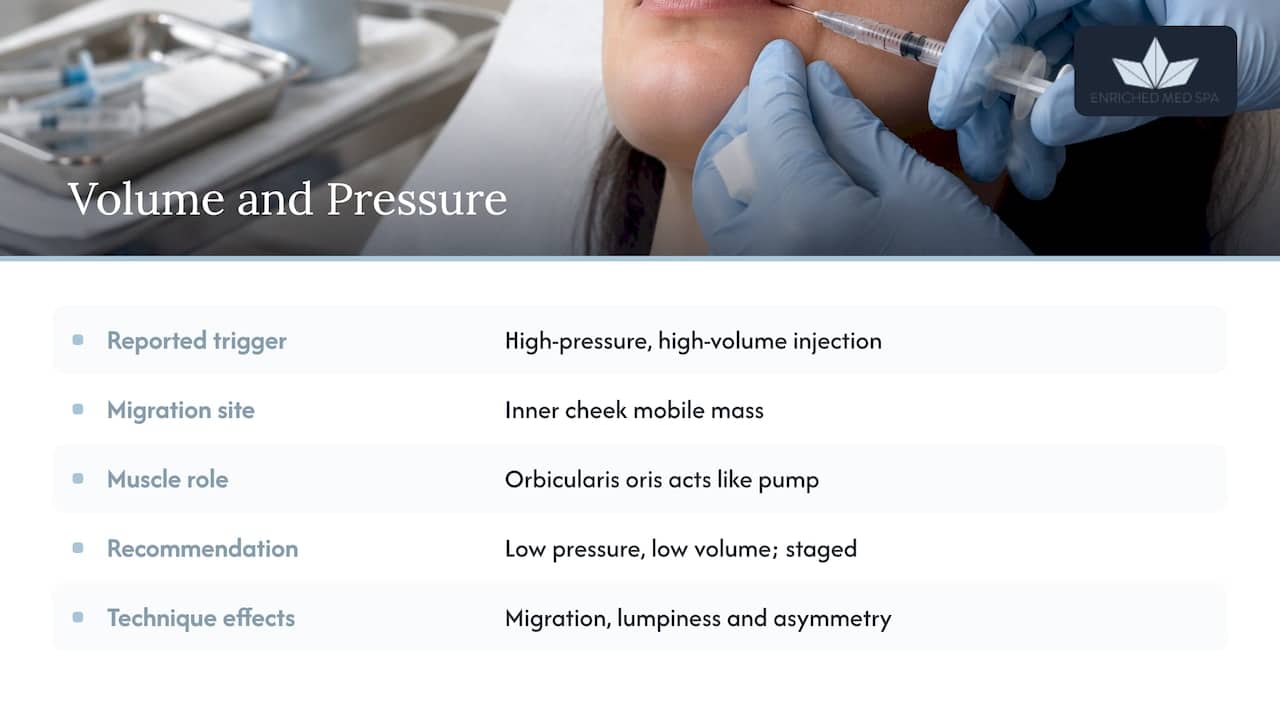
A 2023 case report described HA lip filler that moved into the inner cheek as a mobile mass. The authors attributed it to high-pressure, high-volume injection near the corner of the mouth, with the lip’s circular muscle (orbicularis oris) acting like a pump. Their recommendation was low-pressure, low-volume injections, spread over more than one treatment where needed. The 2024 review similarly notes that inappropriate technique or too much filler can lead to migration, lumpiness and asymmetry.
The anatomy of the lips
Lips are thin and constantly moving. A 2026 ultrasound study of 126 people found the layer just under the lip skin averaged under 1 mm, so filler often ended up in muscle. It also found that vertical injection techniques were associated with deeper placement and with signs of migration. In plain terms: there is very little room, and a moving muscle will work product around over time.
The product itself
Permanent fillers are more likely to migrate than HA fillers, though HA movement has also been reported. Softer, more water-attracting gels placed in high-movement areas can behave differently from firmer gels placed where structure is needed. Matching the product to the area is part of a good treatment plan.
Placement and area
Product placed too superficially or concentrated at a border can show or shift. This is one reason our facial anatomy guide for injectables is worth a read before your first appointment: knowing where each layer sits makes it easier to follow your injector’s reasoning.
Aftercare
In the same case report, the authors suggested avoiding excess lip-muscle activity for 24 to 48 hours after perioral (around the mouth) filler. Very strong massage, pressure and intense exercise in that window are the usual things to skip, unless your injector has told you otherwise.
Does migrated filler go away on its own?
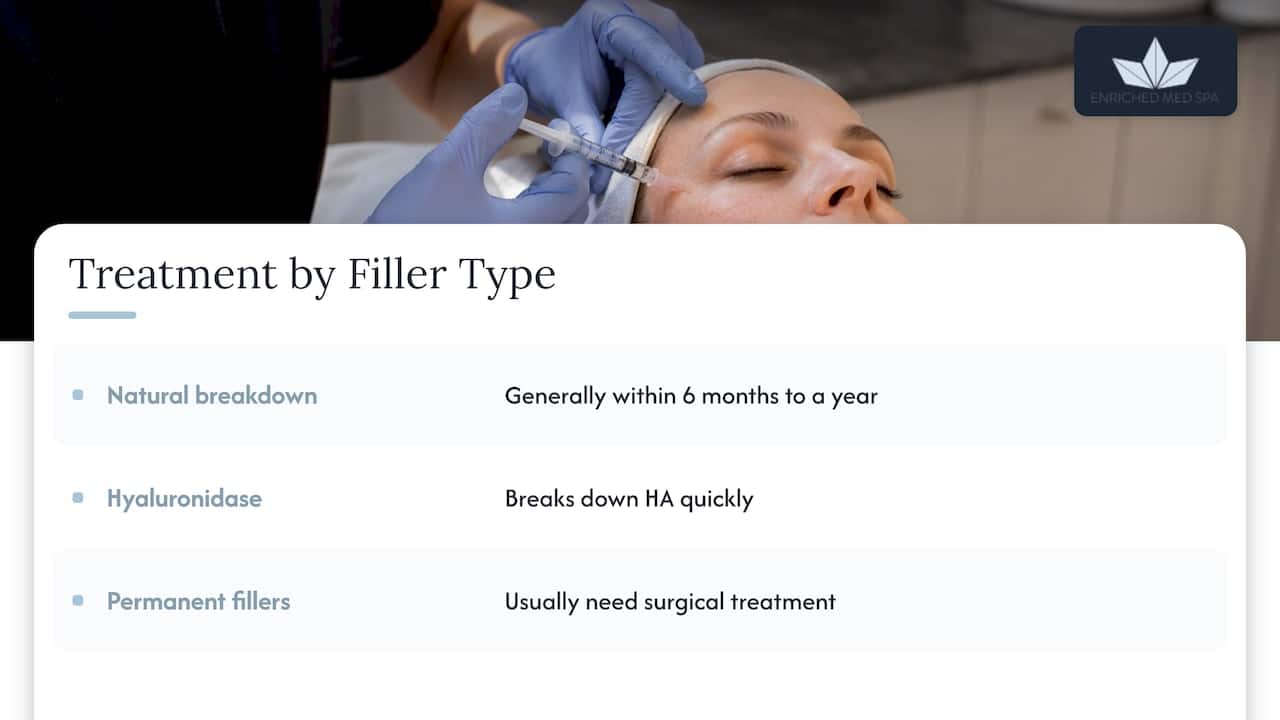
Often, yes, in time. HA filler is broken down by the body, and a health-system explainer notes that filler that has migrated still dissolves naturally, generally within six months to a year. That is a general range. How long yours takes depends on the product, the amount and the area.
Waiting is a reasonable choice when the change is mild. If it bothers you, affects how you look in photos or keeps changing, you do not have to wait that long. The same source explains that hyaluronidase can break down HA filler in a short time, with results often seen quickly. Permanent fillers are different: the 2023 review states they usually need surgical treatment.
How migrated filler is assessed and treated
A typical assessment starts with your history (what was injected, where, when and by whom) and a careful examination. The 2023 review says high-frequency ultrasound can localize filler, with HA appearing as dark (hypoechoic or anechoic) areas, and that biopsy remains the gold standard when the material is unknown.
When HA filler is the cause, hyaluronidase is the standard tool. Some data from published studies:
- A 2025 case series of delayed HA complications found that ultrasound-guided hyaluronidase injected into the visualized filler improved the area within 48 hours and resolved it by one week, while the same treatment done blindly was initially ineffective.
- A 2025 study of 28 patients with ultrasound-identified filler pockets used an average of 81.6 IU of hyaluronidase. All treated sides improved at once, and 32.1% needed a second session.
- A professional chapter on periocular fillers advises that a trial of hyaluronidase is warranted whenever migration is suspected in the tear-trough area.
These figures show a pattern: targeted treatment works, and some areas need a second visit. They are not a promise of any outcome for you. Dosing and the decision to dissolve belong to a licensed clinician after examining you. For a Canadian overview, see our article on how clinicians fix filler migration in Canada.
How to lower your risk
The 2023 review concludes that detailed knowledge of facial anatomy, safer injection techniques and the right filler qualities are the key preventive measures. As a patient, you can act on that in practical ways.
Before treatment
- Book a real consultation. Expect questions about your goals, medical history, medications and any past filler. In Canada, nursing guidance such as the CLHA injectable guideline says informed consent should explain risks, complications and alternatives before treatment.
- Choose a conservative first session. Starting with a smaller amount and adding at a follow-up is a recognized way to reduce the risk of overfilling, in line with the low-volume, staged approach the case report recommends.
- Ask which product and which area. Different gels suit lips, cheeks and folds. Our step-by-step dermal filler guide walks through what to expect.
- Confirm the product is authorized in Canada. Health Canada’s August 12, 2026 advisory reported the seizure of unauthorized and counterfeit injectables, including products labelled as Juvéderm and Restylane, from a business in Hamilton, Ontario. It advises checking for an eight-digit DIN, NPN or DIN-HM and searching Health Canada’s Drug Product Database. Selling unauthorized health products is illegal in Canada.
After treatment
- Keep your face relatively still for the first day or two, and avoid heavy pressure or massage on treated areas unless told otherwise.
- Skip strenuous exercise, saunas and alcohol for the period your injector recommends, as they can increase swelling.
- Take your two-week photos and keep your review appointment.
- Follow the routines in our guide to maintaining skin after fillers.
- Report any problems quickly. Health Canada asks that adverse events be reported on its reporting line, 1-866-234-2345, or online.
Lip filler and cheek filler: what differs
| Lips | Cheeks | |
|---|---|---|
| Tissue | Very thin, in constant motion | More structural support, less movement |
| Reported migration | Reported more often | Reported less often than lips, nose and folds |
| Typical plan | Small amounts, staged sessions, precise placement | Deeper placement for lift, planned by zone |
| What to watch for | Fullness above the lip line, lumps, asymmetry | Heaviness toward the folds or mouth corners |
If cheek volume is your goal, our page on cheek filler for lift explains the three injection zones. For fold treatment, see nasolabial fold filler.
Our perspective
Many clients come to us noticing early signs of aging or tired-looking skin. A smaller number arrive worried about a filler result from somewhere else, and we understand how unsettling that is.
What we believe is simple: natural results come from restraint. We prefer a plan that builds gradually, with a full consultation first, so you understand what each product does and why we are placing it where we are. That is the heart of the patient-first approach we work to bring to every appointment, with treatments performed by experienced nurse-level injectors and aestheticians.
Realistic expectations matter as much as technique. Filler is not permanent, and results change over months. We would rather you leave feeling you looked like yourself, only rested, than chase a dramatic first session. And if something looks off in the weeks afterward, tell us early. Early conversations are easier than late ones.
Felix
Planning filler with Enriched Med Spa
We offer dermal fillers in Woodbridge for clients across Vaughan and East Gwillimbury, with a consultation, treatment and pre and post care guidance built into your plan. If you are new to filler, you are welcome to start with a conversation about your goals and the areas you are considering, not a booking. If you want to compare filler with smoothing expression lines, our filler versus Botox guide is a good place to begin.
FAQ
Does filler migration ever go away?
Often it does, because HA filler is gradually absorbed by the body, even when it has moved. A health-system explainer gives six months to a year as the general timeframe. If you would rather not wait, a licensed clinician can assess whether dissolving it with hyaluronidase is suitable.
Why does lip filler migrate more than other areas?
Lips are thin and move all day, and the layer just under the skin averages less than 1 mm, according to the 2026 ultrasound study. Small amounts, careful placement and staged sessions are the usual ways to work with that.
How can I tell migration from normal swelling?
Swelling is general, appears soon after treatment and typically settles within 2 to 3 days. Migration shows up as a distinct lump, a blurred border or new asymmetry that persists or appears later. Take dated photos and have anything persistent examined.
How can I prevent filler migration?
Choose a thorough consultation, a conservative first session and a product authorized in Canada, then follow your aftercare. Ask your injector to explain the plan for the area, particularly for lips and tear troughs.
Can migrated filler be fixed?
HA filler can generally be dissolved with hyaluronidase, and ultrasound guidance has been shown to improve targeting. Some people need a second session. Permanent fillers may need surgical treatment, according to the 2023 review.
Sources
- Filler Migration after Facial Injection: A Narrative Review (MDPI, 2023)
- Review of the Adverse Effects Associated with Dermal Fillers (PMC, 2024)
- Dermal filler migration: complications following lip augmentation (Journal of Aesthetic Nursing, 2020)
- Complications of fillers in the lips and perioral area (PubMed, 2023)
- Dermal Cosmetic Migration after Lip Augmentation Procedure (MDPI, 2023)
- Ultrasound Evaluation of Lip Anatomy and Filler Placement (Plastic and Reconstructive Surgery)
- Management of Delayed Complications of Hyaluronic Acid Fillers (PMC, 2025)
- Treating facial overfilled syndrome (Journal of Cosmetic Dermatology, 2025)
- Complications of Periocular Dermal Fillers (Plastic Surgery Key)
- What You Need to Know About Filler Migrating (UPMC, 2025)
- Health Canada advisory: unauthorized injectable health products, August 2026
- Health Canada advisory: unauthorized injectables seized, 2018
- CLHA Injectable Aesthetic Therapies guideline (2023)