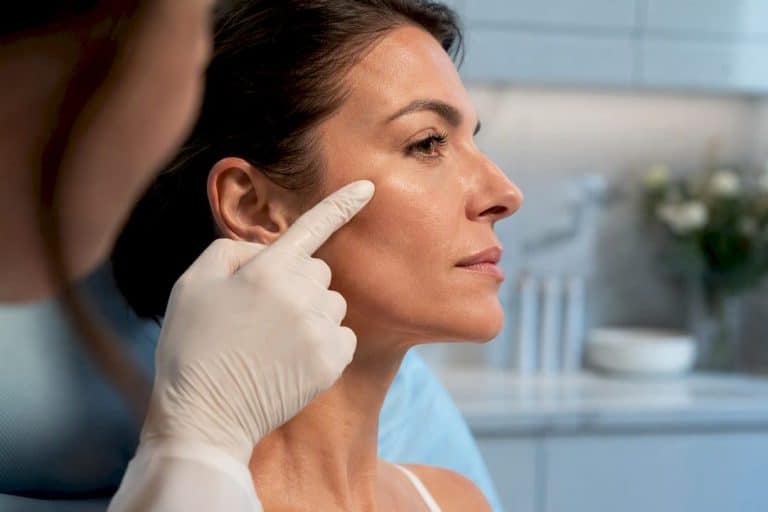
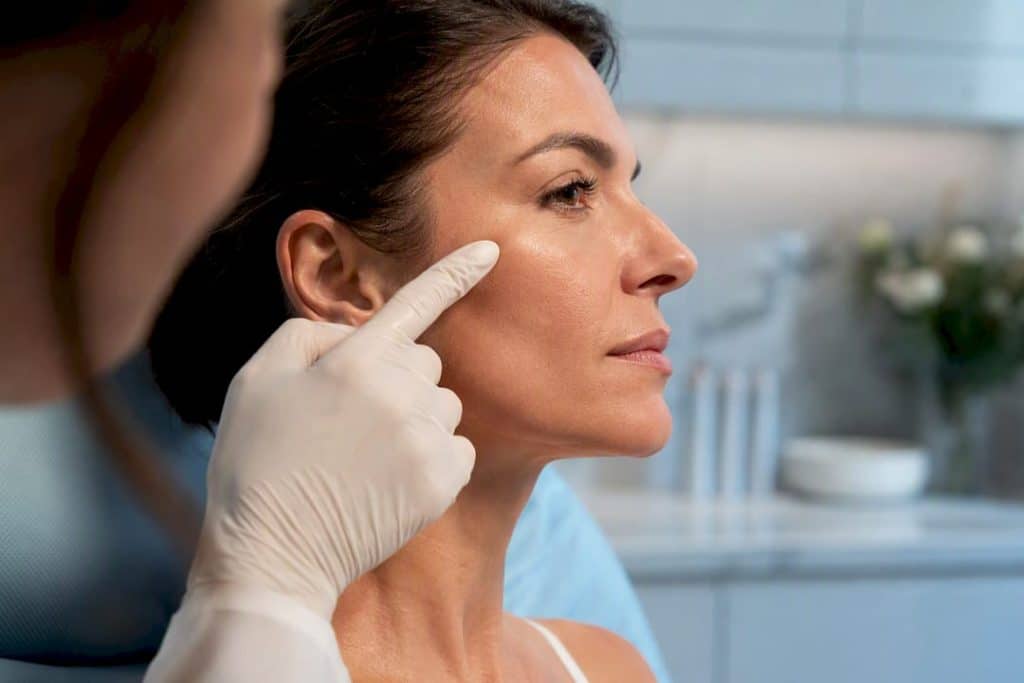
Yes, properly placed cheek filler restores midface projection and can create a natural-looking lift, but the result comes from rebuilding lost volume, not from tightening skin. Most clients see visible change immediately, with results settling into their final shape over several weeks and lasting for an extended period depending on product and placement. The outcome depends heavily on injector skill, filler choice, and honest conversation about risks, including access to hyaluronidase if anything needs correcting.
TL;DR:
- Deep placement of filler near the facial bone in the prezygomatic space or over the zygoma provides the strongest and most stable lift for the midface.
- The effectiveness of cheek filler depends on injector skill, precise targeting of deep anatomical zones, and the use of high G′ hyaluronic acid products that resist deformation.
- Filler placed too superficially in the tissue can create puffiness or worsen jowling rather than produce a natural lift.
- Cheek fillers last between nine months and over a year, with deeper, structural placements tending to maintain results longer.
- A staged, conservative approach with thorough consultation and contingency planning, including hyaluronidase availability, ensures safety and optimal outcomes.
Table of Contents
- How cheek filler creates lift: midface anatomy and the mechanics of volumisation
- Where fillers are placed for lift: target sites and injection planes
- Which filler properties matter for lift: rheology and selection principles
- Who benefits from cheek filler lift: candidacy, limits, and surgical alternatives
- What to expect: appointment steps, swelling timeline, and maintenance
- Safety, risks, and informed consent: what a good clinic does before treating you
- Our approach to a natural midface lift with filler
- Preparing for your consultation: questions worth asking
- Ready to explore a natural cheek lift?
- Sources
- FAQ
How cheek filler creates lift: midface anatomy and the mechanics of volumisation
Cheek filler doesn’t lift the way a surgical facelift does. It works by rebuilding what your face has lost underneath the skin, not by pulling anything tighter.
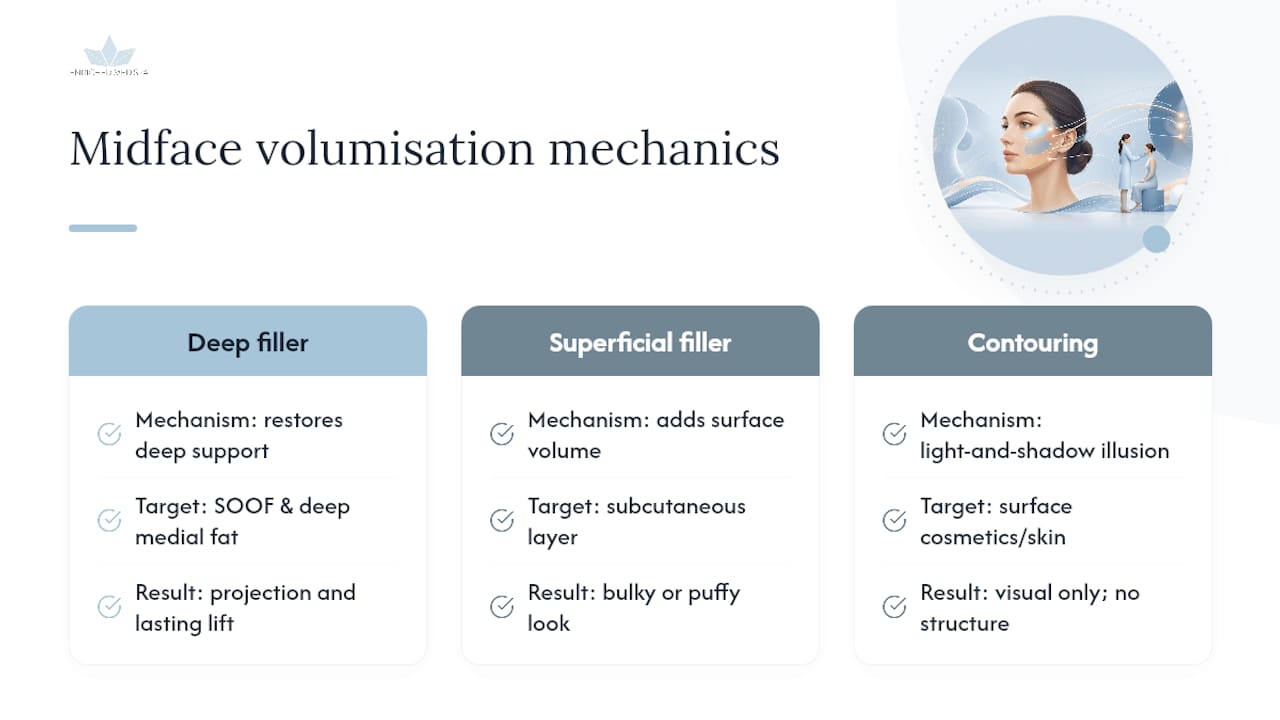
The midface is built in layers: skin, subcutaneous fat, a fibrous membrane called the SMAS, deeper fat compartments, and bone. Two of those deep fat pads matter more than the rest when we talk about cheek filler for lift: the SOOF (suborbicularis oculi fat) and the deep medial cheek fat. These pads sit close to bone, and they’re the first to shrink and drop as collagen production slows in your late 20s and beyond. Many clients come in noticing hollowing under the eyes or a tired, “deflated” look in photos, long before they see actual sagging skin. That hollowing is usually the deep fat pads thinning out, not the skin itself failing.
This distinction matters for how we treat it. Filler placed at the bone level, in or near those deep compartments, re-establishes structural support. The overlying tissue that had started to descend gets a foundation to rest on again, and that reads visually as lift. Filler placed too superficially, in contrast, just adds bulk on top of skin that’s already lost its scaffolding. It can look puffy rather than lifted, and in the wrong hands it produces the overfilled, rounded “pillow face” look that’s become something of a cautionary tale in aesthetic medicine.
Anatomical reviews back this up directly. Injection guidelines built around what researchers call the ATP approach (anatomy, target, and product) recommend multilayer strategies that place deep structural support at the prezygomatic space, paired with lighter superficial shaping only where needed. The deep layer restores projection; the superficial layer refines contour. Skip the deep layer and rely only on surface filling, and you’re fighting gravity with the wrong tool.
This is also why “cheek filler vs contouring” is a slightly misleading comparison. Makeup contouring creates the illusion of structure with shadow and highlight. Cheek augmentation filler creates actual structure, which is why the effect holds up in daylight, in motion, and without a beauty routine attached to it.
Where fillers are placed for lift: target sites and injection planes
Placement is where a cheek filler treatment succeeds or falls short, and it’s the part most patients never get explained to them clearly.
For genuine midface lift, injectors typically work in three related zones:
- The prezygomatic space — a defined pocket just in front of the cheekbone where deep filler placement provides the strongest lifting vector with a relatively low vascular risk profile.
- Deep supraperiosteal injection over the zygoma — filler placed directly on bone under the muscle, giving maximum projection and the most stable long-term support.
- SOOF-proximal placement — targeting the area near the suborbicularis oculi fat pad to correct the tear-trough to cheek transition and soften the “shadow” many clients want gone.
Cadaver-based topography studies have helped injectors map these points precisely, defining safe target zones alongside adverse-event zones so the lifting vector can be planned before the needle ever goes in.
Technique matters as much as location. Some injectors use a fine needle to place small deep boluses at single points; others prefer a blunt cannula that fans filler through tissue with less risk of piercing a vessel. Deep, single-point injections near the medial SOOF have shown strong patient satisfaction for correcting midcheek grooves in published case series, while cannula fanning is often chosen when broader, more diffuse support is the goal.
One safety note worth flagging: injecting too low, too anteriorly, or too superficially near the jawline can push tissue downward and outward instead of up, occasionally worsening the appearance of jowls. This is why an experienced injector maps the zygomatic arch and prezygomatic space before treating lower on the face. Our facial anatomy guide for injectables breaks down these landmarks in more visual detail if you want to understand what your injector is actually assessing during a consult.
Which filler properties matter for lift: rheology and selection principles
Not all fillers behave the same way once they’re under your skin, and the properties that matter for cheek lift are different from the ones that matter for lips or under-eye hollows.
The property injectors talk about most is G′, or elastic modulus, which describes how firm and resistant to deformation a gel is. Higher G′ fillers hold their shape under the weight and movement of facial tissue, which is exactly what you need when you’re trying to support the midface against gravity rather than just fill a fine line. Lower G′, softer fillers are better suited to thin-skinned areas like the lips or tear troughs, where structure isn’t the goal and stiffness would look unnatural.
Two other properties shape the outcome:
- Cohesivity — how well the gel particles hold together as one mass; higher cohesivity resists spreading into unwanted areas and helps maintain a defined contour.
- Hydrophilicity — how much water the gel attracts after injection; more hydrophilic products can swell over the days following treatment, which affects how much filler an injector places at the outset and how they counsel you on the following week.
Most midface treatment today uses hyaluronic acid (HA) fillers, and there’s a practical reason beyond performance: HA is reversible. If a result looks too heavy, sits asymmetrically, or (in rare cases) compromises blood flow, hyaluronidase can dissolve it. Non-HA options like calcium hydroxylapatite exist and offer longer-lasting structural support in some cases, but they can’t be reversed the same way, which is a meaningful trade-off for a first-time midface treatment. Our breakdown of how fillers restore natural facial rejuvenation covers how these product choices play out across different case examples.
Who benefits from cheek filler lift: candidacy, limits, and surgical alternatives
The best cheek enhancement injections candidates share a specific profile: moderate volume loss, skin that still has good elastic recoil, and a realistic sense of what filler can and can’t do.
If you press gently on your cheek and it springs back quickly, your skin likely has enough elasticity for filler alone to produce a clean lift. Clients in their late 20s to mid 40s noticing early hollowing, tired-looking under-eyes, or a loss of that youthful “apple” contour typically fall into this category, and they tend to be thrilled with conservative, well-placed volume.
Skin laxity changes the calculation. When skin has stretched significantly, usually from years of volume loss, sun exposure, or weight change, filler can restore some projection but it can’t take up excess skin the way surgery can. If you’re seeing heavy jowling, significant midface descent, or skin that stays folded rather than recoiling, a surgical midface lift or facelift addresses the actual skin excess in a way injectables were never designed to.
Many clients land somewhere in between, and that’s where combined planning helps. A conservative round of cheek filler paired with radiofrequency skin tightening or later surgical consultation, staged rather than done all at once, often gives a more proportional result than trying to solve everything with volume alone. We generally recommend starting conservative regardless: it’s easier to add more filler at a follow-up than to correct an area that was overfilled from the start.
What to expect: appointment steps, swelling timeline, and maintenance
A cheek filler treatment visit follows a fairly predictable structure, and knowing it in advance takes a lot of the anxiety out of a first appointment.
- Assessment and photography. Your injector examines your face at rest and in motion, takes photos for reference, and discusses your goals against what your anatomy can realistically support.
- Marking and numbing. Injection points get marked based on your specific bone structure and volume loss pattern, then a topical or local anaesthetic is applied.
- Injection. Filler is placed in the planned layers, deep structural support first, superficial shaping second if needed, with the injector checking symmetry and projection as they go.
- Immediate review. You’ll look at the result together in a mirror before leaving, with a plan for any follow-up touch-up once swelling resolves.
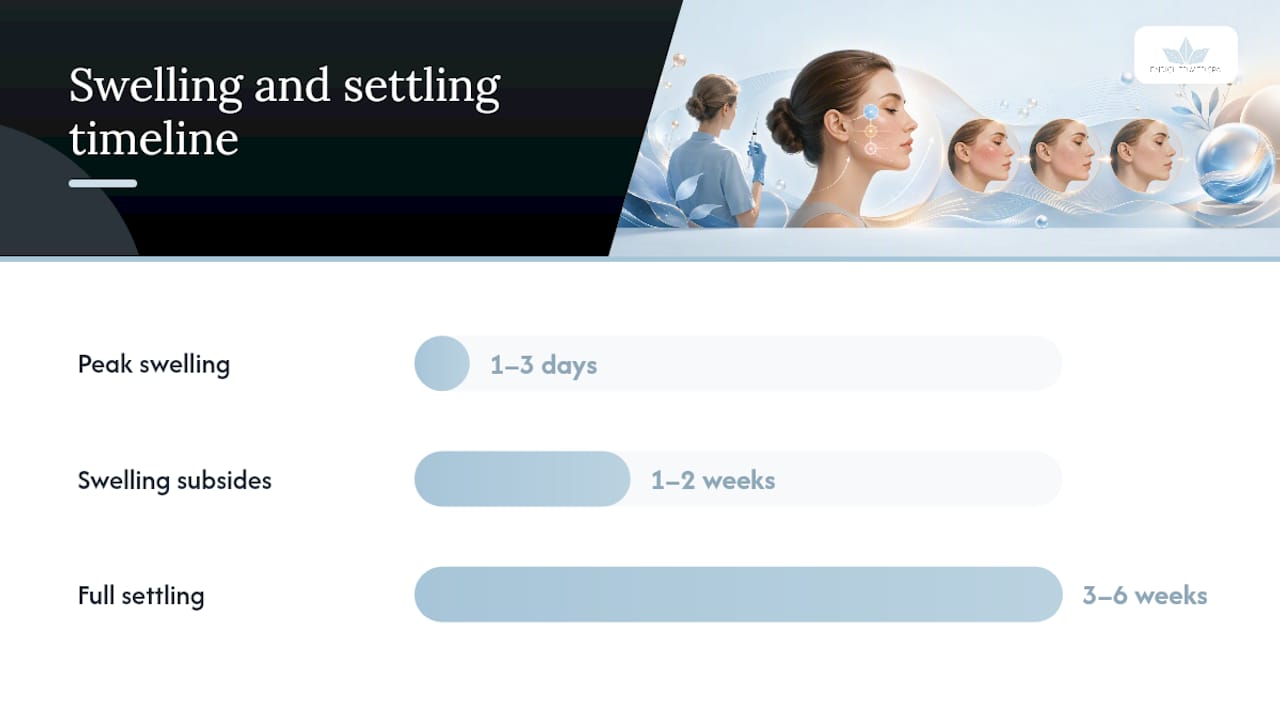
Swelling follows its own timeline, and it’s worth setting expectations here so you don’t panic on day two. Most swelling peaks between 24 and 72 hours after injection, then steadily subsides over the following one to two weeks. Full settling, where the filler has integrated with tissue and any residual puffiness has resolved, generally takes three to six weeks. That’s the point at which you’re seeing the true final result, not before.
As for how long do cheek fillers last: HA midface fillers typically hold their effect for several months to over a year, depending on the product and depth of placement., with deeper, higher-projection placements generally lasting longer than superficial touch-ups. Your metabolism, activity level, and the specific product used all shift that window. Our guide on what to expect after fillers walks through the recovery week in more detail, and our recovery tips cover the small things (sleeping position, sun exposure, skipping the gym for a day or two) that help results settle cleanly.
Safety, risks, and informed consent: what a good clinic does before treating you
Cheek filler is a low-risk procedure in trained hands, but “low-risk” doesn’t mean “no-risk,” and any clinic worth your time will say so plainly.
The most serious complication, vascular occlusion where filler blocks blood flow, is rare but real. In the worst cases it can lead to tissue loss or, extremely rarely, vision changes if filler enters a vessel connected to the ophthalmic artery. Clinical case reviews stress that recognizing early warning signs, like unexpected blanching or severe pain during injection, and having a management protocol ready are what separate a manageable event from a serious one.
A quick safety check: the single most important question you can ask before treatment is whether your provider keeps hyaluronidase on-site and has a documented emergency protocol. This enzyme dissolves HA filler within minutes if a vascular problem is caught early, and its availability is one of the clearest markers of a clinic that treats safety as routine, not an afterthought.
A few other things worth knowing before you book:
- Health Canada has specifically warned that needle-free “hyaluron pen” devices are not authorized for cosmetic injections and carry documented risks of infection and skin damage. Any provider offering needleless filler “pens” is not using a Health Canada approved method.
- Canadian legal and medical-practice reviews emphasize that thorough, documented informed consent, including disclosure of rare severe risks like vascular occlusion, is essential and directly reduces medico-legal risk for both provider and patient.
- Ask directly whether your injector can name the anatomical zone they’re targeting and why. A vague answer is a red flag; a confident, specific one usually isn’t.
Our approach to a natural midface lift with filler
Every cheek filler consultation starts the same way: photographs, a hands-on assessment of your bone structure and skin elasticity, and an honest conversation about what volume can and can’t fix for your face specifically. We map anatomy before we ever plan an injection point, which is what keeps results looking like you, just refreshed, rather than obviously “done.”
We stage treatment conservatively as a default. A first session usually focuses on restoring deep structural volume in the areas that need it most, and we review the result once swelling has settled, typically around the three to six week mark, before deciding whether any additional refinement makes sense. That staged approach gives us room to build gradually and makes any adjustment with hyaluronidase easier if the plan needs a small correction along the way.
Every injector on our team works from documented consent that covers the realistic risks, not just the highlights, and hyaluronidase is kept on-site as standard practice. We’d rather you ask a hard question in the consultation than discover the answer after treatment.
— Felix
Preparing for your consultation: questions worth asking
Walking into a consult with the right questions changes the entire experience, and it tells you a lot about the provider fast.
Ask about their qualifications and how much of their practice is dedicated to injectables specifically. Ask which filler they’re recommending for your case and why, given your anatomy. Ask what their reversal policy looks like if you’re unhappy with a result, and whether hyaluronidase is available on-site. Ask what their emergency plan is if a vascular issue is suspected.
Watch for red flags, too: providers offering needle-free “pen” injections, anyone who can’t clearly explain their consent process, and heavily discounted bulk filler packages that pressure you into more product than you need. Bring reference photos of what you’re hoping to achieve, and go in expecting a staged, conservative first step rather than a total transformation in one visit. That mindset alone tends to produce better outcomes.
Ready to explore a natural cheek lift?
If you’re weighing your options for a non-surgical cheek lift, Enriched Med Spa offers personalized dermal filler consultations built around your own facial anatomy, not a one-size-fits-all injection plan. We use multilayer techniques that place structural support where your midface actually needs it, with conservative staging and documented consent as standard practice, not an upsell. Every client’s assessment includes photography, a real conversation about realistic outcomes, and follow-up scheduled around when your results actually settle. If you’d like to see whether cheek filler is the right fit for your face, you can book a personalized assessment through our dermal fillers page and start with a consultation, not a commitment.
This article is general information, not a substitute for advice from a qualified doctor. Consult a qualified healthcare professional about your own circumstances before acting on anything here.
Sources
- Health Canada notice on unauthorized needle-free dermal filler devices
- Soft tissue filler therapy and informed consent (Canadian legal/medical analysis)
- Injection guidelines for treating midface volume deficiency with hyaluronic acid fillers: the ATP approach
- Liquid malar-lift technique and SOOF-targeted injections
FAQ
Which filler is best for a cheek lift?
Higher G′ hyaluronic acid fillers, placed deep near the bone in the prezygomatic space or over the zygoma, tend to give the strongest lifting effect because they resist deformation and provide real structural support rather than just surface volume.
What kind of filler can lift sagging cheeks?
Deep, structurally firm HA filler placed at the supraperiosteal level or near the SOOF can restore projection and lift moderately sagging cheeks, though significant skin laxity may need surgical correction alongside or instead of filler.
Can cheek filler help lift jowls?
Restoring midface volume can improve the transition from cheek to jawline and soften the appearance of jowling, but filler placed too low or too superficially can actually worsen jowl appearance, which is why precise placement matters.
Where should cheek filler be placed for lift?
For genuine lift, filler is typically placed deep in the prezygomatic space, directly on bone over the zygoma, or near the SOOF, since these deep placements provide structural support rather than surface bulk.
How long does a cheek filler lift last?
HA midface fillers generally last from around nine months to over a year, with deeper, higher-projection placements tending to last longer than lighter, superficial touch-ups.