

Anti-aging injectables are defined as prescription-grade cosmetic treatments that use neuromodulators or dermal fillers to reduce wrinkles and restore facial volume without surgery. The two main categories are neuromodulators, such as Botox, Nucieva, and Xeomin, and hyaluronic acid-based dermal fillers, such as Juvederm and Teosyal. Both are regulated by Health Canada and require a Drug Identification Number (DIN) to be legally sold and administered in Canada. If you are between 25 and 55 and wondering whether these treatments are right for you, this guide explains how each type works, what to expect, and how to stay safe.
What are anti-aging injectables and how do they work?
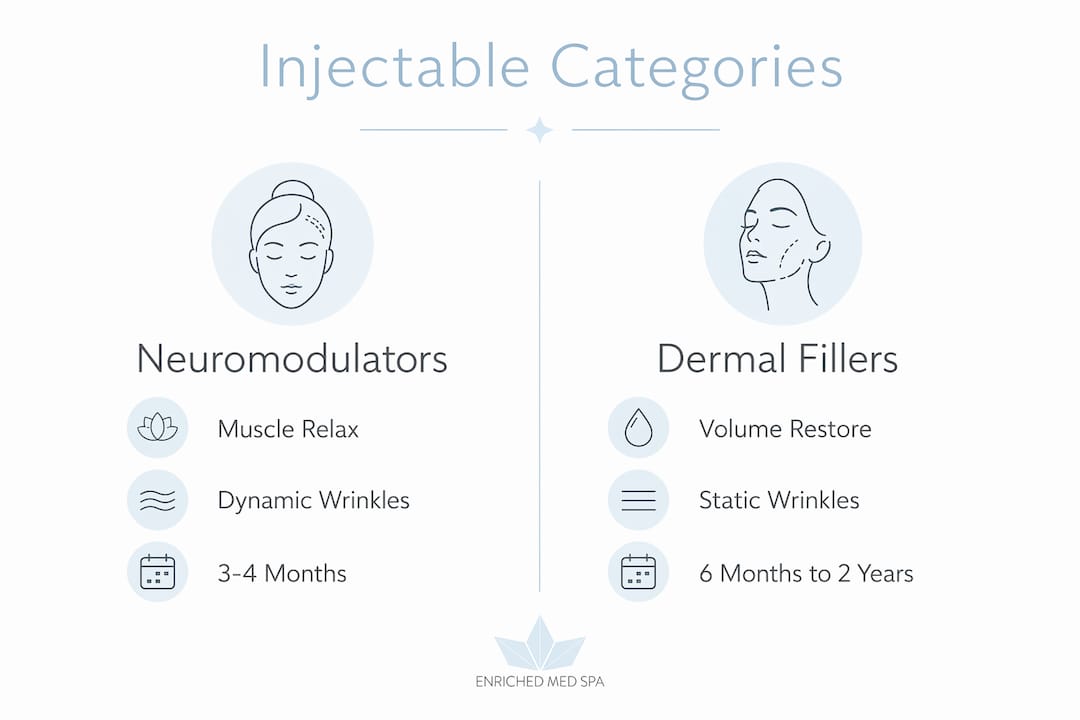
Anti-aging injectables fall into two distinct categories that address ageing differently. Neuromodulators relax the facial muscles that cause expression lines. Dermal fillers add volume beneath the skin to smooth static creases and restore contours that have softened over time. Understanding this difference is the first step toward choosing the right treatment for your goals. For a full overview of both categories, the cosmetic injectables guide at Enrichedmedspa is a useful starting point.
The skin ages through two parallel processes. Repeated muscle movement creates dynamic wrinkles, the lines you see when you smile or frown. Collagen and fat loss creates static wrinkles and hollows that are visible even at rest. Injectables target one or both of these processes depending on which product is used and where it is placed.

How do neuromodulators like Botox reduce wrinkles?
Botox works by temporarily blocking the nerve signals that tell a muscle to contract. When the muscle relaxes, the overlying skin smooths out. The effect is not permanent, which is why maintenance appointments are part of any realistic treatment plan.
The most common treatment areas for neuromodulators include:
- Forehead lines: horizontal creases caused by raising the brows
- Frown lines (glabellar lines): the vertical lines between the brows
- Crow’s feet: the fine lines at the outer corners of the eyes
- Brow lift: a small amount placed under the brow tail can create a subtle lift
- Lip lines and chin dimpling: less common but effective for the right candidate
Botox lasts 3–4 months on average, though first-time patients sometimes notice results fading slightly sooner as their muscles are not yet conditioned to the treatment. Most clients find that with consistent appointments, results become more predictable and may last toward the longer end of that range.
Results appear gradually. You will typically notice the muscle relaxing within 3–5 days, with full effect visible by day 14. Enrichedmedspa recommends a two-week follow-up after your first treatment so any minor asymmetries can be corrected before they become a concern.
Pro Tip: Book your Botox appointment at least 1–2 weeks before a major event. This gives the product time to settle and leaves room for a small touch-up if needed.
Botox, Nucieva, and Xeomin are all Health Canada-approved neuromodulators. They work through the same mechanism but have slightly different protein profiles, which a qualified injector will consider when selecting the right product for you.
How do dermal fillers restore volume and treat static wrinkles?
Dermal fillers are gel-like substances injected beneath the skin to add volume, smooth deep creases, and restore facial contours. The most widely used fillers are hyaluronic acid-based, including Juvederm and Teosyal, because hyaluronic acid occurs naturally in the body and binds water to plump tissue from within. A separate category, collagen stimulators such as Sculptra, works by triggering the body’s own collagen production over several months rather than adding immediate volume.
Common treatment areas for dermal fillers include:
- Cheeks: restoring the lifted, full midface of youth
- Lips: adding definition, volume, or symmetry
- Nasolabial folds: the lines running from the nose to the corners of the mouth
- Under-eye hollows (tear troughs): one of the more technically demanding areas
- Jawline and chin: for definition and facial balance
Hyaluronic acid fillers last 6 months to 2 years depending on the product, the area treated, and your individual metabolism. Lips tend to metabolise filler faster than cheeks. Thicker, more cross-linked gels placed in structural areas like the cheeks generally last longer than softer gels used in delicate areas.
| Filler area | Typical duration | Product type |
|---|---|---|
| Lips | 6–9 months | Soft hyaluronic acid gel |
| Nasolabial folds | 9–12 months | Medium-density gel |
| Cheeks | 12–18 months | Firm, cross-linked gel |
| Under-eyes | 9–12 months | Soft, low-viscosity gel |
| Collagen stimulator (Sculptra) | 18–24 months | Poly-L-lactic acid |
Recovery after filler is generally mild. Swelling and bruising are the most common side effects and typically resolve within 3–7 days. Avoiding blood-thinning supplements like fish oil and vitamin E for one week before your appointment reduces bruising risk. You should also avoid intense heat, exercise, and alcohol for 24–48 hours after treatment.
Pro Tip: Plan filler appointments 2–3 weeks before a significant event. Swelling can be more pronounced than expected, particularly in the lips, and you want to see your final result before the occasion.
The skill of your injector matters more with fillers than with almost any other aesthetic treatment. Anatomical expertise is critical for safe filler placement. Misplaced filler near a blood vessel can cause vascular occlusion, a rare but serious complication that requires immediate treatment. This is why filler should only be administered by a regulated health professional in a clinical setting. You can learn more about how long fillers last and what affects their longevity at Enrichedmedspa.
What are the safety and regulatory standards for injectables in Canada?
Health Canada regulates all injectable cosmetic products sold in Canada. Every legitimate product carries a Drug Identification Number (DIN), which confirms it has been assessed for safety, efficacy, and quality. Asking to see the product packaging and verifying the DIN before your treatment is one of the most straightforward ways to protect yourself.
Health Canada flagged 14 unauthorized peptides in april 2026 that were being marketed online for anti-aging purposes. These products had not been assessed for safety or quality, and their use carries real risk. The same concern applies to counterfeit injectables, which may contain dangerous ingredients, improper dosages, or contaminants.
“Unauthorized or counterfeit injectables may contain dangerous ingredients, improper dosages, or contaminants, posing serious health risks including infection, scarring, and delayed access to appropriate medical care. Every injectable product used in Canada must carry a Health Canada Drug Identification Number. A provider who cannot or will not show you that number is a provider you should walk away from.”
Red flags to watch for when choosing a provider:
- No DIN available or provider is evasive when asked
- Treatment offered in a non-clinical setting such as a home or pop-up event
- Prices significantly below market rate with no clear explanation
- No consultation or medical intake process before treatment
- No follow-up care or complication management plan offered
Reputable providers maintain documented client-specific treatment records, proper product storage protocols, and a clear plan for managing complications. In Ontario, cosmetic injectables must be prescribed and administered or supervised by a regulated health professional. Asking about your injector’s qualifications and scope of practice is not impolite. It is your right as a patient.
Should you combine neuromodulators and dermal fillers?
Combining Botox and dermal fillers addresses both dynamic wrinkles and volume loss at the same time, producing more balanced results than either treatment alone. This approach is sometimes called a liquid facelift, though the term is informal. The logic is straightforward: relaxing the muscles that cause expression lines while simultaneously restoring lost volume creates a more complete and natural-looking result.
A typical combined treatment plan might look like this:
- Consultation: Your injector assesses your facial anatomy, skin quality, and goals. Photos are taken for reference.
- Neuromodulator first: Botox or Xeomin is administered to the forehead, frown lines, and crow’s feet.
- Filler second (same or separate visit): Juvederm or Teosyal is placed in the cheeks, nasolabial folds, or lips depending on your assessment.
- Two-week review: Results are assessed and minor adjustments are made if needed.
- Maintenance schedule: Neuromodulator appointments every 3–4 months; filler top-ups every 9–18 months depending on the area.
Treatment choice depends on facial anatomy and goals, not on age or trends. A 30-year-old with significant volume loss may benefit more from filler than from Botox alone. A 50-year-old with strong muscle activity and minimal volume loss may see better results from neuromodulators first. There is no single formula.
Over-treatment is a real risk. Adding too much filler in one session or treating areas that do not need it produces an unnatural appearance. Subtle treatment aimed at preserving natural expression and anatomical balance consistently produces better long-term outcomes than aggressive approaches. A good injector will tell you what you do not need, not just what they can offer.
Pro Tip: If you are new to injectables, start with one treatment at a time. This lets you understand how your face responds before adding a second product.
For a side-by-side look at how these two treatment types compare, the Botox vs. fillers guide at Enrichedmedspa walks through the key differences clearly.
Key takeaways
Anti-aging injectables work best when the right product is matched to the right problem, administered by a qualified provider using Health Canada-approved products in a clinical setting.
| Point | Details |
|---|---|
| Two distinct categories | Neuromodulators relax muscles; dermal fillers restore volume. They treat different signs of ageing. |
| Duration varies by product | Botox lasts 3–4 months; hyaluronic acid fillers last 6 months to 2 years depending on area and product. |
| Safety requires a DIN | Every legitimate injectable in Canada carries a Health Canada Drug Identification Number. Always ask to see it. |
| Combined treatments produce better results | Using both neuromodulators and fillers addresses dynamic wrinkles and volume loss simultaneously. |
| Injector skill is the most important variable | Anatomical knowledge and clinical oversight determine both safety and the quality of your result. |
What I have learned from watching clients choose injectables
After years of working in medical aesthetics, the pattern I see most often is this: clients who do their research and ask good questions get better results. Not because they know more than their injector, but because they come in with realistic expectations and a clear sense of what bothers them.
The clients who are most satisfied are rarely the ones who asked for the most. They are the ones who trusted a qualified provider to assess their face honestly and recommend only what was genuinely needed. I have seen people come in after treatments done elsewhere, carrying results that looked overdone or uneven, and almost always the problem traces back to either an unqualified injector or a provider who did not take the time to assess properly.
The regulatory piece matters more than most people realise. Unauthorized peptides and counterfeit injectables are not a fringe concern. They show up in real clinics and at real events, and the consequences can be serious. Asking to see a DIN is not an awkward question. It is the most basic form of self-advocacy you can practise before any injectable treatment.
My honest advice: start with a thorough consultation, not a treatment. A good injector will spend time understanding your face before recommending anything. If a provider skips that step and goes straight to a price list, that tells you something important. For those curious about how technology is also changing the anti-aging space beyond injectables, reversing skin ageing with technology offers a useful broader perspective.
— Felix
Injectables at Enrichedmedspa: what to expect
Enrichedmedspa serves clients in Woodbridge and East Gwillimbury, Ontario, offering cosmetic injectables including Botox, Nucieva, Xeomin, Juvederm, and Teosyal. Every product used carries a Health Canada DIN, and all treatments are administered by qualified regulated health professionals. The process begins with a thorough consultation to assess your facial anatomy and discuss your goals before any product is recommended. Follow-up care is built into every treatment plan. If you are ready to learn more about your options, the complete cosmetic injectables guide at Enrichedmedspa covers the full range of treatments, what each involves, and how to prepare.
FAQ
What is the difference between Botox and dermal fillers?
Botox is a neuromodulator that relaxes muscles to smooth dynamic wrinkles, while dermal fillers are gel-like substances that add volume and treat static creases. They address different signs of ageing and are often used together for more complete results.
How long do anti-aging injectables last?
Botox typically lasts 3–4 months, while hyaluronic acid dermal fillers last 6 months to 2 years depending on the product and the area treated.
Are cosmetic injectables safe in Canada?
Health Canada-approved injectables with a valid DIN, administered by a regulated health professional in a clinical setting, are considered safe. Unauthorized or counterfeit products carry serious risks including infection and scarring.
At what age should you start anti-aging injectables?
There is no single correct age. Many clients in their late 20s and early 30s use neuromodulators preventatively to slow the formation of deep expression lines, while others begin in their 40s or 50s for corrective purposes.
How do I know if a provider is qualified to administer injectables in Ontario?
Ask about their regulated health professional designation and request to see the product packaging and DIN before treatment. Reputable providers welcome these questions and maintain clear documentation and follow-up protocols.