
Many people walk into a cosmetic clinic thinking Botox and dermal fillers are essentially the same thing, just different names for the same needle. It’s an understandable assumption, but acting on it can lead to underwhelming results or the wrong treatment for your concerns. These two injectables work in entirely different ways, target different signs of facial ageing, and deliver results that vary in onset, duration, and appearance. Understanding these distinctions is the first step toward making a confident, informed decision about your own aesthetic journey.
Table of Contents
- What is the main difference between Botox and fillers?
- Where and when should you use each treatment?
- How quickly will you see results and how long do they last?
- What do Botox and fillers cost?
- What are the risks and myths about these treatments?
- A fresh perspective: why your goals, not trends, should guide your treatment choice
- Discover your optimal injectable solution with expert guidance
- Frequently asked questions
Key Takeaways
| Point | Details |
|---|---|
| Distinct mechanisms | Botox relaxes facial muscles for wrinkle reduction, while fillers restore lost volume and shape. |
| Tailored use | Botox is best for dynamic lines, fillers for volume loss—both can be combined for a natural look. |
| Different results timelines | Fillers show results immediately; Botox typically takes 3–14 days, with duration varying between products. |
| Cost varies by area | Expect Botox sessions to range from $250–600 and fillers from $600–1800 per treated area. |
| Safety with expertise | Both are safe when administered by qualified professionals, with most side effects being minor and brief. |
What is the main difference between Botox and fillers?
With clarity on why these treatments are often mistaken for one another, let’s look closer at exactly how Botox and fillers act beneath the skin.
At the most fundamental level, Botox and dermal fillers are two very different types of products. Botox is a neuromodulator (botulinum toxin type A) that temporarily relaxes facial muscles to reduce dynamic wrinkles, meaning the lines caused by repeated expressions such as forehead creases, crow’s feet, and frown lines between the brows. It does not fill anything. It simply quiets the muscle so the overlying skin can smooth out.
Dermal fillers, on the other hand, are gel-like substances injected directly into the tissue to restore volume, define contours, and smooth out lines that exist even when your face is at rest. The primary mechanical difference is that Botox blocks nerve signals at the neuromuscular junction to prevent muscle contraction, while fillers provide physical volume and structural support without touching the muscles at all.
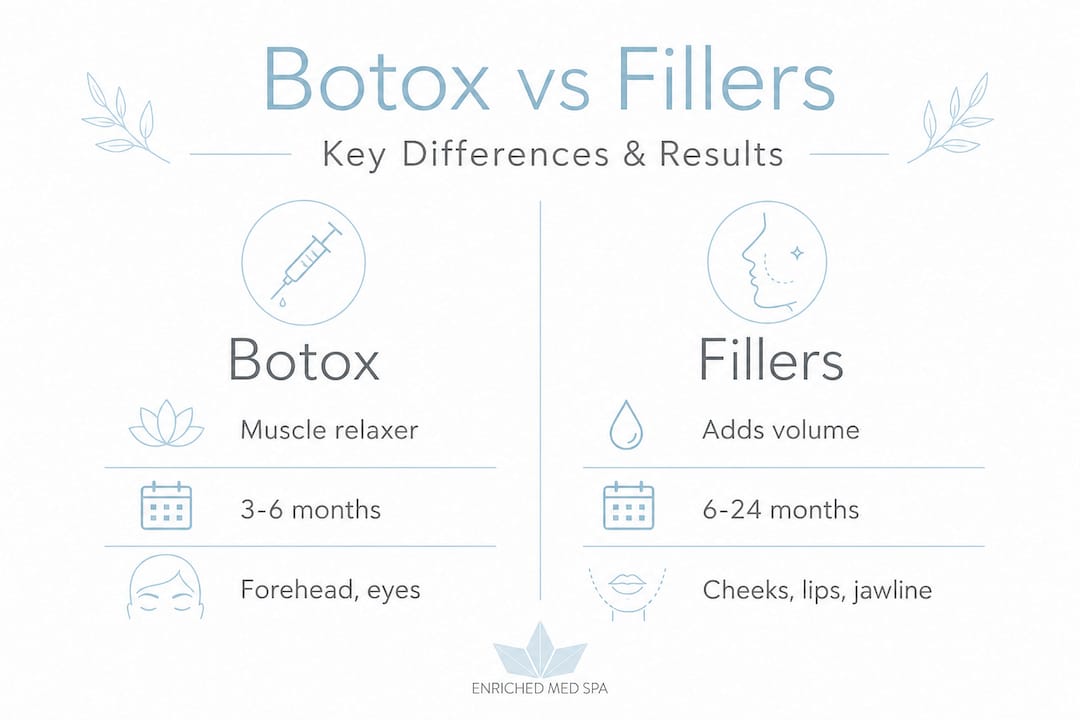
When you explore comparing Botox and fillers side by side, the distinction becomes very clear. Here is a quick overview:
| Feature | Botox | Dermal fillers |
|---|---|---|
| Mechanism | Relaxes muscles | Adds volume and structure |
| Target | Dynamic wrinkles | Static wrinkles and volume loss |
| Common areas | Forehead, crow’s feet, frown lines | Lips, cheeks, nasolabial folds, jawline |
| Result onset | 3 to 14 days | Immediate |
| Duration | 3 to 6 months | 6 to 24 months |
Key uses for each treatment:
- Botox works best for expression lines that appear when you smile, squint, or raise your brows. It is also used to treat excessive sweating, jaw clenching, and even migraines.
- Dermal fillers work best for cheek augmentation, lip plumping, correcting deep folds, and restoring facial contours lost through natural ageing.
- Both together can address the full spectrum of facial ageing, targeting muscles and soft tissue simultaneously.
Choosing your injectable should always begin with understanding which type of concern you are treating. Trying to fill a dynamic wrinkle with filler alone, for example, often leads to unsatisfying results because the underlying muscle movement continues to create the line.
Where and when should you use each treatment?
Now that you grasp how these injectables work, it’s important to understand where each shines and when you might need one or both.
Location matters enormously in injectable planning. The upper face, which includes the forehead, the area between the brows (the glabella), and the outer corners of the eyes, responds beautifully to Botox because these lines are almost exclusively caused by muscle movement. The mid and lower face, including the cheeks, lips, chin, and jawline, is where volume loss tends to show up most, making fillers the stronger choice in those zones.
Here is a practical, region-by-region guide:
- Forehead lines: These horizontal creases develop from years of raising your eyebrows. Botox relaxes the frontalis muscle, softening these lines significantly.
- Crow’s feet: The fine lines that fan out from the outer corners of your eyes are classic Botox territory, caused by squinting and smiling.
- Frown lines (11s): The vertical lines between your brows are among the most common Botox treatment areas, especially for preventative care in your late twenties and thirties.
- Cheeks: Volume in the cheeks naturally diminishes with age, causing a flat or hollow appearance. Fillers such as Juvederm or Teosyal restore lift and fullness here.
- Lips: Fillers add definition, hydration, and gentle volume without the overdone look when administered correctly.
- Nasolabial folds: These are the lines running from the nose to the corners of the mouth. Fillers soften these creases by restoring the underlying structural support.
Botox is ideal for preventative anti-ageing in those aged 25 to 55 with dynamic lines in the upper face, while fillers address volume loss in the mid and lower face. For many clients, combining both produces the most balanced and naturally refreshed outcome. This dual approach addresses both the muscular and structural aspects of ageing simultaneously, which is exactly why so many providers now recommend it.
If you’re interested in how natural facial rejuvenation with fillers works across different face shapes and ages, it is worth exploring the options with a skilled injector before making any decisions.

Pro Tip: Book a consultation before committing to any specific treatment. A qualified injector will assess your face at rest and in motion, take note of your concerns, and recommend a personalised plan. Coming in with a list of your top three concerns is a great way to start that conversation productively.
When you focus on matching treatments to needs rather than trends, results look more natural and last longer. Age-related guidance matters here too. In your mid-twenties, Botox can prevent lines from becoming etched into the skin. In your forties and fifties, a combination of Botox and strategic filler placement is often the most effective approach for an overall renewal.
How quickly will you see results and how long do they last?
Understanding placement and purpose leads naturally to a vital question: when will you see improvements, and how long will they last?
This is where the two treatments diverge quite noticeably. Botox results appear in 3 to 14 days after treatment, with most clients noticing a difference around the five to seven day mark. Fillers, by contrast, produce results that are visible immediately, though minor swelling in the first 24 to 72 hours may temporarily affect the appearance.
Here is a comparison at a glance:
| Factor | Botox | Dermal fillers |
|---|---|---|
| Onset of results | 3 to 14 days | Immediate |
| Peak results | 10 to 14 days | 2 to 4 weeks (once swelling settles) |
| Duration | 3 to 6 months | 6 to 24 months |
| First-timer note | May wear off faster initially | Results are still immediate |
Factors that influence how long results last:
- Metabolism: Those with faster metabolisms often find Botox wears off closer to the three-month mark. Regular sessions gradually extend the duration as muscles become conditioned.
- Lifestyle habits: Sun exposure, smoking, and significant weight fluctuation can shorten the longevity of both treatments.
- Filler type: Filler result duration varies by product. Hyaluronic acid (HA) fillers such as Juvederm typically last 6 to 18 months, while collagen-stimulating fillers may provide results for two years or more.
- Treatment area: Areas with more movement, such as the lips, tend to break down filler faster than less mobile areas like the cheeks.
Botox typically lasts 3 to 4 months, with some clients seeing effects for up to 6 months, particularly after multiple consistent treatments. First-time Botox clients often experience a slightly shorter duration, which is entirely normal. Understanding Botox duration helps set realistic expectations from the very first session.
Pro Tip: Schedule your Botox appointment roughly two weeks before a major event. This gives the product time to fully settle and ensures you look your best for photos. For fillers, allow at least four weeks if possible so any residual swelling has completely resolved. You can learn more about Botox results timing to plan your treatment calendar accordingly.
What do Botox and fillers cost?
Equipped with knowledge of the effects and duration, it’s common to compare what these services might mean for your budget.
Cost is one of the most frequently asked questions we hear, and rightfully so. Understanding what you’re investing helps you plan and avoids any surprises. Botox typically costs $10 to $20 per unit, with sessions ranging from $250 to $600. Fillers generally run $500 to $900 per syringe, with total costs per area ranging from $600 to $1,800 depending on how much product is needed.
| Treatment | Unit cost | Typical session cost |
|---|---|---|
| Botox | $10 to $20 per unit | $250 to $600 |
| Dermal fillers | $500 to $900 per syringe | $600 to $1,800 per area |
Key financial considerations before your first appointment:
- Multiple syringes are common: Achieving natural-looking lip, cheek, or jawline results often requires more than one syringe, which affects overall cost.
- Treatment area size matters: A single area like crow’s feet may cost less than a full upper face treatment with Botox.
- Frequency adds up: Botox requires maintenance every three to six months. Fillers, while lasting longer, still need periodic touch-ups.
- Quality over price: Choosing a provider based on the lowest price is rarely the wisest approach for injectable treatments. Experience and technique directly influence outcomes.
“Investing in your appearance should feel good, not stressful. Understanding the costs upfront allows you to plan treatments that align with your goals and your timeline, rather than rushing into decisions based on a promotion alone.”
For a thorough look at what to expect financially, our detailed filler cost breakdown walks through exactly what influences pricing. If you’re still weighing your options, deciding based on cost alongside your aesthetic goals is always a smart approach.
What are the risks and myths about these treatments?
With cost and procedure details in mind, it’s essential to separate fact from fiction and address any stigma or social misconceptions.
Both Botox and dermal fillers are very well-studied treatments with strong safety profiles when performed by trained medical professionals. That said, understanding the realistic risks helps you go into your appointment with appropriate expectations.
Common, typically mild side effects include:
- Bruising and swelling at the injection site, which usually resolve within a few days
- Temporary redness or tenderness, particularly with fillers
- Minor asymmetry that often corrects itself as the product settles
- Headache following Botox, which is uncommon and usually brief
More significant complications are rare but do exist, which is precisely why provider experience and credentials matter so much. Always ensure your injections are performed by a regulated healthcare professional in a clinical setting.
“Some experts take issue with the term ‘filler’ because it implies simply stuffing volume into a face. In skilled hands, these products are used for sculpting and structural refinement, not just filling space.”
This distinction matters because it ties directly into the social media myths that have given injectables an unfair reputation. The over-treatment backlash seen online often reflects poorly calibrated treatments rather than the treatments themselves. When done thoughtfully, results are subtle, proportionate, and genuinely flattering. The “frozen face” or “pillow cheek” look is not inevitable. It is a result of technique and volume choices, not the products themselves.
Combining Botox and Juvederm strategically can actually mimic a surgical facelift result without any incisions, and when the balance is right, no one needs to know you’ve had anything done at all.
A fresh perspective: why your goals, not trends, should guide your treatment choice
We see it regularly. A client arrives with a saved photo from Instagram, asking for “that look.” Sometimes the treatment in the photo is even mislabelled. What we’ve learned over years of practice is that chasing a trend in aesthetics is almost always a shortcut to disappointment. Faces are unique. Bone structure, skin quality, muscle strength, and proportions all influence what works and what doesn’t for any given person.
Social media has created the illusion that injectable treatments are one-size-fits-all, but the opposite is true. A lip technique that looks stunning on one face shape may look entirely out of place on another. Volume that beautifully lifts one client’s midface might overwhelm a smaller face structure. This is not a reason to avoid treatment. It’s a reason to invest in a thorough consultation with someone who will look at you as an individual, not apply a template.
The science of cosmetic injectables has also advanced significantly. Providers now approach the face in three dimensions, considering how fat pads shift, how bones change, and how the skin responds over time. A well-planned treatment at thirty looks different from one at fifty, not because the goal changes, but because what the face needs changes. Ongoing evaluation at each visit allows for adjustments that keep results looking natural over the years.
Our honest advice: be transparent with your injector about what you love about your face and what you’d like to gently change. The best results come from tailoring treatment decisions to your unique anatomy and personal goals, not to what’s trending this month.
Discover your optimal injectable solution with expert guidance
If you’ve made it this far, you already have a much clearer picture of what Botox and dermal fillers can do, and more importantly, what each one is actually designed for. At Enriched Med Spa, we work with clients across Woodbridge and East Gwillimbury to build personalised injectable plans that respect your natural features and reflect your individual goals. Whether you’re curious about beginning with Botox, considering a detailed comparison of your options, or ready to explore dermal fillers, our team is here to guide you at every stage. Book a consultation today and take the first confident step. You can also learn more about our Botox in Woodbridge services and what to expect during your visit.
Frequently asked questions
Is Botox or filler better for preventing wrinkles?
Botox is more effective at preventing new wrinkles by relaxing the muscles that cause expression lines, while fillers address existing volume loss rather than preventing new lines. As research confirms, Botox is ideal for preventative anti-ageing in the upper face for those aged 25 to 55.
How do I know if I need Botox, filler, or both?
If wrinkles appear when you move your face and fade at rest, Botox is likely the right choice. If lines are visible at rest or you notice hollowing and volume loss, fillers or a combination may serve you better. As noted by medical experts, Botox relaxes muscles causing dynamic wrinkles while fillers restore lost volume and smooth static lines.
Are Botox and fillers safe?
Both treatments are considered safe when performed by a trained, experienced medical provider. Side effects such as bruising and swelling are typically mild and temporary when procedures are done correctly.
Which lasts longer, Botox or fillers?
Fillers generally last longer. Botox lasts 3 to 6 months, while most dermal fillers remain effective for 6 to 24 months depending on the type and area treated.
How much does Botox or filler cost in Woodbridge or East Gwillimbury?
Botox typically costs $250 to $600 per session, while fillers range from $600 to $1,800 per area. Current cost benchmarks show Botox at $10 to $20 per unit and fillers at $500 to $900 per syringe, with multiple syringes sometimes needed.
Recommended
- Botox vs. Fillers: What’s the Difference?
- Botox vs. Fillers: Which One is Right for You? – Botox Laser Hair Removal OxyGeneo Medi Facial Microneedling – Enriched Med Spa – Vaughan Woodbridge Maple Vellore Village
- Dermal Fillers vs. Botox: Which Suits Your Needs? – Botox Laser Hair Removal OxyGeneo Medi Facial Microneedling – Enriched Med Spa – Vaughan Woodbridge Maple Vellore Village
- Dermal Fillers vs. Botox: Which Suits Your Needs? – Botox Laser Hair Removal OxyGeneo Medi Facial Microneedling – Enriched Med Spa – Vaughan Woodbridge Maple Vellore Village