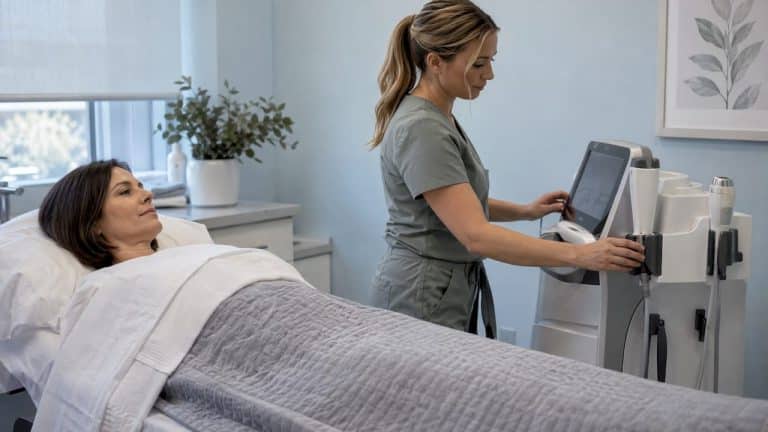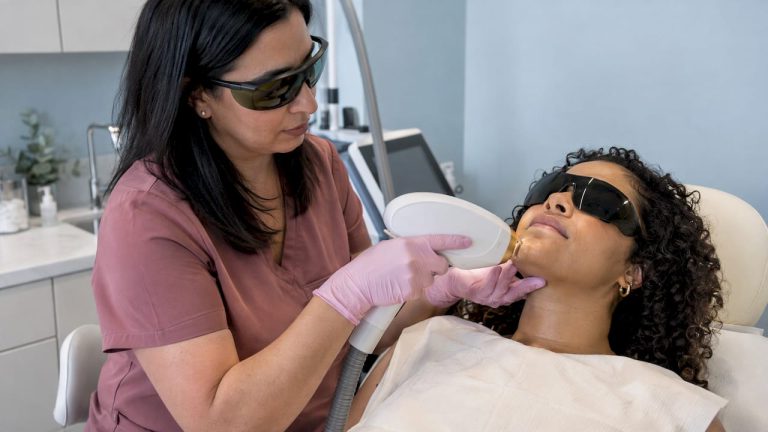
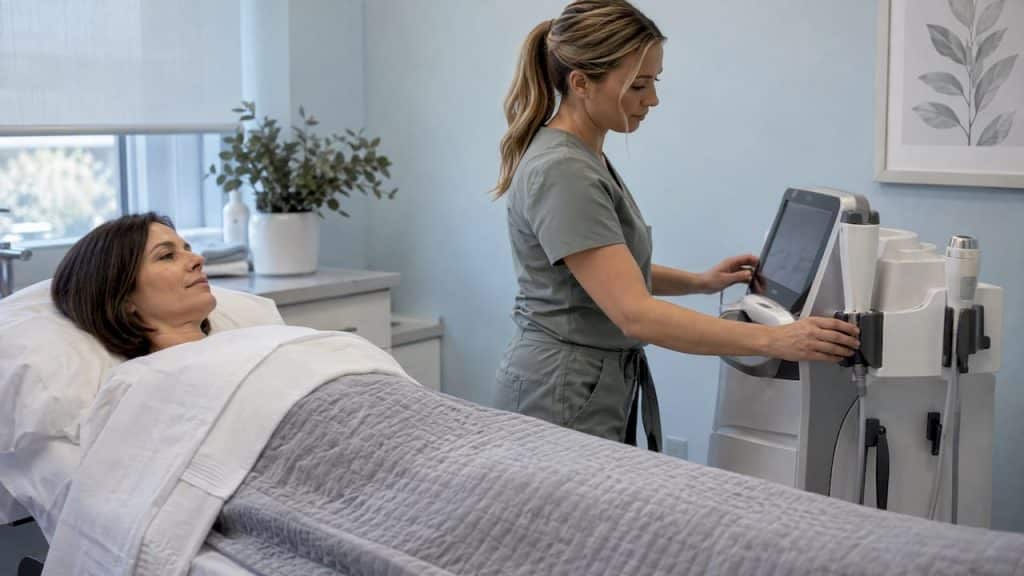
Radiofrequency (RF) skin tightening warms the deeper layers of skin so your body builds new collagen, which is why it is used on softer, looser areas such as the lower abdomen and the upper arms. It is gradual, it needs no surgery, and it works best when the area, the device and the number of sessions are matched to your skin during a proper consultation. At Enriched Med Spa in Woodbridge, our radiofrequency skin tightening (TriPollar) is performed by experienced nurse-level injectors and aestheticians, and the plan starts with a conversation about what you want to change.
Below, we walk through how RF works, what the research says about the stomach and arms, how many sessions to plan for, and who should not have it.
TL;DR
- RF heats the dermis (the layer under the surface) to tighten existing collagen and prompt new collagen over about 3 to 4 months, so results build slowly.
- Both the abdomen and the upper arms are well-studied areas for RF, with the best-documented outcomes in mild to moderate looseness.
- Plan for a series of sessions rather than one, and for visible change over two to six months.
- Pacemakers, pregnancy and breastfeeding, and metal implants in the area are among the reasons RF is not suitable.
- A consultation is where area, device and number of sessions are decided for your skin.
Table of Contents
- How RF tightens skin
- Why the abdomen and arms are common areas
- Results and timeline you can plan around
- Is RF right for your abdomen or arms?
- Side effects and safe use
- Health Canada and the device in the room
- What the first visit looks like
- Booking radiofrequency skin tightening in Woodbridge
- Our perspective
- FAQ
- Sources
How RF tightens skin
RF is an electromagnetic current. As it passes through tissue, the tissue’s natural resistance turns it into heat. According to a 2020 review of RF in aesthetic medicine, this does not depend on skin colour or pigment, and it acts in two ways.
First, the heat immediately loosens the bonds in collagen fibres, which shortens and thickens them. That is the quick, mild tightening some people notice soon after a session. Second, the warmth sets off the skin’s repair response: new blood vessels, new collagen and reorganized elastin develop over roughly three to four months.
Temperature matters. A 2025 review of RF skin rejuvenation technology notes that collagen begins to denature at about 40°C to 48°C, and that a gentler temperature held for longer (around 43°C for three to five minutes) is recommended to remodel collagen while keeping burn risk low. That is why a well-run session is slow and steady, with the skin warm rather than hot.
The same review explains that fat resists the current more than most tissues and therefore heats the most. On the abdomen, where the layer of fat under the skin is thicker, depth and energy control are what separate a comfortable, effective treatment from a poor one. This is a skill of the practitioner, not just the machine.
Why the abdomen and arms are common areas
The stomach and upper arms are places where skin tends to lose firmness quietly. Many clients come in after pregnancy, after weight changes, or simply noticing that the skin above the waistband or the back of the arms feels softer and less defined than it used to. These are the areas where RF is most often discussed for the body.
The 2020 review states that monopolar RF has been used for noninvasive tightening of the abdomen and extremities. The same paper reports a bipolar RF body study covering the arms, the area above the navel, the thighs and the underarm rolls, with about 40% clinical skin contraction. It also describes a related 40-patient study in which three independent plastic surgeons rated arm contouring improvement as good to excellent 80% of the time.
What the abdominal research shows
A 2025 clinical study of 17 postpartum women with mild to moderate abdominal laxity used three RF microneedling sessions eight weeks apart. The women showed significant improvements in skin elasticity, viscoelasticity (how well skin springs back) and ultrasound measures of skin density, and 80% reported being satisfied. No serious treatment-related adverse events were recorded.
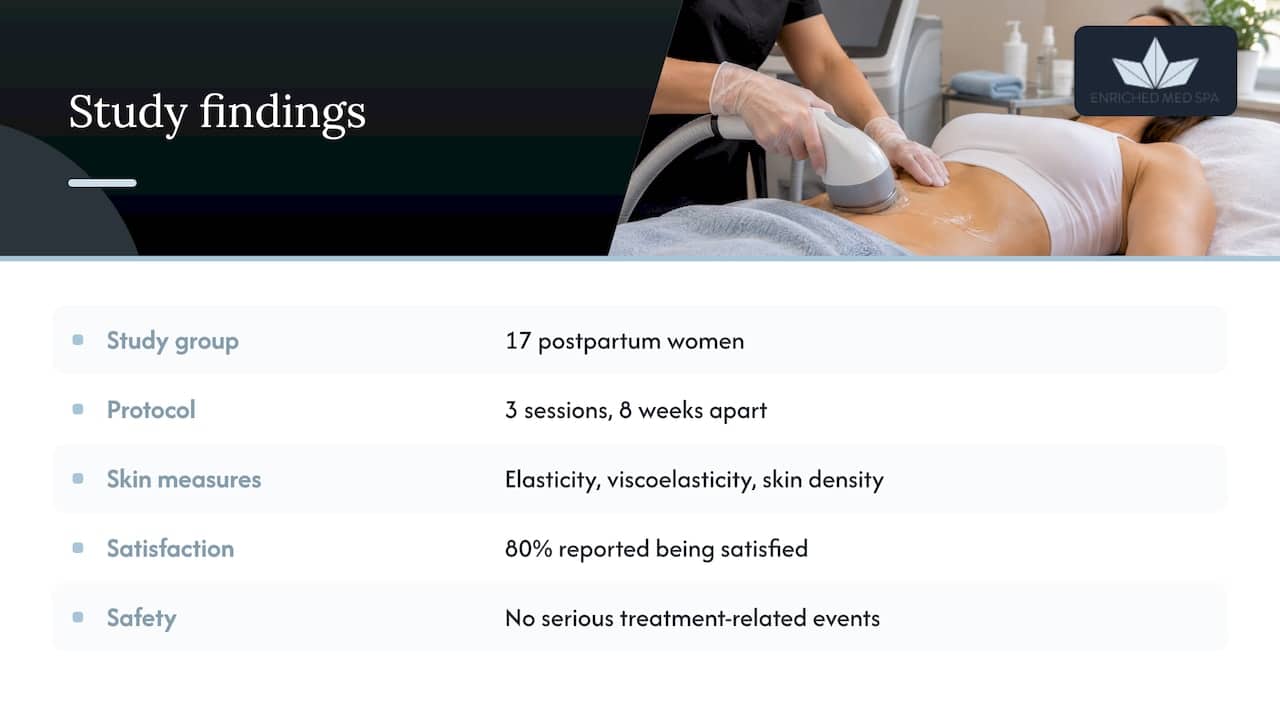
This is encouraging for a very common concern, though it is one study of a small group. It is a reason to plan a short series and measure progress over months, not a promise of a particular outcome.
What the arm research shows
In a 2021 study of 31 women treated with a single fractional RF microneedling session for body laxity, investigators assessed improvement in every participant at one, three and six months for the upper arms and bra-line area. Temporary redness appeared after 69% of treatments and swelling after 46%, both of which are expected and settle.
Older case work points the same way. In a 2007 case report, a woman in her sixties had each upper arm treated with a different RF system. One arm showed better texture and less crinkling at two months after a single long session, while the other became firmer after a series of treatments two weeks apart. The practical lesson is that the device and protocol shape how many visits you need.
Results and timeline you can plan around
RF is a build-over-time treatment. Here is a realistic picture, in the order you will experience it.
- Right after a session: the skin may look slightly pink and feel warm. Mild swelling is common and short-lived.
- First few weeks: some people notice a subtle firmness from the immediate collagen contraction.
- Two to six months: Cleveland Clinic describes changes in skin tone and appearance appearing in this window as new collagen forms.
- Beyond six months: a 2022 systematic review of monopolar and bipolar RF found measurable improvement in skin laxity of the face and body, with an acceptable complication profile in which most complications were minor and transient.
How many sessions? It depends on the device and on how much laxity you have. Training material for one Canadian RF microneedling device, for example, recommends three to five treatments four to six weeks apart for mild to moderate laxity, with continued improvement over six to twelve months. Other technologies use more frequent, shorter sessions. We set the number of visits for you after assessing your skin, and we will say plainly if your concern calls for a different approach.
Skin keeps ageing after treatment, so maintenance sessions are a normal part of keeping results. We talk through that rhythm with you from the start so there are no surprises.
A quick comparison with lighter options
| Approach | What it does | Best suited to | Typical pace |
|---|---|---|---|
| Chemical peels and facials | Refresh the surface: texture, tone, glow | Dullness, mild texture concerns | Visible within days to weeks |
| Microneedling | Creates tiny channels to stimulate repair | Texture, scars, early laxity | Series of sessions |
| RF skin tightening | Heats the dermis to firm and build collagen | Softness and mild to moderate looseness | Gradual over 2 to 6 months |
| Surgery | Removes excess skin | Significant excess skin | Not part of what we offer |
Lighter treatments improve how skin looks on the surface. RF works on how it holds together underneath, which is the reason it is the one we raise when firmness, not just glow, is the concern.
Is RF right for your abdomen or arms?
Good candidates are usually people with mild to moderate looseness who want a non-surgical option and are happy with a gradual change. A typical profile is the client in her thirties or forties a year or two after a baby, or a man who has lost weight and notices the skin has not fully followed. A wedding or a trip months away can also be a good motivator, because the timeline lets collagen build before the event.
The research is also clear about who should hold off. These points matter for safety, and your practitioner will go through them at consultation.
- Pacemakers and defibrillators: the 2009 review of RF therapy lists implanted pacemakers or defibrillators as absolute contraindications for monopolar RF.
- Pregnancy and breastfeeding: both are listed among relative contraindications in that review, and a 2023 clinical overview of body contouring also advises against treating people who are pregnant or lactating.
- Metal implants in the treatment area, active skin infections, and some medical conditions: Canadian device training material lists these, along with keloid tendency, diabetes, bleeding disorders and recent isotretinoin use, as reasons to defer or avoid RF microneedling.
- Autoimmune or collagen vascular disease, smoking, and some anti-inflammatory medication: the 2020 review lists these as factors that can affect how skin responds.
- Recent peels or laser resurfacing in the area: treated as a relative reason to wait.
If any of these apply to you, speak to your family doctor or specialist before booking, and tell us at your consultation so we can plan around it. Remove metal jewellery before treatment, as the same 2009 review recommends.
Side effects and safe use
Most people experience temporary redness and mild swelling. A 2023 overview of RF body contouring describes transient redness and swelling as common, and blistering, scarring and contour changes as rare. In the postpartum abdominal study mentioned above, minor reactions in the first week included redness, swelling, a burning sensation, itching and occasional scabbing.
A consensus panel of eight international aesthetic dermatology experts stressed in 2019 that careful patient selection, pre-treatment counselling, treatment planning and good technique are what make outcomes reproducible. That is the thinking behind our consultation first approach.
A few habits help your skin recover well:
- Avoid heat such as saunas, hot yoga and very hot showers for the first day or two, or as advised for your device.
- Keep the area moisturized and use broad-spectrum SPF if it is exposed to sun.
- Do not pick at any scabs or crusting.
- Contact us if you notice blistering, unusual pain or colour change that does not settle.
Health Canada and the device in the room
In Canada, RF devices are regulated as medical devices. A guide to Health Canada’s classification explains that non-invasive RF skin-tightening devices start at Class II, and move to Class III where the energy delivered is potentially hazardous. Licensed platforms exist for body and face; for example, one manufacturer announced Health Canada certification of its RF platform for skin tightening in May 2025.
What this means for you is simple: treatment should be done with a licensed, professional-grade device by a trained clinician who adjusts energy and depth to your anatomy. If you want to understand the technology in more depth, our guide on how radiofrequency skin tightening works goes step by step, and RF skin tightening results covers timelines in more detail.
What the first visit looks like
The visit is a conversation before it is a treatment. We look at the area, ask about pregnancies, weight changes, medications and your health history, and talk about what you hope to see. We then recommend whether RF suits you, and whether a lighter option such as a peel or microneedling (listed at $359) would serve you better or work alongside it.
To help you prepare, bring photos of how the area looked when you were happiest with it, tell us about any upcoming events, and note any implants or devices. If you are comparing non-surgical options for the whole body, our overview of non-invasive body contouring lays out how they differ.
Booking radiofrequency skin tightening in Woodbridge
Enriched Med Spa offers Radiofrequency/Skin Tightening (TriPollar) alongside medical-grade skin treatments, with care from experienced nurse-level injectors and aestheticians. Pricing for this treatment is not published online, because it depends on the area and the plan we build with you. You can see the full list on our services page and book a consultation to talk through your abdomen or arms.
Our perspective
Many clients arrive telling us they are not unhappy with their body, just with how one area feels. That is a good place to start, because it means the goal is realistic: firmer, smoother skin that still looks like yours.
We believe RF is at its best when it is chosen for the right person. That means asking about your history, explaining the timeline honestly, and building a plan with spacing, aftercare and maintenance in mind. Collagen takes months to build, and we would rather you understand that on day one than be surprised on day thirty.
Our approach is patient-first and personalized. We would like you to leave a consultation knowing what we recommend, why, and what to expect at each stage.
Felix
FAQ
Can RF skin tightening treat the stomach after pregnancy?
It is commonly considered for mild to moderate postpartum looseness. A 2025 study of 17 postpartum women found improved skin elasticity after three RF sessions. If you are pregnant or breastfeeding, RF is not suitable, so timing matters and we will go through it with you.
Does RF skin tightening work on the upper arms?
Yes, the upper arms are a studied area. A 2020 review reports about 40% clinical skin contraction in a bipolar RF body study that included the arms. Results build gradually and depend on how much laxity you start with.
Is it painful?
Most people describe warmth rather than pain, and the skin may look pink afterwards. Comfort varies by device and area, and we adjust energy to keep you comfortable. Tell your practitioner straight away if anything feels too hot.
How long until I see a difference?
Some people notice mild firmness soon after, but the main change appears over two to six months as new collagen forms, according to Cleveland Clinic. If you are planning around an event, it is best to start several months ahead.
Sources
- The Use of Radiofrequency in Aesthetic Surgery (PMC, 2020)
- The Landscape of Radiofrequency Technology for Skin Rejuvenation (PMC, 2025)
- Cleveland Clinic: Radio Frequency (RF) Skin Tightening
- Open single-arm clinical study of postpartum abdominal laxity (2025)
- Single treatment protocol with microneedle fractional RF (PMC, 2021)
- Mayoral, skin tightening case reports (2007)
- Systematic review of minimally invasive skin tightening (2022)
- Clinical training material for RF microneedling in Canada (2023)
- Skin rejuvenation by radiofrequency therapy (2009)
- Nonsurgical body contouring with energy devices (Medicine Today, 2023)
- Consensus recommendations for 4th generation monopolar RF (2019)
- Aesthetic device classification in Canada
- Health Canada certification of an RF platform (May 2025)