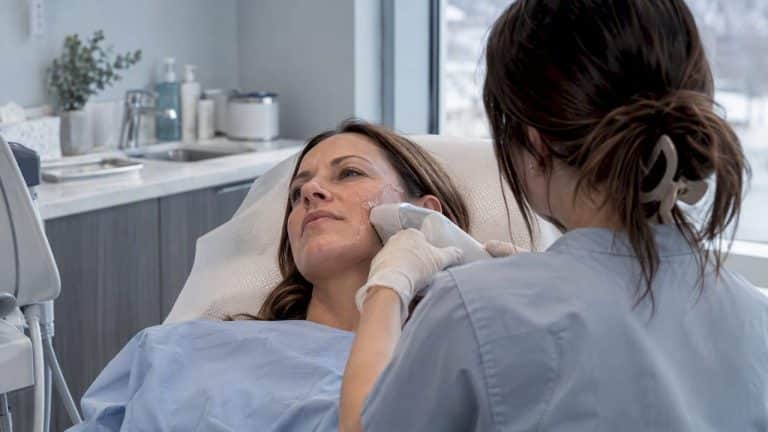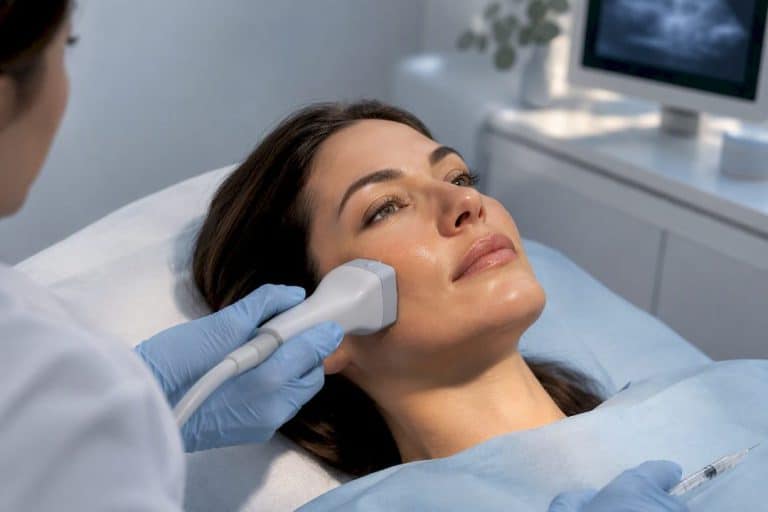
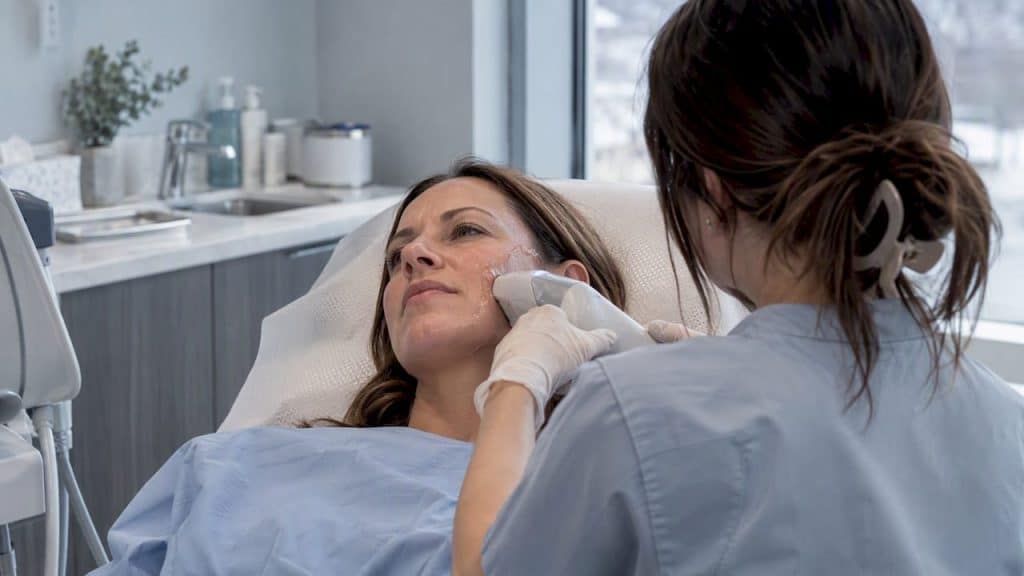
Yes, for mild to moderate skin laxity, non-surgical treatments can produce measurable tightening, though they do not replace a surgical lift. Microfocused ultrasound, radiofrequency, and laser or IPL treatments are the three options worth knowing about, each working through a different mechanism to firm skin gradually over several months. None of them deliver the dramatic, immediate change of a facelift, but for the right candidate, the improvement is real and visible.
TL;DR:
- Non-surgical skin tightening works gradually over several months, with microfocused ultrasound providing the strongest results in the right candidates.
- Radiofrequency and laser treatments offer measurable improvements for mild to moderate laxity, mainly in the face, neck, and certain body areas.
- Results depend heavily on device settings and operator skill, with safety risks like burns or pigment changes being rare but tied to improper use.
- Candidates should have stable weight, mild to moderate laxity, and realistic expectations, while severe sagging generally requires surgical intervention.
- Maintenance treatments and staged sessions help sustain improvements, but no non-surgical option offers permanent tightening.
Table of Contents
- The main non-surgical methods and how they differ
- Why skin tightens: the science behind the heat
- Who is a good candidate for non-surgical tightening
- What results to expect and how long they take
- Risks, side effects, and what the safety guidance says
- How to choose a provider you can trust
- Our approach to non-surgical skin tightening
- A practitioner’s note on setting realistic goals
- Book a consultation with us
- FAQ
- Sources
The main non-surgical methods and how they differ
Microfocused ultrasound (MFU) uses focused sound energy to heat tissue at the level of the superficial musculoaponeurotic system (SMAS), the same layer surgeons tighten during a facelift. It is the modality with the strongest investigator-rated outcomes in the systematic review of MFU for facial skin tightening.
Radiofrequency (RF) devices, whether monopolar or bipolar, heat the dermis more broadly and work through a slower collagen remodelling process. A systematic review of monopolar and bipolar radiofrequency devices found that RF produces measurable improvement in facial and body laxity, generally with a favourable safety profile. Lasers and IPL, meanwhile, are often chosen for texture and pigment concerns and provide some tightening as a secondary benefit, though ablative versions carry more downtime. Microneedling and microneedle RF cause controlled micro-injury that stimulates collagen production, making them a good fit for early-stage laxity paired with texture concerns. Our microneedling service follows this approach for clients focused on texture and mild firmness together.
Treatment areas vary by device:
- Lower face and jawline respond well to MFU and RF.
- Neck laxity is commonly treated with RF or combined RF and microneedling.
- Body areas like the abdomen and upper arms are usually addressed with RF given its broader coverage.
Why skin tightens: the science behind the heat
These devices all rely on controlled thermal injury to the dermis. Heat causes an immediate, modest contraction of existing collagen fibres, which is why some clients notice a subtle tightening right after treatment. The more meaningful change happens over the following months, as the body responds to that injury with neocollagenesis and neoelastogenesis, the production of new collagen and elastin fibres.
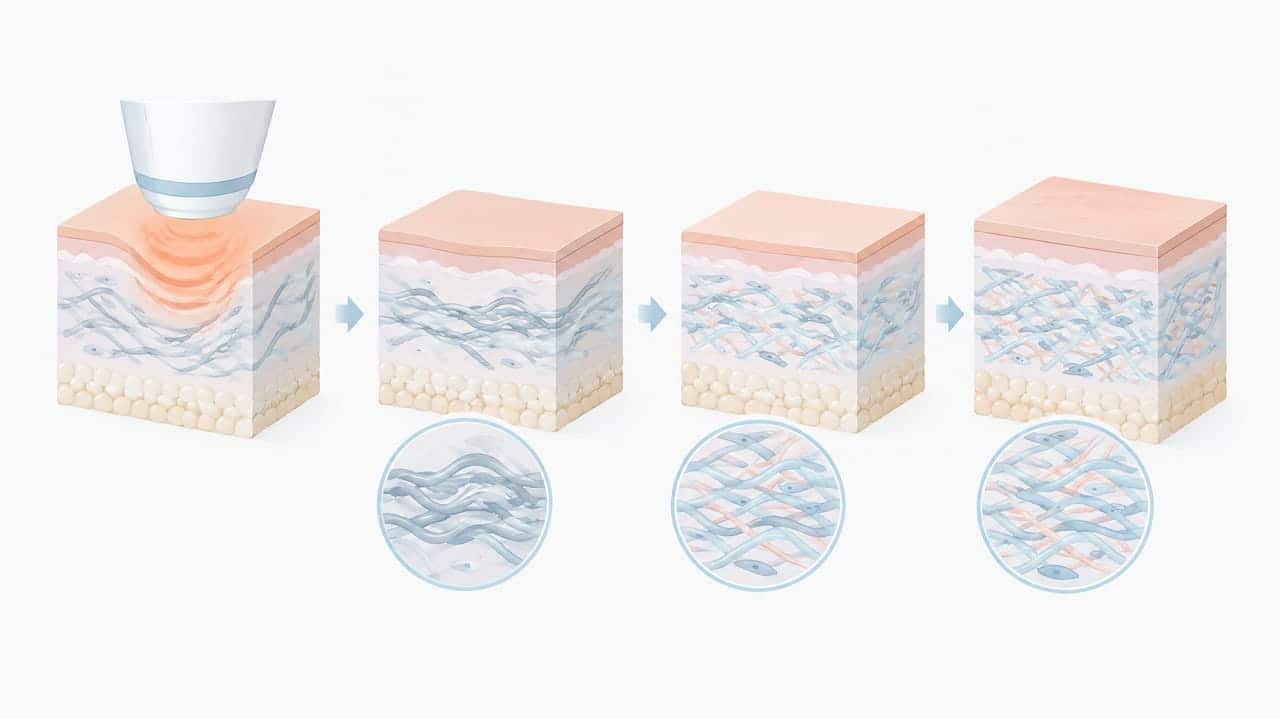
Device settings determine how deep that heat reaches and how strong the effect is. A review evaluating radiofrequency for face and neck rejuvenation found histological evidence of this new collagen and elastin formation alongside measurable volumetric and elasticity improvements. Because outcomes depend so heavily on depth and energy settings, operator training matters as much as the device itself. This is also why many programmes use staged sessions rather than a single pass, giving tissue time to remodel between treatments. You can read more about how this process works in our explainer on radiofrequency skin tightening and what to expect.
Who is a good candidate for non-surgical tightening
Many clients come in noticing early signs of aging, like a slightly softer jawline or tired-looking skin around the neck, rather than significant sagging. That early-stage laxity is exactly where non-surgical options perform best.
- Good candidates have mild to moderate laxity, a stable weight, and realistic expectations about gradual change.
- Excessive laxity, higher BMI, recent tanning, or active skin infections are reasons a provider may recommend a different approach or delay treatment.
- Age and Fitzpatrick skin type both influence which device and settings are appropriate, since darker skin tones need careful energy calibration to avoid pigment changes.
Clients with more advanced sagging are usually better served by a surgical consultation, and a honest provider will say so rather than overselling a device’s reach.
Pro Tip: Ask your provider to take standardized photos at your consultation. Comparing them against future visits gives you an objective way to track change, rather than relying on memory alone.
What results to expect and how long they take
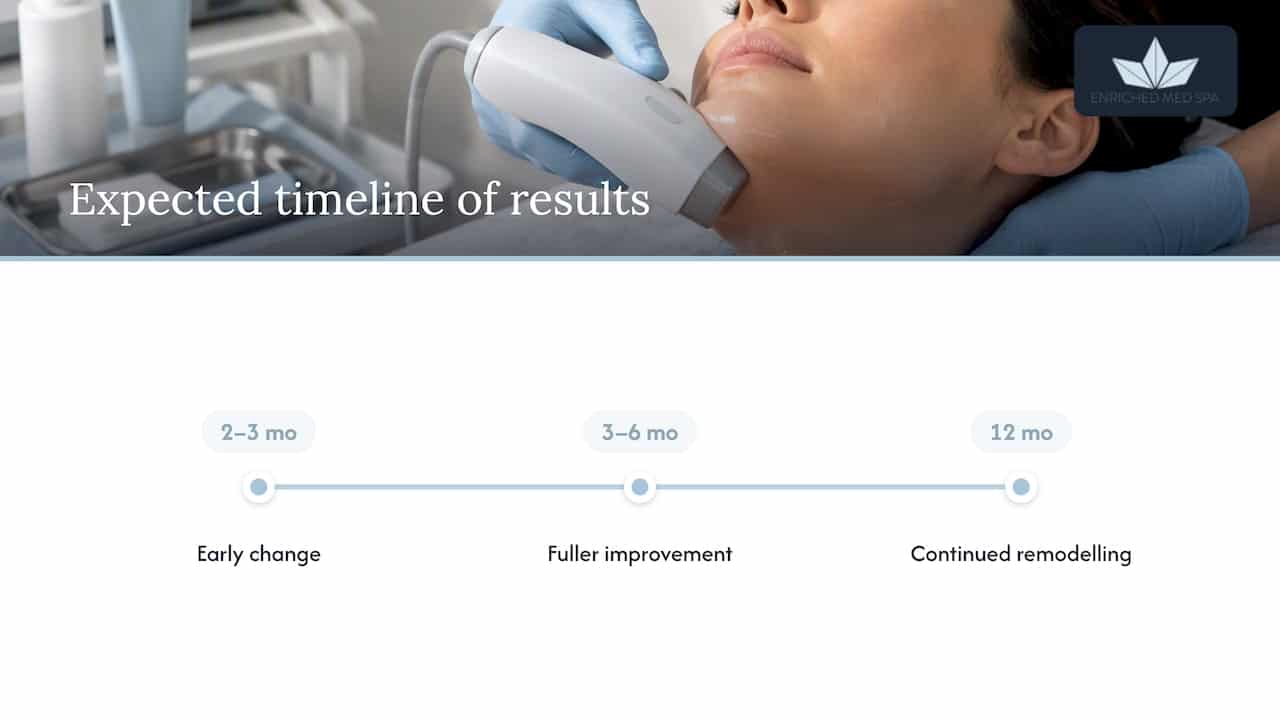
Results build slowly. Some clients notice early change by 2 to 3 months, fuller improvement by 3 to 6 months, and continued remodelling for up to a year after treatment. This is consistent with how collagen regeneration works biologically rather than instantly.
It is worth understanding the gap between what a clinician sees and what a client feels. In the MFU systematic review, investigator-rated improvement in facial laxity reached most treated patients at 90 days, while patient-reported improvement was lower, increasing over time. That gap is normal: objective measurement often shows more than a client feels looking in the mirror daily. Many programmes involve a single series of sessions followed by occasional booster treatments every year or two to maintain teeth whitening results. For pre- and post-treatment habits that support those results, our guide on skin tightening tips for smoother, youthful skin covers the basics.
Risks, side effects, and what the safety guidance says
Most side effects are temporary: redness, mild swelling, and short-lived discomfort are common after RF, MFU, or laser treatments. Less common but more serious risks include burns, pigment changes, and infection, particularly when settings are not matched to skin type.
- Temporary redness, swelling, and tenderness are the most frequently reported effects.
- Burns and pigment changes are rare but are tied directly to device settings and operator skill.
- Infection risk, though low, rises when aftercare instructions are not followed.
Health Canada regulates energy-based cosmetic devices and requires manufacturers to support safety and performance claims, including skin-temperature testing across different skin tones. A related notice specifies that a maximum skin temperature above 45°C without scientific justification will be deemed unsafe for device licensing, a detail worth knowing when comparing providers. Avoiding recent tanning, disclosing medications, and following aftercare instructions closely all reduce risk meaningfully.
How to choose a provider you can trust
Choosing the right provider matters as much as choosing the right device. A short checklist helps you walk into a consultation prepared:
- Confirm the provider is a licensed healthcare professional with specific training in energy-based devices.
- Ask which exact device and model will be used, and whether it is licensed for the treatment you want.
- Request before-and-after photos from real patients treated with that same device and setting.
- Ask directly about complication rates and how they are handled if they occur.
Pressure to book immediately, vague answers about which device is being used, or promises of guaranteed results are all signs to walk away. Bring a list of current medications, recent skin history, and any photos that show the areas you are concerned about.
Pro Tip: If a provider cannot name the specific device they plan to use on you, ask again before booking. A confident, specific answer is a good sign; a vague one is not.
Our approach to non-surgical skin tightening
We offer radiofrequency skin tightening through TriPollar technology alongside Forma, a radiofrequency-based face-lifting treatment, plus microneedling for clients who want texture and firmness addressed together. Every programme starts with a consultation that includes a discussion of your skin history, standardized photography, and a conversation about which device suits your skin type and goals.
We set expectations early: non-surgical tightening offers modest-to-moderate improvement delivered through a staged programme, not a one-time dramatic transformation. Maintenance sessions are usually spaced over months to years depending on how your skin responds. You can see how our Forma treatment fits into a broader tightening plan, or walk through our step-by-step process guide before your first visit.
A practitioner’s note on setting realistic goals
We prefer conservative planning over aggressive promises. Photographic documentation and staged sessions let us adjust as your skin responds, rather than committing to an outcome before we have seen how you heal.
— Felix
Book a consultation with us
If you are ready to find out what realistic tightening looks like for your skin, we invite you to book a consultation. We will review your history, take baseline photos, and talk through which treatment fits your goals and timeline. Explore our skin tightening options to get started.
FAQ
Can you tighten saggy skin without surgery?
Yes, for mild to moderate sagging, treatments like radiofrequency, microfocused ultrasound, and microneedling can produce measurable tightening over several months. Severe sagging typically responds better to a surgical lift, so a consultation helps determine which category your skin falls into.
Can sagging skin be firm again?
Skin firmness can improve with treatments that stimulate new collagen and elastin production, though the degree of change depends on how much laxity is present to begin with. Improvement tends to be gradual, continuing for months after treatment rather than appearing immediately.
Is there a skin tightener that actually works?
Radiofrequency and microfocused ultrasound both have systematic review evidence supporting measurable tightening, particularly for mild to moderate laxity. Results vary by individual, and maintaining them typically requires occasional booster sessions over time.
What is the best permanent skin tightening?
No non-surgical treatment produces permanent tightening, since skin continues to age after the procedure and collagen production slows again over time. A surgical lift offers longer-lasting results for significant laxity, while non-surgical options require maintenance sessions to sustain their effect.
Sources
- A systematic review of the efficacy of microfocused ultrasound for facial skin tightening
- Minimally invasive approach to skin tightening of the face and body: systematic review of monopolar and bipolar radiofrequency devices
- Cosmetic laser treatments – Health Canada