
Yes, targeted botulinum toxin injections into the masseter muscle can reduce muscle bulk and often create a slimmer, more V shaped lower face, but only when the width comes from muscle rather than bone. Visible change usually starts within a few weeks and builds over a couple of months, and it needs upkeep. Anatomy and injector technique both shape the outcome.
TL;DR:
- The effectiveness of masseter Botox depends on whether jaw width results from muscle bulk or bone structure; it cannot modify bone or fat.
- Most patients see initial signs of softening between two and six weeks, with full results peaking around three months and lasting three to six months on average.
- Outcomes are influenced by baseline muscle size, habits like teeth grinding, and facial anatomy, making proper assessment essential before treatment.
- A qualified, experienced healthcare professional should perform the injections, using authorized products and personalized dosing based on individual muscle characteristics.
- Repeated treatments may cause changes in surrounding muscles and possibly affect jawbone density, emphasizing the importance of conservative dosing and follow-up.
Table of Contents
- How masseter Botox works to soften a wide jawline
- What results look like and how long they take to show
- Who actually benefits from masseter reduction Botox
- What a masseter Botox appointment actually involves
- Risks, side effects, and what happens with repeat treatments
- How long masseter Botox lasts and when to plan your next visit
- Choosing a safe, qualified provider for jaw slimming Botox
- How we think about masseter Botox at consultation
- How Enriched Med Spa can help you plan a jaw slimming treatment
- Sources
- FAQ
How masseter Botox works to soften a wide jawline
Botulinum toxin A works by blocking the release of acetylcholine at the neuromuscular junction, which is the chemical signal that tells the masseter muscle to contract. With that signal reduced, the muscle relaxes and works less each time you chew or clench.
That is where the slimming comes from, and it is not immediate. A muscle that stops working as hard slowly loses bulk, the same way a limb in a cast thins over weeks of disuse. The masseter is a large, dense chewing muscle, so this process of gradual atrophy takes time rather than happening overnight. You will not walk out of a consultation with a new jawline the same afternoon.
This distinction matters because masseter Botox only addresses one possible cause of a wide lower face. Many clients come in believing their jaw looks square, when the real driver is a combination of factors: some have a strong, prominent masseter that bulges visibly when they clench, others have a naturally wide mandible or jawbone, and some are carrying subcutaneous fat along the jawline that has nothing to do with muscle at all. Botox for facial contouring works well for the muscle component. It cannot narrow a bony jaw angle and will not touch fat. A careful clench test and palpation during consultation is how a practitioner figures out which of these is really at play, and that assessment should always come before any injections are planned.
What results look like and how long they take to show
Most people notice the first signs of softening around two to six weeks after treatment, with the fuller effect building steadily from there. A phase 2 randomized trial found that onabotulinumtoxinA at doses of 48 and 72 units produced a significantly greater reduction in masseter prominence by day 90 compared with placebo, with investigator-assessed improvement in about 90% of treated participants versus 21.7% on placebo. That trial also recorded meaningful gains in lower facial volume, width, and jaw angle at follow-up visits, which lines up with what a systematic review of the evidence also reports: peak effect tends to land around the three-month mark after a single injection.
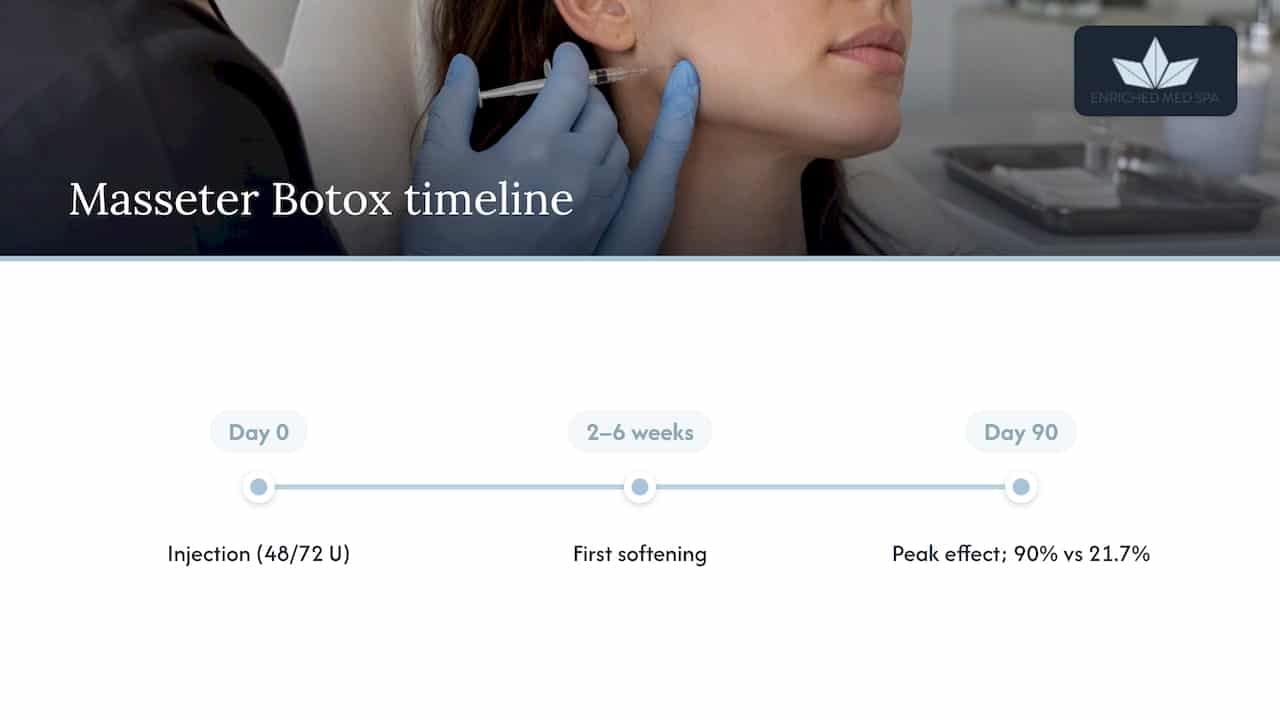
Roughly 90% of patients who received onabotulinumtoxinA showed measurable improvement in masseter prominence by day 90, compared with about 21.7% on placebo, according to the phase 2 trial results. That is a meaningful gap, and it is the clearest evidence available that the effect is real rather than anecdotal.
How much slimming any one person sees depends on several things. Baseline masseter size matters a great deal, since someone with a genuinely large, overdeveloped muscle from years of clenching or grinding has more room for visible change than someone whose masseter was only mildly enlarged to begin with. Sex, ethnic variation in jaw musculature, and habits like nighttime bruxism all play a role too. A person who grinds their teeth heavily every night is working against the treatment somewhat, since ongoing clenching keeps stimulating the muscle even as the toxin dampens its response.
Who actually benefits from masseter reduction Botox
Not every square or wide looking jaw is a masseter problem, and figuring that out before booking anything saves you time, money, and disappointment. The muscle sits at the back of the jaw and becomes obvious when you clench your teeth: if you press your fingers there and feel a firm, bulging mass that was not visible with your jaw relaxed, that is a strong sign the masseter itself is contributing to the width.
- A visible bulge on clenching that flattens out when the jaw is relaxed usually points to muscle-driven width.
- A history of teeth grinding or jaw clenching, often noticed by a dentist or a sore jaw in the morning, tends to correlate with masseter hypertrophy.
- A jawline that looks wide even at rest, with no bulge on clenching, is more likely a skeletal or bone-shape issue that Botox will not change.
- Fullness that sits low along the jaw and feels soft rather than firm often points to fat rather than muscle, which calls for a different approach such as skin tightening or contouring treatments.
When the width comes from bone structure, no amount of muscle relaxant will narrow it, and a practitioner should say so plainly rather than promising a result the treatment cannot deliver. A related guide on jaw slimming mechanisms goes into more detail on how clinicians distinguish these cases at consultation. A hands-on clench test, sometimes paired with photos taken at rest and under clench, remains the simplest and most reliable way to sort out which cause is driving your particular jawline.
What a masseter Botox appointment actually involves
A typical visit starts well before any needle comes out. The practitioner will ask about your medical history, review any bruxism or TMJ symptoms, take photos at rest and under clench, and physically palpate the masseter to gauge its size and shape on each side.
- Consultation and assessment: history, clench palpation, and photographs to document baseline width and asymmetry.
- Mapping injection points: the practitioner marks several sites across the belly of the masseter on each side, since even distribution reduces the risk of an uneven result.
- Injection: a series of small injections delivered with a fine needle, typically taking only a few minutes total, with most people describing mild pinching rather than significant pain.
- Immediate aftercare: light activity is fine, but you will usually be told to avoid vigorous chewing, massaging the area, or lying flat for a few hours.
- Follow-up check: many clinics schedule a look-in around two to four weeks later to assess early response and decide if any touch-up is needed.
Bruising and mild soreness at the injection sites are common in the first day or two and settle quickly. Dosing has to be individualized based on the size of your masseter and how much reduction you are hoping for, since there is no single standard unit count that applies to every face. You should confirm current pricing directly with a provider rather than relying on general estimates.
Risks, side effects, and what happens with repeat treatments
Most people tolerate masseter Botox well. The most common effects are local soreness at the injection sites, some bruising, and a temporary feeling of weaker chewing strength, particularly with tougher foods, in the first couple of weeks. These tend to resolve on their own as the toxin’s effect matures.
Less common but more serious issues can include visible asymmetry if dosing was uneven, an unnatural change to your smile if the toxin diffuses toward nearby muscles, or in rare cases difficulty swallowing. Any of these warrant a call back to the treating clinic promptly rather than waiting it out.
Some clinical trials and studies report compensatory changes in the temporalis muscle and possible structural bone effects after repeated or high-dose injections, signalling the need for monitoring with serial treatments.
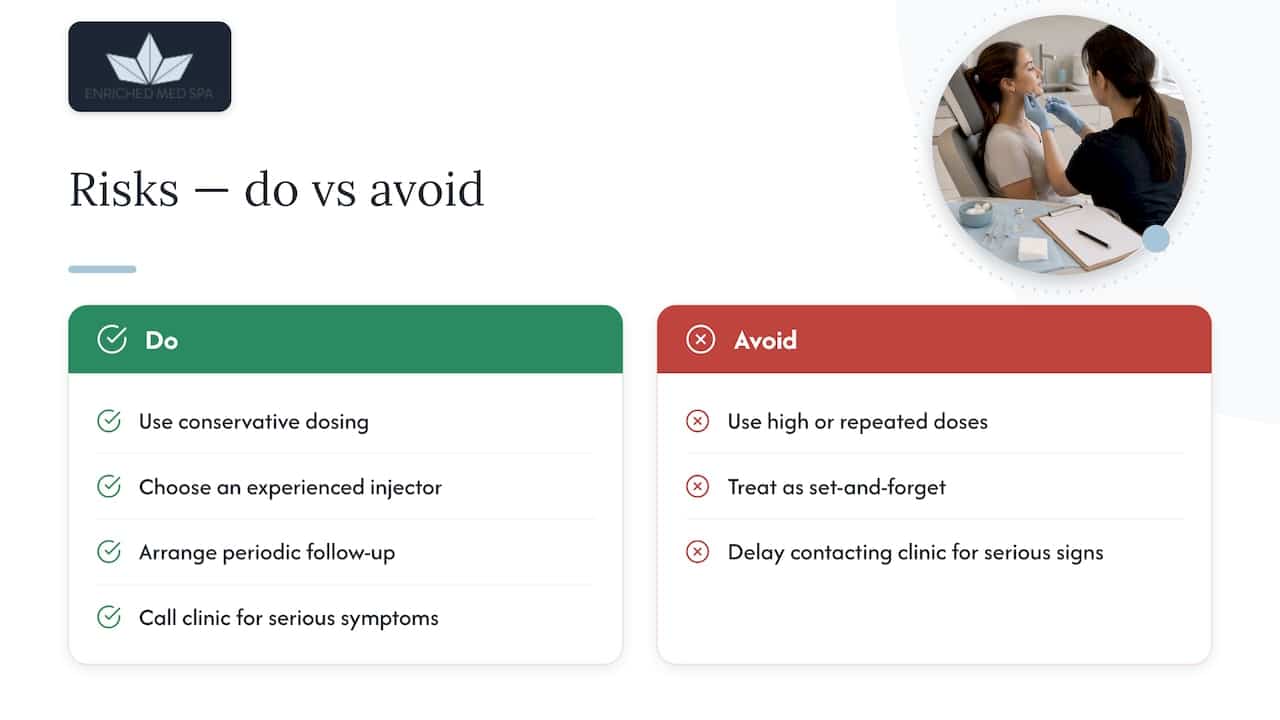
That summary reflects findings from a randomized trial on temporalis muscle changes, which found that repeat masseter injections were associated with measurable increases in temporalis muscle thickness and electrical activity, with the effect more pronounced at six months after multiple treatment rounds. The same trial also raised questions about whether repeated or high-dose injections could influence mandibular bone density over time, though the evidence here remains limited and the clinical significance is still being worked out. This is not a reason to avoid treatment, but it is a good reason to favour conservative dosing, an experienced injector, and periodic follow-up rather than treating masseter Botox as a set-and-forget procedure.
How long masseter Botox lasts and when to plan your next visit
For most people, the visible slimming effect holds for roughly three to six months, though the systematic review of masseter Botox studies notes some patients report benefits lasting up to six to twelve months, particularly after several rounds of treatment as the muscle becomes accustomed to working less. Health Canada’s own guidance on cosmetic injections similarly notes that cosmetic Botox effects commonly last around three to four months, and it recommends that treatments only be administered by qualified health professionals who understand appropriate re-treatment intervals.
In practice, this means most people return for a top-up once or twice a year once they have settled into a maintenance rhythm. A good practitioner will track how your muscle responds over successive visits and may adjust the dose or interval slightly, both to maintain your result and to watch for the kind of compensatory temporalis changes mentioned earlier. A longer explainer on how long Botox results last covers retreatment planning in more depth if you want the fuller picture before booking.
Choosing a safe, qualified provider for jaw slimming Botox
The single biggest variable in how well masseter Botox works, and how safely it goes, is who is holding the needle. Injection technique, dose distribution, and product sourcing all depend on the training and judgment of the person treating you.
- Confirm the injector is a regulated health professional with specific experience treating the masseter, not just the upper face.
- Ask which product is being used and confirm it is a Health Canada authorized botulinum toxin, since unauthorized or imported vials have been linked to serious safety alerts.
- Request to see real before-and-after photos from the clinic and ask how they think about dosing philosophy for your specific facial shape.
- Treat a few things as red flags: prices that seem unusually low for the market, no real consultation before treatment, or pressure to prepay for multiple sessions upfront.
Pro Tip: Bring a photo of your jaw at rest and one mid-clench to your consultation. It gives the practitioner a clearer starting point than a single relaxed shot and makes it easier to track your progress later.
A dental perspective on Botox for jaw clenching is a useful companion read if bruxism is part of your picture, since it explains the functional side of treatment alongside the cosmetic one.
How we think about masseter Botox at consultation
We start every masseter consultation with a clench test and a close look at your facial proportions before we talk about units or injection points. If your width is coming from bone rather than muscle, we say so, because setting that expectation early is part of doing this responsibly.
From there, dosing is personalized, documented, and reviewed at follow-up so we can track how your muscle is actually responding rather than guessing. Many clients tell us they expected an instant change and are surprised the softening builds gradually, which is exactly why we walk through timeline and maintenance before the first injection, not after.
— Felix
How Enriched Med Spa can help you plan a jaw slimming treatment
Some clinics offer Botox, Nuceiva, and Xeomin as options for masseter reduction, with treatment plans tailored to individual facial anatomy rather than generic dosing charts. A proper consultation and clench assessment can help determine whether muscle reduction is likely to provide the desired result before any injections.
- A first visit may include a clench and palpation assessment, photos, and a discussion about realistic timelines for the jaw.
- Dosing is planned per side based on muscle size rather than a fixed unit count applied to everyone.
- Follow-up scheduling may be arranged to review early results and determine if touch-ups are needed.
If you are trying to figure out whether your jawline would respond well to this treatment, the next step is a consultation rather than guesswork. You can review our Botox and injectable options and book a visit to have your jaw properly assessed.
This article is general information, not a substitute for advice from a qualified doctor. Consult a qualified healthcare professional about your own circumstances before acting on anything here.
Sources
- Reduction of masseter muscle prominence after treatment with onabotulinumtoxinA: Primary results from a randomized phase 2 study
- Efficacy of botulinum toxin in masseter muscle hypertrophy for lower face contouring (systematic review)
- Canada
- Temporalis muscle changes following botulinum toxin A injections in masseter hypertrophy patients: A randomized trial
- Unauthorized Nabota botulinum toxin may pose serious health risks – Canada.ca
FAQ
Will masseter Botox make my face slimmer?
For many people whose lower face width comes from an enlarged masseter muscle, yes, it can create a visibly slimmer, more V shaped jawline. It will not help if your width comes mainly from bone structure or fat, which is why a clench assessment before treatment matters.
How much does masseter Botox slim your face?
The degree of change depends on your starting masseter size and how much of your width is muscle versus bone or fat. A phase 2 trial recorded significant improvements in facial width and jaw angle by day 90 in people who responded to treatment, though individual results vary.
How long does it take for masseter Botox to slim?
Most people begin noticing softening within two to six weeks, with the fuller effect typically peaking around three months after injection. This timeline is consistent with findings from a systematic review of masseter Botox studies.
Is there a downside to masseter Botox?
The main downsides are mild, temporary soreness, bruising, or a short period of weaker chewing strength, and results require ongoing maintenance every few months. Less commonly, uneven dosing can cause asymmetry, and some trial evidence suggests repeated treatments may cause compensatory changes in the nearby temporalis muscle, which is why follow-up monitoring matters.