
Yes, Botox works for crow’s feet. OnabotulinumtoxinA relaxes the orbicularis oculi muscle responsible for the fanning lines beside your eyes, and clinical trials confirm significantly higher responder rates than placebo. Most people notice softening within a few days, with full effect by two to several weeks, and results lasting approximately several months. The outcome depends far less on the toxin itself than on the injector’s grasp of your eye anatomy.
TL;DR:
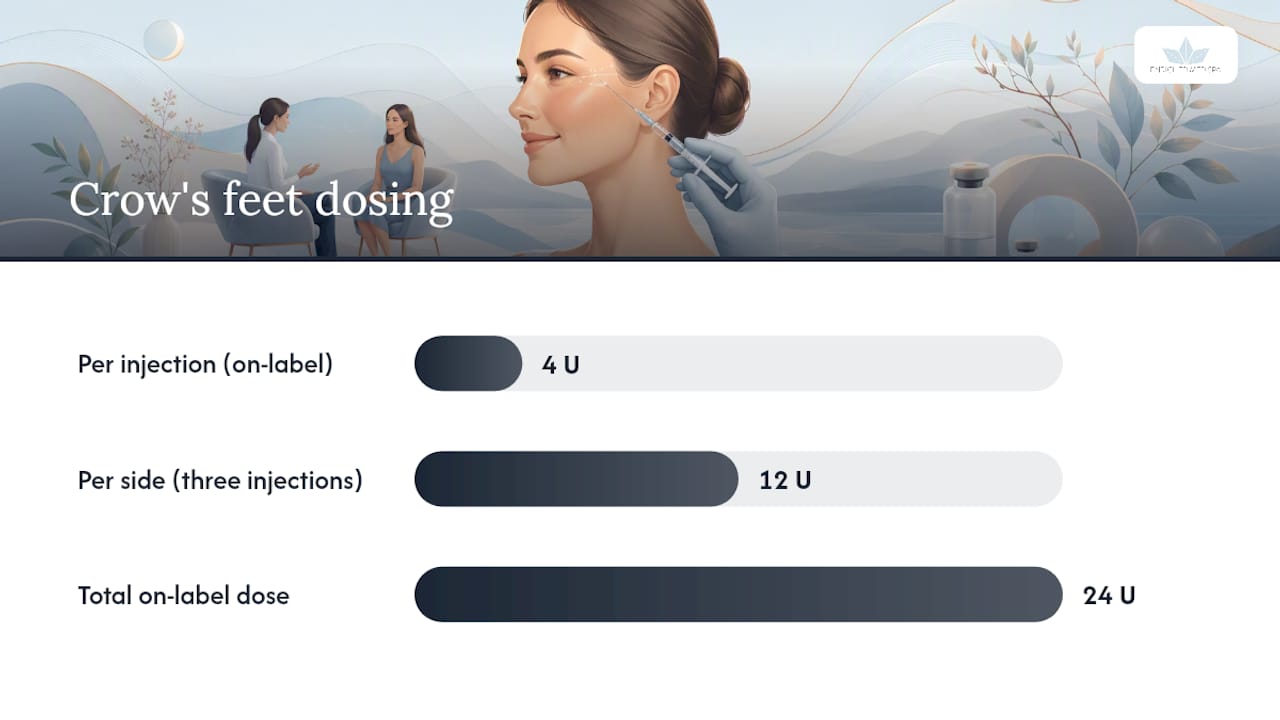
- Most effective dosing involves three injections per side at the recommended 24 units, with slight variations based on muscle strength and anatomy.
- Side effects are generally mild and temporary, with eyelid swelling occurring in about 1% of treatments and serious adverse events being rare.
- Proper injection technique requires careful mapping to avoid diffusion into the eyelid muscle, minimizing the risk of ptosis.
- Results typically appear within a few days, peak at two to four weeks, and last three to four months, requiring re-treatments for maintenance.
- Static lines caused by skin aging do not respond to Botox alone, making combination treatments or skincare essential for comprehensive improvement.
Table of Contents
- How Botox reduces crow’s feet: what the clinical trials show
- Dosing and injection technique for crow’s feet
- Safety, side effects, and who should avoid this treatment
- What the appointment looks like: preparation, injection, and aftercare
- Results, maintenance, and what complements Botox over time
- How to read before-and-after photos honestly
- The Enrichedmedspa view on treating crow’s feet naturally
- Ready to talk about your crow’s feet treatment options?
- Sources
How Botox reduces crow’s feet: what the clinical trials show
Crow’s feet form because the orbicularis oculi, the ring of muscle circling your eye, contracts every time you squint, smile, or laugh. Over years, that repeated folding etches lines into skin that no longer has the collagen and elasticity to bounce back on its own. Botox does not fill or resurface anything. It blocks the nerve signal telling that muscle to contract, so the skin above it stops creasing with every expression. That is the mechanism Cleveland Clinic describes when explaining why the treatment is meant to soften dynamic lines rather than erase the ability to express emotion.
The clinical backing for this is stronger than most cosmetic treatments get. A pivotal set of phase 3 trials involving 1,362 patients tested onabotulinumtoxinA against placebo using a standardized total dose at the on-label amount, split into three injection sites per side. The responder rate, meaning the percentage of patients whose crow’s feet severity dropped at least one grade on a standard clinical scale, was significantly higher in the treatment group than placebo at day 30, with a statistical significance of P < .001. That is not a marginal edge. It is the kind of separation from placebo that regulators expect before approving a cosmetic indication.
By the numbers: what the trials actually found
- Responder rates at day 30 were significantly greater with onabotulinumtoxinA than with placebo across the phase 3 program.
- Eyelid oedema, a mild, temporary puffiness around the eye, occurred in about 1% of treated patients.
- Serious adverse events were uncommon at the recommended dose across the trial population.
- Onset of visible softening typically begins within the first few days, with results commonly lasting three to four months.
Many clients come in assume Botox is a blunt instrument, something that either works dramatically or does nothing. The trial data paints a more precise picture: a treatment with a narrow, well-documented side effect profile that performs consistently better than placebo, provided the dose and placement follow the pattern tested in those studies.
Prescribing information for BOTOX Cosmetic mirrors that trial design closely. The official product insert lists 24 units as the on-label dose for lateral canthal lines, the clinical term for crow’s feet, delivered as three injection sites per side. It also flags warnings clinicians take seriously: the possibility of toxin effects spreading beyond the injection site in rare cases, and cumulative dose limits that matter if you are treating crow’s feet alongside forehead lines or frown lines in the same visit. None of this is meant to alarm you. It is the reason a proper consultation involves reviewing your full treatment history, not just counting units for the area in front of you.
What the numbers do not capture is how much variation exists between one person’s crow’s feet and another’s. Some people have lines that appear mostly when they smile broadly. Others have visible creasing even at rest, often because skin laxity and sun damage have compounded the muscle activity over time. Botox addresses the muscle component reliably. It does not rebuild collagen or reverse photoaging, which is why realistic expectations matter as much as the injection itself. If you are curious about how injectables fit into a broader anti-aging plan, that distinction between muscle relaxation and skin quality is worth understanding before your first appointment.
Dosing and injection technique for crow’s feet
The on-label starting point for crow’s feet is a total dose delivered as three separate injections per side along the lateral orbicularis oculi. That pattern comes directly from the BOTOX Cosmetic prescribing information and matches the dosing used in the pivotal trials. In practice, though, few experienced injectors treat every patient identically, because no two sets of crow’s feet fan out the same way.
Muscle strength varies by patient, sex, and how long the lines have been forming, so injectors often adjust within a defensible range rather than applying a fixed number. It is common to see:
- Doses adjusted within a range per side depending on muscle strength and the depth of existing lines.
- A conservative “baby Botox” approach for first-time patients who want softened lines without any risk of a frozen appearance.
- Asymmetric dosing when one side of the face is naturally more expressive or has stronger muscle tone than the other.
- Slightly higher placement for lines sitting closer to the brow, and lower placement for creasing that extends toward the cheek.
That last point matters more than most patients realize. Injector guidance on treating crow’s feet stresses adjusting the vertical position of each injection based on whether a patient’s lines sit above or below the lateral canthus, the outer corner of the eye. Someone whose crow’s feet fan mostly upward toward the temple needs a different injection map than someone whose lines run straight out toward the ear.
The anatomical landmark every competent injector respects is the levator palpebrae superioris, the muscle that lifts your upper eyelid. Injecting too close to it, or too deep, risks diffusion into that muscle and a temporary eyelid droop known as ptosis. This is rare with a skilled injector who understands the orbital bone structure and stays lateral and superficial enough to avoid that muscle entirely. It is also the single most common reason patients hear “no” or “let’s adjust the plan” during a consultation. Understanding the facial anatomy behind injectables helps explain why a slower, more careful mapping process at your first visit pays off later.
Pro Tip: If you have never had Botox before, ask your injector whether they are planning a full 24 unit on-label dose or a lower, conservative starting dose. There is no wrong answer, but knowing the plan ahead of time helps you set expectations for how much movement you will retain in that first week.
Needle angle plays a role too. Standard technique places the needle bevel up and directed away from the eye, keeping the injection superficial in the muscle rather than deep near the orbital rim. That single technical detail, more than the exact unit count, is what separates a natural, symmetrical result from one that looks uneven or feels stiff.
Safety, side effects, and who should avoid this treatment
Most side effects from Botox for crow’s feet are minor and resolve within days. Bruising at the injection site is the most commonly reported issue, largely because the skin around the eyes is thin and rich in small blood vessels. Injection-site pain, usually mild and brief, and occasional headache round out the list of common, temporary effects noted in clinical safety reviews.
What the safety data shows
In the pivotal phase 3 trial, eyelid oedema, a mild swelling around the eyelid, occurred in approximately 1% of treated patients. Serious adverse events were uncommon among patients treated at the recommended dose. That is a narrow risk profile for a procedure performed hundreds of thousands of times a year, but “uncommon” is not “impossible,” and a proper consultation should walk you through what those rare outcomes look like.
The rare but serious concern with any botulinum toxin injection is distant spread of toxin effect, meaning symptoms appearing away from the injection site, such as generalized muscle weakness, difficulty swallowing, or breathing problems. Manufacturer safety communications note there have not been confirmed serious cases of this occurring with BOTOX Cosmetic at recommended doses for crow’s feet, forehead lines, or frown lines. Still, it is the reason reputable clinics ask about your full medical history before treating, and why you should call your clinic immediately if you notice unusual weakness, vision changes, or swallowing difficulty in the days after treatment.
Certain people should not receive Botox for crow’s feet, and a responsible injector will screen for these before booking you in:
- Known hypersensitivity to botulinum toxin or any component of the formulation.
- Active infection at or near the planned injection site.
- Neuromuscular disorders such as myasthenia gravis or Lambert-Eaton syndrome, which affect how muscles respond to nerve signals.
- Pregnancy or breastfeeding, where the treatment is generally deferred out of caution rather than documented harm.
- Current use of medications such as aminoglycoside antibiotics, which can interact with botulinum toxin and potentiate its effect.
None of this is meant to make the treatment sound riskier than it is for a healthy adult without those conditions. It is meant to explain why a real consultation, not a quick form, is part of doing this safely. If your injector does not ask about your neurological history, your current medications, or prior reactions to injectables, that is worth noticing.
What the appointment looks like: preparation, injection, and aftercare
A crow’s feet Botox appointment is short, but the preparation and aftercare matter as much as the ten minutes in the chair. Here is roughly how it unfolds.
- Before you arrive, disclose your full medical history, including neuromuscular conditions, current medications (especially antibiotics), allergies, and whether you are pregnant or breastfeeding. Avoid blood thinners like aspirin or ibuprofen for a few days beforehand if your doctor approves, since this reduces bruising risk.
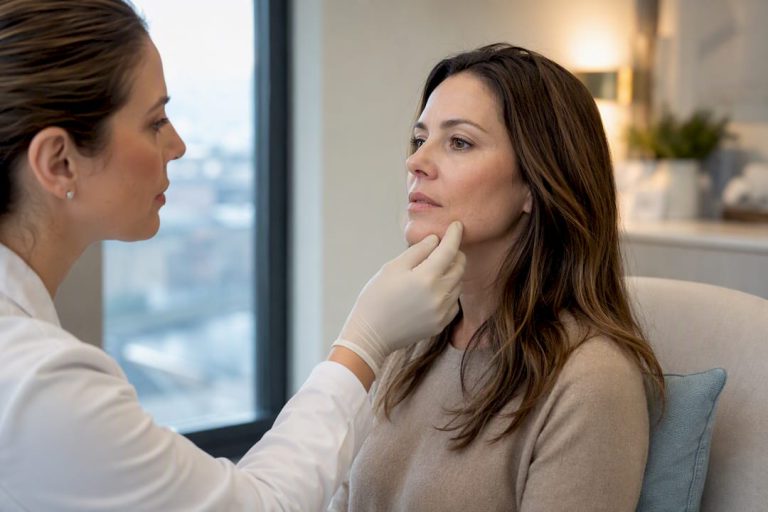
- During the consultation, your injector examines your crow’s feet at rest and during a full smile, mapping where your lines sit relative to the lateral canthus and levator palpebrae superioris. This is when dose and injection pattern get finalized for your face specifically, not from a generic template.
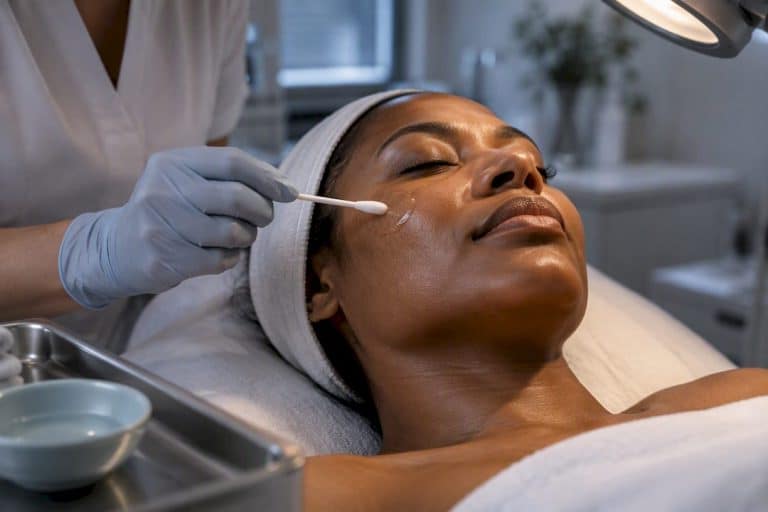
- The injection itself takes only a few minutes. Expect a few small injections per side, each a brief pinch or sting. Most people describe it as more startling than painful. The whole visit, including consultation and paperwork, typically runs 20 to 30 minutes.
- Immediately after, your injector checks for any asymmetry in your smile and confirms you are not experiencing unusual heaviness in the eyelid before you leave.
- Aftercare is simple but important: avoid rubbing or massaging the treated area for several hours, stay upright rather than lying flat for at least four hours, and skip strenuous exercise for the rest of the day. Mild bruising can be managed with a cold compress and covered with mineral makeup once any pinpoint marks have settled.
Pro Tip: Book your appointment at least two weeks before any major event. Full results take up to a few weeks to show, and if an adjustment is needed, you want time for a follow-up before the big day.
Call your clinic if you notice drooping in the eyelid, difficulty closing one eye fully, or any swallowing or breathing changes in the days following treatment. These are uncommon, but knowing when to call is part of informed consent, not a reason to avoid the treatment altogether.
Results, maintenance, and what complements Botox over time
The timeline for crow’s feet Botox follows a predictable arc. Most patients see the first softening around day three, with the muscle-relaxing effect building toward its peak between two and four weeks. From there, results typically hold steady for several months before the muscle gradually regains its full range of motion and the lines start reappearing with expression.
That window is why most people rebook every few months to maintain the effect, though some notice the treatment lasting slightly longer with repeated use, likely because the muscle becomes trained to contract with less force over time. Watch for these signs that a touch-up is due:
- Lines becoming visible again during a full smile, even if they are still smooth at rest.
- A gradual return of movement in the treated area over several weeks rather than an abrupt change.
- Asymmetry appearing as one side’s effect fades slightly faster than the other, which is normal and easily corrected at your next visit.
Botox has one clear limitation worth naming directly: it treats dynamic lines caused by muscle movement, not static lines etched into skin that has lost collagen and elasticity. If your crow’s feet are visible even when your face is completely relaxed, Botox alone will soften but likely not eliminate them. That is where complementary treatments come in. Dermal fillers can add subtle volume to support thinning skin around the eye, while laser resurfacing or radiofrequency skin tightening address texture and firmness rather than muscle movement. For prevention, daily broad-spectrum SPF and a topical retinoid remain the most evidence-backed way to slow new static lines from forming in the first place. Understanding how long results last and when to rebook helps you plan maintenance rather than treating each visit as a surprise.
How to read before-and-after photos honestly
Before-and-after photos are useful, but they are also the easiest place to be misled. Lighting angle alone can exaggerate or hide a line completely, and a photo taken at rest looks dramatically different from one taken mid-smile, which is when crow’s feet actually show up. A gallery showing only relaxed, neutral expressions tells you very little about how well the treatment preserved natural movement.
When you’re evaluating photos, look for a few specific things:
- Matching expressions between the before and after shot, ideally a genuine smile rather than a neutral pose.
- Consistent lighting and camera angle, since shadows can fake improvement or hide it.
- Realistic softening rather than complete erasure, especially in patients with deeper, longstanding lines.
- Multiple patients with different starting points, not just the single best-case result a clinic chooses to showcase.
Genuine results usually show visibly reduced creasing during expression, not a face that no longer moves. If a gallery only features one flawless case, ask to see a broader range, including patients whose lines were more pronounced to start.
The Enrichedmedspa view on treating crow’s feet naturally
At Enrichedmedspa, we treat crow’s feet as a facial movement pattern to understand, not a number of units to inject. Every consultation starts with watching how you smile, squint, and laugh, because that tells us more about your muscle strength and line pattern than any standard chart. We offer Botox, Nuceiva, and Xeomin, along with dermal fillers, so if static lines or volume loss are part of what you’re seeing, we can talk through what actually addresses that versus what a neurotoxin alone will not fix.
Many clients come in want a “no makeup needed” kind of result, less about erasing every line and more about looking less tired in photos. That preference shapes our dosing conversation from the first visit. We would rather start conservatively and adjust at your follow-up than risk an overdone look you cannot undo for months. If you want to understand how natural-looking Botox results are actually achieved, that conservative, expression-first philosophy is the reason.
— Felix
Ready to talk about your crow’s feet treatment options?
Enrichedmedspa gives you what a quick search or a big-box injectable chain usually cannot: an assessment built around your specific muscle pattern, not a fixed protocol applied to everyone who walks in. We serve clients across Woodbridge and East Gwillimbury, and every crow’s feet consultation includes an honest conversation about whether Botox alone is right for you, or whether a filler or skin treatment should be part of the plan instead.
If you are weighing Botox against other options for the lines around your eyes, our guide on cosmetic injectables walks through how the different treatments compare so you can come to your consultation with real questions instead of guesses. Book a consultation with Enrichedmedspa and we’ll map your crow’s feet, talk through dosing that fits your face, and set a treatment plan that keeps your expression looking like yours.
This article is general information, not a substitute for advice from a qualified doctor. Consult a qualified healthcare professional about your own circumstances before acting on anything here.
Sources
- OnabotulinumtoxinA for Treatment of Moderate to Severe Crow’s Feet Lines: A Review
- OnabotulinumtoxinA for Treatment of Moderate to Severe Crow’s Feet Lines: A Review
- BOTOX Cosmetic prescribing information (highlights)
- Botulinum toxin: clinical overview and safety considerations (NCBI Bookshelf)
- Crow’s feet — Cleveland Clinic patient information