
Chin filler in Canada is priced mostly by the syringe, and a syringe typically runs between $500 and $1,000 nationally, with Toronto at $700 to $1,200, according to a 2026 Canadian cost guide. Your total depends on how many syringes your chin needs, which product is used, who injects it and where the clinic is. Below we walk through each of those pieces so you can build a realistic budget before you book a consultation.
TL;DR
- Expect roughly $500 to $1,000 per syringe across Canada, and $700 to $1,200 in Toronto.
- Your total is the number of syringes multiplied by the per-syringe price, so a plan that needs two syringes costs about twice a one-syringe plan.
- Filler is temporary, so budget for touch-ups. Many Canadians plan for them every 6 to 12 months.
- A price far below the market range is a reason to ask questions about the product and the injector, not a bargain.
- Surgical chin implants cost several times more than filler, but they are a different treatment with a different recovery.
Table of Contents
- What chin filler costs in Canada
- How much filler a chin usually needs
- What changes the price
- How clinics charge: by syringe, by area or by session
- Why a very low price deserves a second look
- Safety and credentials to check before you pay
- Maintenance: the real cost over a year
- Chin filler versus chin implant surgery
- Our perspective
- Booking a chin filler consultation with us
- FAQ
- Sources
What chin filler costs in Canada
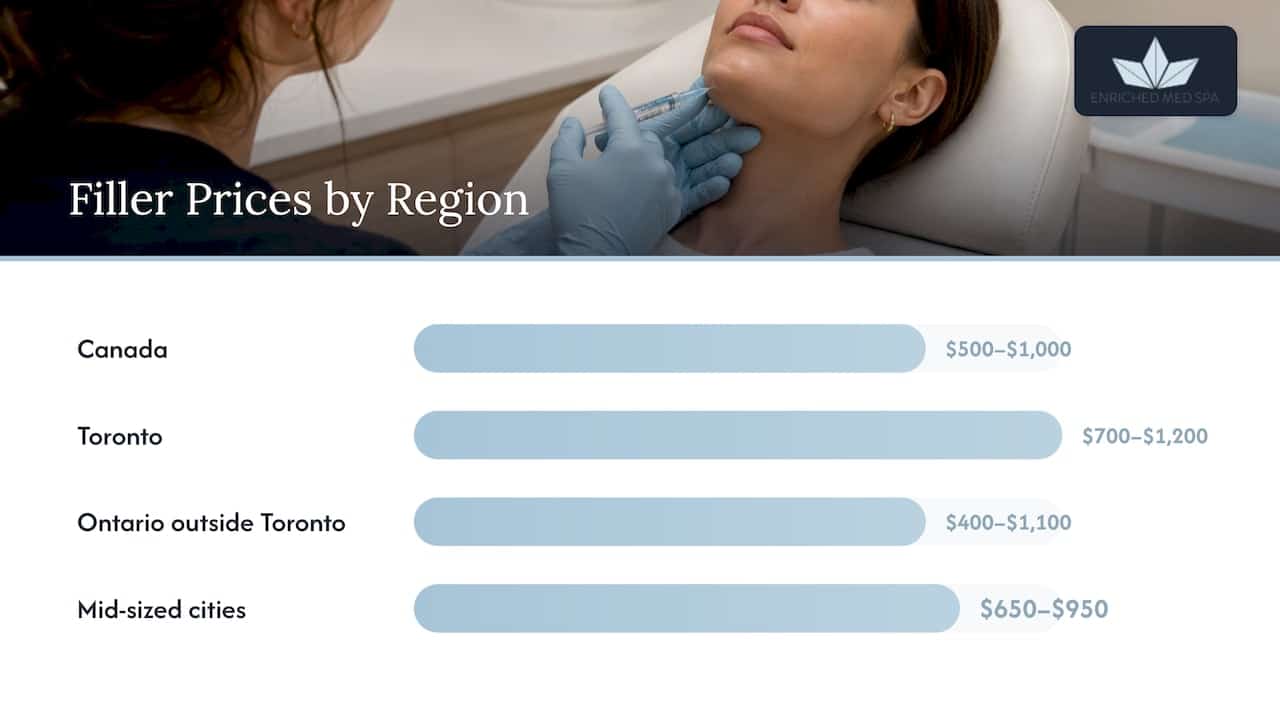
The most useful number is the price per syringe, because almost every quote is built from it. The KNTR Canada guide from February 2026 puts dermal filler at $500 to $1,000 per syringe nationally. It gives Toronto as $700 to $1,200, Ontario outside Toronto as $400 to $1,100 and mid-sized Canadian cities as $650 to $950.
A second source, Lifetimes Canada’s 2026 article, describes Canadian filler procedures as ranging from $500 to $2,000 per session depending on the product and the area. It also notes that Canadian prices often sit at the higher end because of import costs, clinic overhead and practitioner qualifications.
Here is how that arithmetic looks for a chin, using the Toronto range as an example:
| Plan | Syringes | Toronto range (per KNTR) |
|---|---|---|
| Subtle definition | 1 | $700 to $1,200 |
| Visible projection | 2 | $1,400 to $2,400 |
| Chin and jawline balance | 3 | $2,100 to $3,600 |
Those totals are our own multiplication of a published per-syringe range, not a quote from any clinic. Treat them as a way to frame your budget. Your actual price comes from your consultation.
How much filler a chin usually needs
This is the question that moves the price most. A chin is a small area, and many people start with a modest amount. Some faces need more because the chin sits well behind the lips and nose, and the goal is to bring it into balance with the rest of the profile.
In our experience, many clients come in saying their chin looks “small” or that their profile feels unbalanced. Often the first conversation is less about the chin alone and more about how it relates to the lips, the jawline and the nose. A chin that is mildly recessed may look quite different with a conservative amount, while a clearly recessed chin may need more volume, sometimes placed in stages.
Staging matters for cost as well as for results. Adding filler gradually lets you see how your face responds, and it lets your injector adjust. If you are weighing a chin-only treatment against a fuller profile plan, our article on staged chin and jawline filler explains how that works. If the jawline is part of your plan, our jawline filler cost guide shows how a larger session is priced.
What changes the price
Two clinics in the same city can quote quite different totals for what looks like the same treatment. These are the usual reasons.
Location
A 2025 market analysis cited in the KNTR guide found that major Canadian urban centres charge 20 to 40 percent more than mid-sized cities for the same cosmetic procedures. If you live in Vaughan, Woodbridge or East Gwillimbury, it is worth comparing quotes from nearby clinics as well as downtown ones, because rent and overhead feed into price.
Product choice
Hyaluronic acid fillers, such as Juvéderm and Restylane, make up about 89% of the Canadian filler market. Within that group, products differ in firmness and how they hold structure. A chin generally needs a product with enough lift to support projection, which is a conversation for your injector. Firmer products can cost more per syringe than softer ones.
Injector training and experience
Price reflects who is holding the needle. In Canada, filler placement is a medical act that calls for proper training, and an experienced nurse injector or physician charges for that skill. We come back to credentials in the safety section below.
Number of areas treated
Many people combine chin filler with lip, cheek or jawline treatment. Each area adds syringes, though a clinic may plan the whole face together so the proportions work. A combined plan costs more up front but can be designed with fewer surprises.
How clinics charge: by syringe, by area or by session
Most clinics quote by the syringe, which keeps pricing transparent and lets you see exactly what you are paying for. Some price by area or offer a bundle for a multi-syringe session. Whichever model a clinic uses, ask for the total in writing before treatment and confirm what it includes.
Questions worth asking at your consultation:
- Is the price per syringe, per area or per session?
- Which product and brand will be used, and how many syringes are planned?
- Does the quote include a follow-up visit, and is a small adjustment covered or charged separately?
- Are taxes included in the quoted number?
- What is the typical timing for a touch-up?
KNTR’s guide adds a practical flag: clinics that won’t discuss pricing until you are already in the chair often rely on pressure. A clear consultation, with the plan and the price explained before anything happens, is the standard to look for.
Why a very low price deserves a second look
The same guide says fillers priced far below market, such as $200 per syringe, raise questions about whether the product could be diluted, expired or counterfeit. Choose a clinic whose pricing sits within the normal range and can tell you exactly what is in the syringe.
Safety and credentials to check before you pay
Chin filler is not a place to chase the lowest number. Health Canada regulates dermal fillers as medical devices, so a product should hold a Health Canada medical device licence and appear in the Medical Devices Active Licence Listing, known as MDALL. The College of Registered Nurses of Alberta states this in its practice advice for injectable cosmetic therapies, which also says nurses need additional education and training before administering injectables. It recommends an assessment and a client-specific order from an authorized prescriber.
The college is Alberta’s, and rules are set provincially, so if you are in Ontario, you can ask your clinic how its injectors are regulated and how the prescribing process works. A good clinic answers this readily. In practice that means asking:
- Who will inject, and what are their credentials?
- Is there an assessment before treatment?
- Which product will be used, and is it licensed by Health Canada?
- What is the plan if something needs adjusting afterward?
If you notice swelling that keeps worsening, severe pain, skin that turns pale or dusky, or changes in vision after any filler treatment, contact your injector or go to emergency care straight away.
Maintenance: the real cost over a year
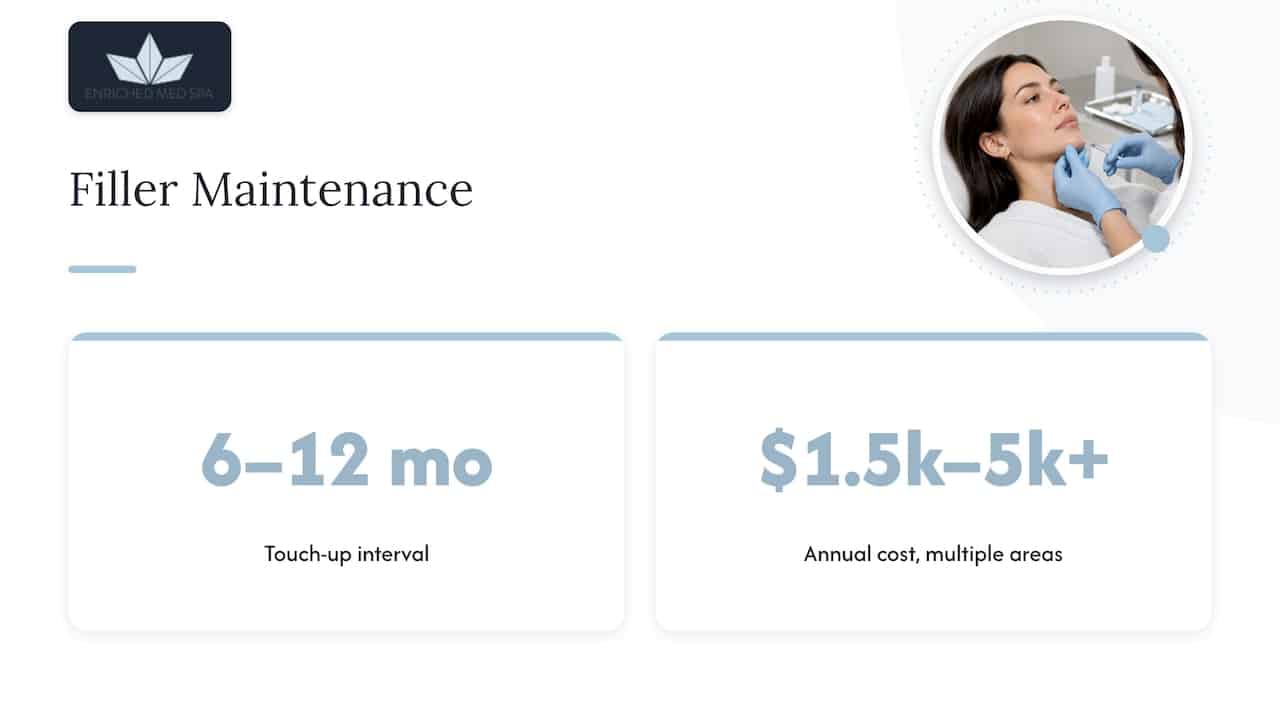
Hyaluronic acid filler is temporary, so the first treatment is not the whole cost. Lifetimes Canada notes that most Canadians budget for touch-ups every 6 to 12 months, and that over a year, regular maintenance for multiple areas can reach $1,500 to $5,000 or more. For a chin on its own, the figure will be lower, but it is wise to plan for a return visit.
How long your result holds depends on the product, the amount, your metabolism and how much movement the area gets. Our overview of how long dermal fillers last covers the factors in more detail. Often a smaller top-up costs less than the original session, because some of the first treatment is still in place.
Skin quality also supports a filler result. Some providers pair filler with skin treatments such as microneedling, and there is professional discussion about timing microneedling over fillers. Ask your injector how to sequence treatments if you are planning both. Our guide to looking after your skin after fillers covers aftercare in the weeks following your appointment.
Chin filler versus chin implant surgery
Some readers compare filler with surgery. A chin implant is permanent and involves an operation, while filler is non-surgical and adjustable. On price, one Ontario plastic surgery clinic lists chin implant surgery at $7,000 to $10,000, and the same page gives chin augmentation with fat at a similar range.
Filler is a lower-commitment way to see what a stronger chin does for your profile. If you decide you like the result and want something longer lasting, a surgeon is the right person to discuss that with.
Our perspective
When people ask us about chin filler, they usually start with price, and that is fair. But the number only makes sense once we understand what you want your profile to look like. Many clients come in noticing that their chin looks recessed in photos, or that their lower face feels out of balance with their lips. We start by looking at proportion, not by deciding how many syringes to sell.
Our approach is conservative and personalized. We would rather plan a modest first treatment, see how your face responds and refine from there than overfill on day one. Every treatment is performed by experienced nurse-level injectors, and we take the time to explain the plan, the price and the aftercare before anything is done.
Realistic expectations matter too. Filler is temporary, results soften over time and a touch-up is part of the plan. Knowing that up front means no surprises, and it helps you budget sensibly across the year.
Felix
Booking a chin filler consultation with us
If you are in Woodbridge, Vaughan or East Gwillimbury, we offer dermal filler consultations where we assess your profile, talk through products and give you a clear plan. We do not publish filler prices, so the consultation is where you get your specific total. You can read more about our dermal filler treatments or see what the filler experience looks like from consultation to results.
FAQ
How much is chin filler in Canada?
Most Canadian clinics charge between about $500 and $1,000 per syringe, with Toronto closer to $700 to $1,200. A chin may use one syringe or more, so a typical total is a small multiple of that range. Your consultation gives the exact figure.
Is chin filler cheaper than a chin implant?
Yes, filler costs much less up front. One Ontario plastic surgery clinic lists chin implant surgery at $7,000 to $10,000. Filler is temporary, though, so you repeat it, while an implant is a permanent surgical decision.
How often will I need chin filler touch-ups?
Many Canadians budget for touch-ups every 6 to 12 months. The timing depends on the product, the amount used and your own body. Your injector can suggest a schedule after seeing how your first treatment settles.
Why do prices differ so much between clinics?
Location, product, the injector’s training and the number of syringes all affect the total. Large cities tend to be 20 to 40 percent higher than mid-sized ones. Compare the plan and the product, not only the headline price.
What should I check before booking?
Ask who will inject, which licensed product will be used and what the total includes. Confirm that the filler has a Health Canada licence. Be cautious of prices far below the market range.
Sources
- Medical Aesthetics Pricing Canada 2026 | Cost Guide
- Dermal Fillers Cost in Canada 2026: Lips, Cheeks, and Jawline
- Injectable Cosmetic Therapies: Practice Advice for RNs (CRNA)
- Pricing at Our Clinic, The Plastic Surgery Clinic
- Microneedling Over Fillers: Timing and Protocol for Providers