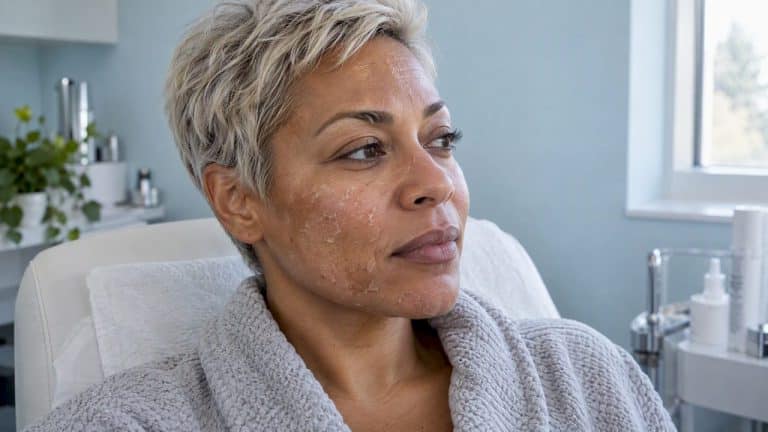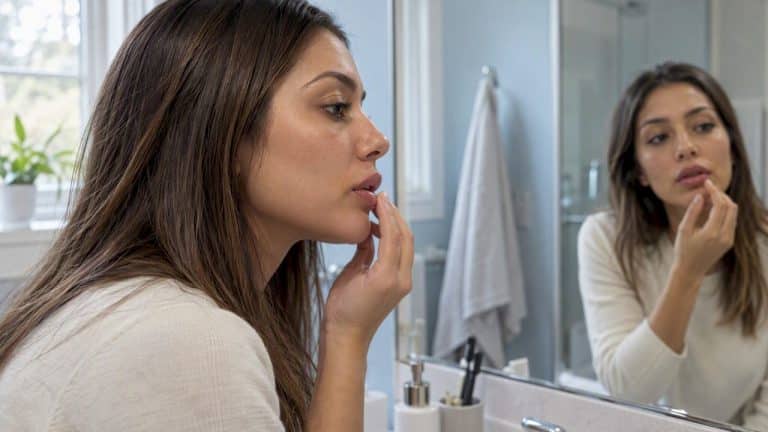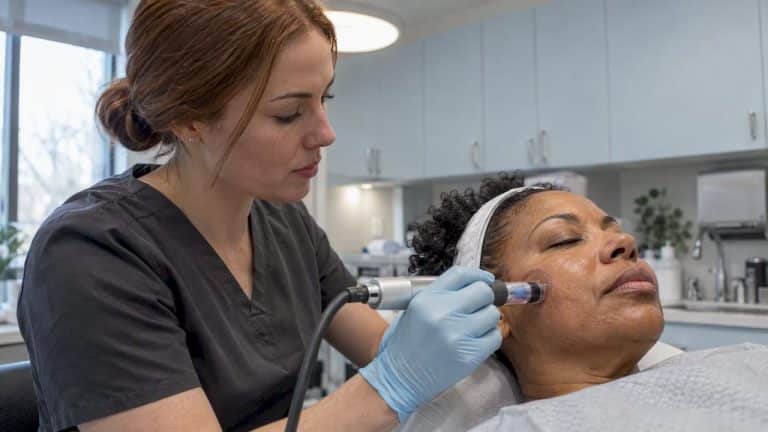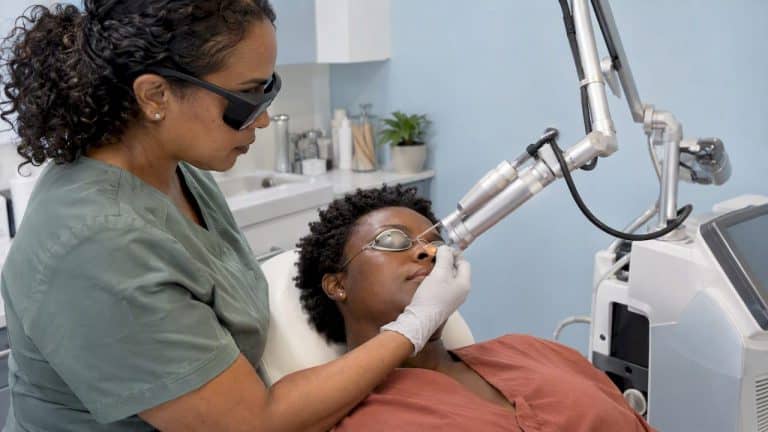
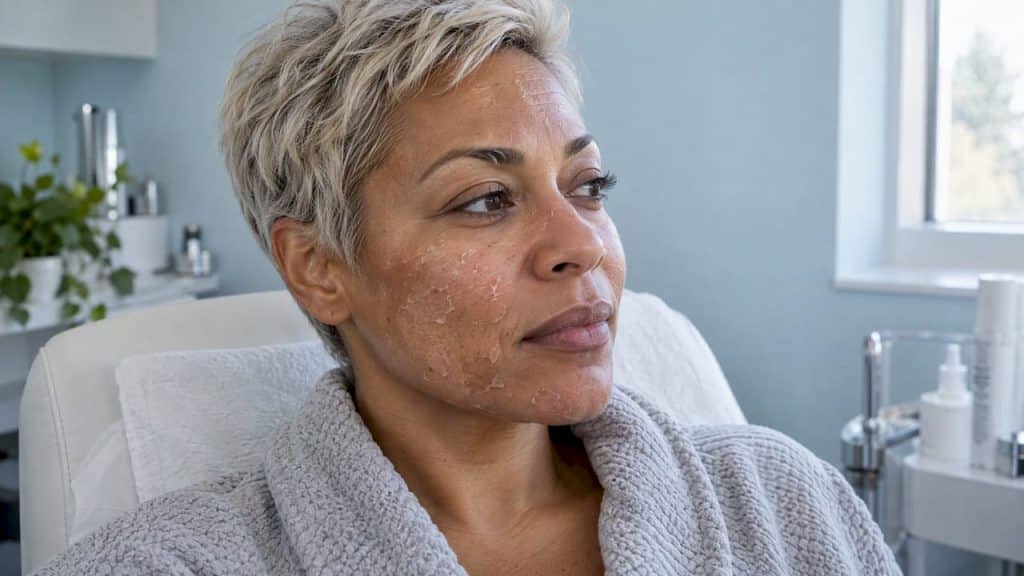
Chemical peel downtime depends almost entirely on how deep the peel goes. A light peel usually means a day or two of pink, tight skin and no time off. A medium peel, including most TCA peels, means roughly one to two weeks of visible peeling. A deep peel can mean two to three weeks at home, with redness lasting longer. Below, we walk through each level the way we would in a consultation, so you can plan around work, family and events.
TL;DR
- Light peels: you can usually return to normal activities right away, with redness and flaking for roughly three to seven days.
- Medium peels (TCA is the most common): expect swelling in the first 48 hours, then crusting and peeling over about 7 to 14 days.
- Deep peels: about two to three weeks of recovery at home, and months of strict sun protection.
- Aftercare shapes your downtime as much as the peel itself: gentle cleansing, moisturizer, no picking, and no sun until peeling stops.
- Skin tone, medical history and sun exposure change which depth is safe for you, so the right peel is a decision for your consultation, not a guess online.
Table of Contents
- Why downtime varies so much
- Downtime at a glance, by peel depth
- Light peels: little to no time off
- Medium peels and TCA peel downtime
- Deep peels: weeks, not days
- Our perspective
- Planning your peel around real life
- Caring for your skin while it heals
- What is normal, and when to call
- Who should be careful, and why depth matters for skin tone
- Lighter options if you cannot afford the downtime
- Booking a consultation at Enriched Med Spa
- FAQ
- Sources
Why downtime varies so much
A chemical peel works by applying an acid solution that makes the outer layers of skin shed, so new skin can form. The deeper the solution reaches, the more dramatic the change, and the longer your skin needs to rebuild. A 2010 review in the journal literature describes peel depth as a critical choice: superficial peels act on the epidermis to improve luminosity, while deeper peels target collagen regeneration.
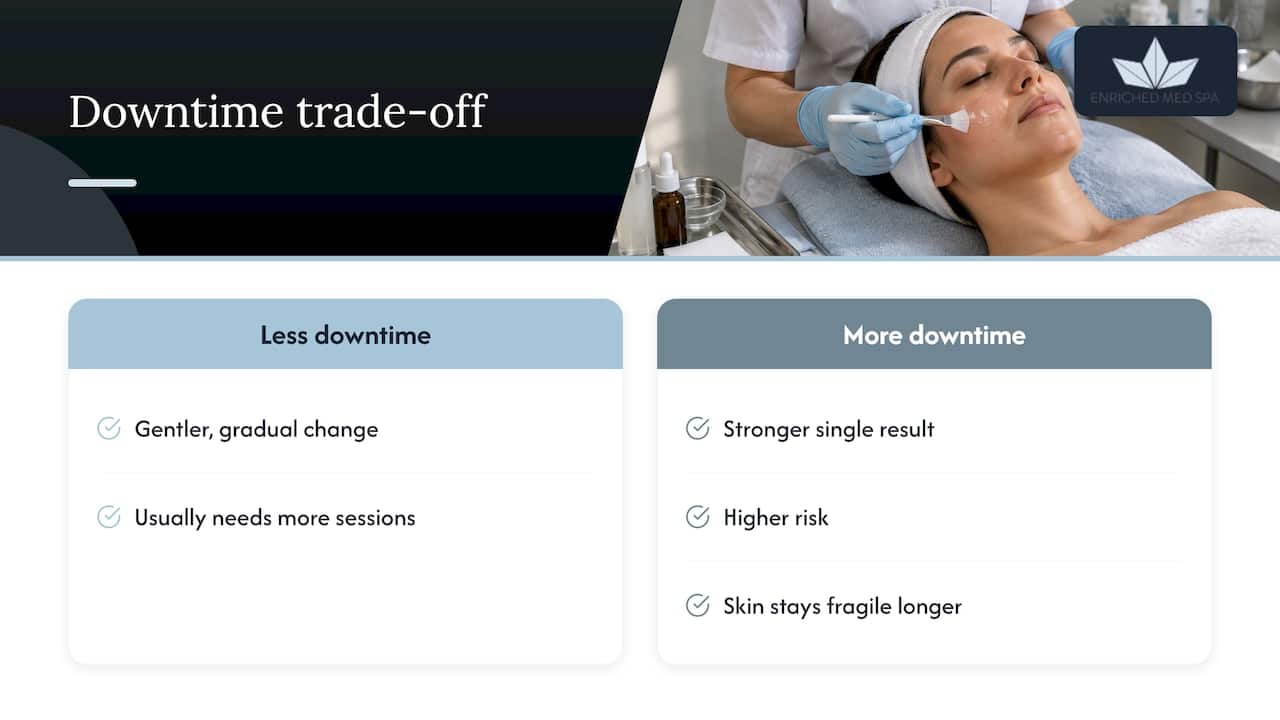
That is the trade-off in plain terms. Less downtime usually means more gentle, gradual change and more sessions. More downtime usually means a stronger single result, with higher risk and a longer period when your skin is fragile.
Many clients come to us after seeing a peel advertised as “no downtime” and then being surprised by a week of flaking. Others avoid peels altogether because they imagine a deep peel is the only kind. Neither picture is accurate, and the depth is the thing to ask about first.
Downtime at a glance, by peel depth
| Peel depth | Typical healing | What you see | Back to work |
|---|---|---|---|
| Light (superficial) | A few days, commonly 3 to 7 days of scaling | Redness, stinging, light flaking | Usually right away |
| Medium (often TCA) | About 7 to 14 days | Swelling, crusting, then peeling | Often about one week |
| Deep | About 14 to 21 days, longer redness | Bandaged area, significant swelling | Commonly about two weeks off |
These ranges come from Alberta Health Services patient guidance, the Cleveland Clinic and the American Academy of Dermatology. Individual healing varies, and your own timeline will depend on the product used, your skin and how well you follow aftercare.
Light peels: little to no time off
After a light peel, Alberta Health Services says most people can return to normal activities right away. Stinging, redness, flaking and some irritation are common, and the skin generally heals quickly. The Cleveland Clinic describes redness followed by scaling for three to seven days, and notes that makeup can usually be worn right away or the next day.
A realistic timeline looks like this:
- Day 0 to 1: skin feels warm, tight and a little pink, like a mild windburn.
- Day 2 to 4: dryness and fine flaking appear, often around the nose, chin and mouth first.
- Day 5 to 7: flaking settles and skin looks smoother and more even.
Light peels are repeated, usually as a series, because each one does a little. If you need a fresh look for a dinner or a work week, they are the easiest to fit around a calendar. If you are weighing them against more active treatments, our guide to types of medical grade peels explains how depth maps to results.
Medium peels and TCA peel downtime
Trichloroacetic acid (TCA) is the most common chemical used for a medium-depth peel, usually at concentrations of 20 to 35%. The AAD says a medium peel takes 7 to 14 days to heal: the skin crusts and peels, and a follow-up check is likely.
Here is what that usually looks like in practice:
- First 48 hours: redness and swelling. The Cleveland Clinic notes swelling for up to 48 hours after a medium peel. Swelling can be most noticeable around the eyes.
- Days 3 to 5: the skin tightens, darkens and begins to crust or flake. This is usually the least photogenic stretch.
- Days 5 to 10: sheets or flakes of skin come away. Do not pull them.
- Days 10 to 14: new skin looks pink and fresh, and the pinkness fades gradually.
The AAD also notes that skin will be red and swollen, swelling can worsen before it improves, eyelids may swell, and blisters can form and break open. That is expected for this depth, not a sign that something went wrong, but it is why a medium peel is a planned event, not a lunch-hour treatment.
After medium and deep peels, an antiviral medication is typically taken for 10 to 14 days to reduce the risk of a cold sore outbreak. Tell your provider if you get cold sores, so this can be planned in advance.
At concentrations above 35%, single-agent TCA peels are used only for small, focal areas because of the risk of scarring and pigment changes. If someone offers to put a high-strength TCA across your whole face for a quick fix, that is the time to slow down and ask questions.
Deep peels: weeks, not days
Deep peels heal in about 14 to 21 days. The AAD says the area is bandaged and several follow-up visits are required. Alberta Health Services notes that complete healing may take several months, and HealthLink BC says redness from deeper peels can last weeks or months.
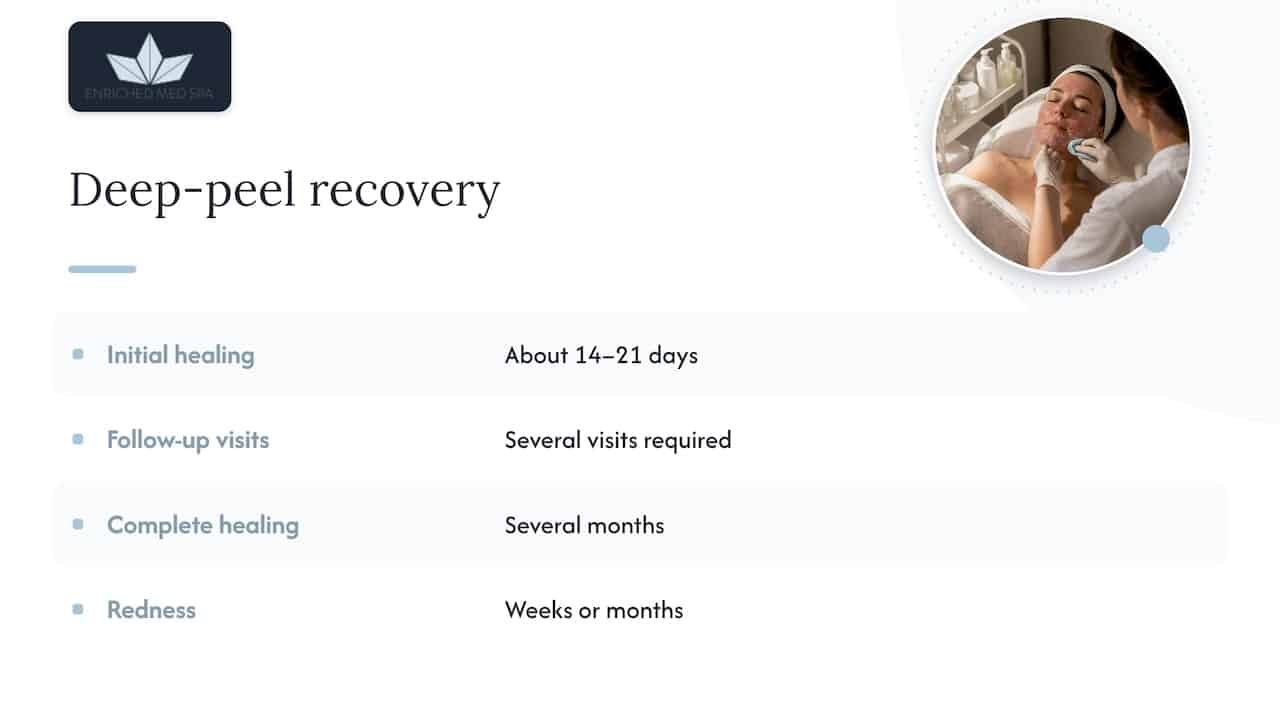
Deep peels also carry higher risks: scarring, pigment changes and, with phenol, possible effects on the heart rhythm, according to the 2010 review. A 2026 clinical overview makes the same point about long recovery and a higher risk of scarring and dyschromia. These are procedures for a physician-led setting with monitoring. For most people who want a refreshed face with a normal schedule, a series of lighter treatments is the more practical route.
Our perspective
We talk about downtime at nearly every skin consultation, because it is the question that decides whether a treatment actually happens. Many clients arrive noticing early signs of aging or tired-looking skin, wanting a visible change, but with a job, children and a calendar that cannot stop for ten days.
Our approach is to start with your schedule and your skin, not the treatment. If you have a wedding in three weeks, we would rather plan a gentle series that finishes with a quiet buffer than push for the strongest option and have you peeling in the photos. If pigment or texture is the real concern, we will tell you honestly when a peel is not the best tool and when something else, such as microneedling or a laser, fits better.
We also believe aftercare is half the treatment. Your skin needs time to breathe and rebuild, and most of the problems we see after peels come from picking, sun exposure or harsh products too soon, not from the peel itself. A good provider will give you written instructions and be reachable if something looks unusual.
— Felix
Planning your peel around real life
The best way to handle downtime is to treat it like any other commitment, with a plan.
- Work. Light peels rarely need time off. For a medium peel, Alberta Health Services suggests about one week before resuming normal activity, and about two weeks off after a deep one. Many people book a medium peel for a Thursday or Friday so the heaviest peeling lands over a weekend.
- Makeup. The Cleveland Clinic says makeup can go on immediately or the next day after a light peel, after five to seven days following a medium peel, and only after at least 14 days following a deep peel.
- Events. Finish any peel that causes visible flaking at least two to three weeks before a wedding, trip or photoshoot. Light peels can often be done closer to the date, but we still suggest avoiding anything new in the final week.
- Sun and travel. Do not book a peel just before a beach holiday. Avoid sun exposure until peeling stops, and use sunscreen daily afterwards, because new skin is more likely to be damaged by the sun. After a deep peel, the AAD recommends total sun avoidance for 3 to 6 months.
If you are also considering injectables, ask us about sequencing, because the order of treatments can affect how you feel and look in between. You can read about our botox options or dermal fillers before your visit.
Caring for your skin while it heals
Alberta Health Services lists the basics: clean the skin often, change the dressing or ointment for medium and deep peels, moisturize daily, and avoid sun until peeling stops. Beyond that, this is what we tell clients:
- Cleanse gently. Use a mild, non-comedogenic cleanser with lukewarm water, and pat dry.
- Moisturize often. Peeling skin feels tight, and a bland moisturizer keeps it comfortable.
- Do not pick or peel. Pulling flakes early can cause marks, pigment changes or scarring. Let the skin shed on its own.
- Skip actives. Pause retinoids, exfoliating acids and scrubs until your provider says they are safe to restart.
- Protect from the sun. Once peeling stops and sunscreen can be used, apply a broad-spectrum SPF every day. Hats and shade help in the meantime.
- Mind the heat. Avoid steamy showers, saunas and hot yoga for the first week or two after a medium peel. Keep showers lukewarm and keep the stream off your face.
The Cleveland Clinic puts it simply: treat newly renewed skin as fragile, follow your provider’s instructions and use lotion or cream as directed.
What is normal, and when to call
Normal healing involves redness, a tight feeling, stinging, flaking or crusting, and, for stronger peels, swelling mainly around the eyes. HealthLink BC also lists increased sun sensitivity as an expected effect.
Contact your provider or doctor if your skin itches, swells or burns beyond what you were told to expect. The Cleveland Clinic notes that infection, scarring and changes in skin colour are possible complications. Specific signs worth a same-day call include:
- spreading redness, warmth or pus-like drainage
- blisters or sores that look like a cold sore breakout
- pain that is getting worse instead of better after the first few days
- patches that turn noticeably darker or lighter
If you cannot reach your provider and symptoms are severe, see your family doctor or go to urgent care.
Who should be careful, and why depth matters for skin tone
Peel depth is not only a scheduling question. Medium-depth peels should be approached with caution in patients with darker skin because of the higher risk of prolonged hyperpigmentation. That does not mean peels are off the table. It means the product, strength and number of sessions are chosen more conservatively.
Bring up the following at your consultation:
- a history of cold sores, keloid or raised scarring, or slow healing
- recent sun exposure, tanning or waxing on the treated area
- current prescription skincare such as retinoids, or oral acne medication
- pregnancy or breastfeeding
- any upcoming event or travel
These details change what we recommend, and in some cases they mean waiting.
Lighter options if you cannot afford the downtime
Sometimes the honest answer is that a stronger peel is not the right fit for your calendar. Alternatives and complements include:
- Series of light peels. Gradual improvement in tone and texture, with minimal time away from your routine.
- Microneedling. A collagen-stimulating treatment with a short period of pinkness for most people. Ours is listed at $359 on our microneedling page, and our post-microneedling care guide explains the first few days.
- Laser resurfacing. Better suited to deeper texture concerns such as acne scarring. Our articles on how laser resurfacing works and CO2 laser for acne scars cover the trade-offs, including downtime and skin-tone considerations.
- Injectables. If lines and volume are the main concern, injectables have little visible downtime compared with a medium peel.
For a wider comparison, see our guide to skin rejuvenation treatments.
Booking a consultation at Enriched Med Spa
We serve Woodbridge, Vaughan and East Gwillimbury, and every treatment is performed by experienced nurse-level injectors and aestheticians. Our peel and skin treatment options, including CoolPeel and the Herbs2Peel B and C peels, are listed on our services page. Prices for most peels are not published, because the right option depends on your skin and goals.
Tell us your schedule at your consultation, whether that is a work week, a wedding or a trip, and we will build a plan around it, including how much healing time to expect and what aftercare to follow. If you are not sure which treatment suits you, start at our website and we will guide you from there.
FAQ
How long does it take to heal after a chemical peel?
It depends on depth. Light peels heal in a few days, medium peels in about one to two weeks, and deep peels in two to three weeks, with redness and sun sensitivity lasting much longer. Your aftercare matters: gentle cleansing, moisturizer and sun avoidance all help the skin recover on schedule.
What is the downtime for a TCA peel?
TCA is the most common acid for medium-depth peels, which take 7 to 14 days to heal. Expect swelling early, then crusting and peeling. Plan to keep your calendar light for the first week, and ask whether a follow-up visit is needed.
Can I wear makeup or go to work after a chemical peel?
After a light peel, usually yes, often the same or next day. After a medium peel, makeup is usually fine after about five to seven days, and many people return to normal activity in about a week. Deep peels typically mean about two weeks off work and no makeup for at least 14 days.
Is a chemical peel worth the downtime?
That depends on what you want to change. A series of light peels suits mild dullness or uneven tone, and a medium or deep peel can do more but comes with real healing time and higher risk. We would rather talk through your goals and schedule first, and sometimes the better answer is a different treatment altogether.
Sources
- Chemical Peel, Alberta Health Services (MyHealth.Alberta.ca)
- Chemical Peel, HealthLink BC
- Chemical Peels, Cleveland Clinic
- Chemical peels: FAQs, American Academy of Dermatology
- Chemical peels (face peels), DermNet
- Evidence and Considerations in the Application of Chemical Peels, PMC
- Chemical peels, Medicine Today (May 2026)