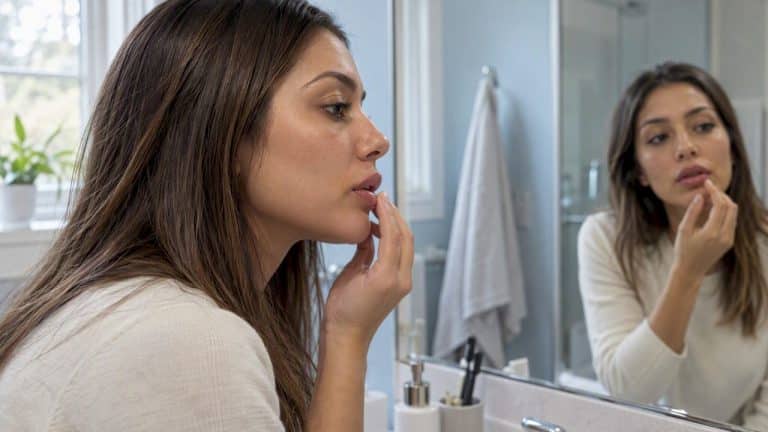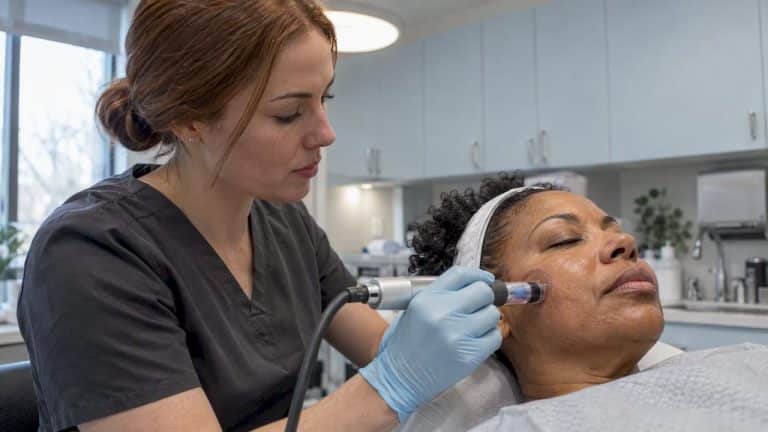
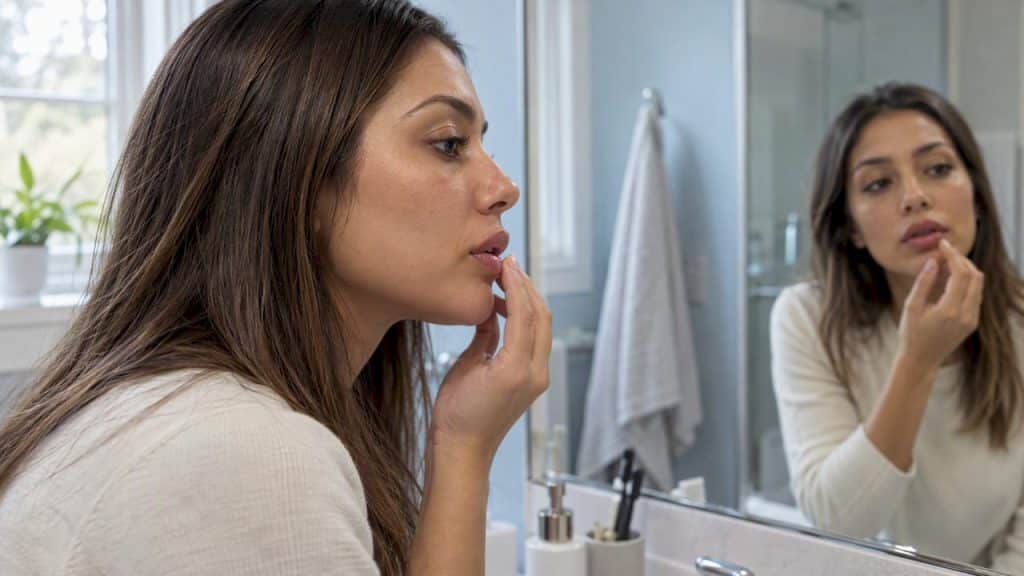
Swelling after lip filler is normal, and it follows a fairly predictable path. Your lips look fullest in the first few days, then settle gradually over about one to two weeks, and the result you actually keep shows up once the swelling is gone. This guide walks through each stage, explains why lips can look uneven along the way, and names the signs that mean you should call someone straight away.
TL;DR
- Expect lips that look larger than planned for the first few days. Official guidance says swelling after filler may last up to 36 hours, and in practice many people look puffier for several days longer.
- Most of the visible puffiness fades over one to two weeks. A 2025 anatomical review notes that roughly 10 to 20% of the initial apparent volume goes away as swelling reduces in that window.
- Judge your result at about two weeks, not on day two. Lumps, asymmetry and tightness often settle on their own.
- Swelling that gets worse, new pain, pale or dusky skin, or any vision change is not normal. Call your injector or seek urgent care right away.
Table of Contents
- Why lips swell after filler
- The lip filler swelling stages, day by day
- Why your lips can look uneven or lumpy on day three
- What changes how much you swell
- Aftercare that helps swelling settle
- Normal swelling versus a warning sign
- Safe treatment starts before the swelling
- Our perspective on lip filler recovery
- Lip filler with Enriched Med Spa
- FAQ
- Sources
Why lips swell after filler
Lips are soft, very vascular tissue. A needle or cannula passes through them, a gel that attracts water is placed inside, and the body responds with a mild inflammatory reaction. That reaction is the swelling you see. It is not a sign that something went wrong.
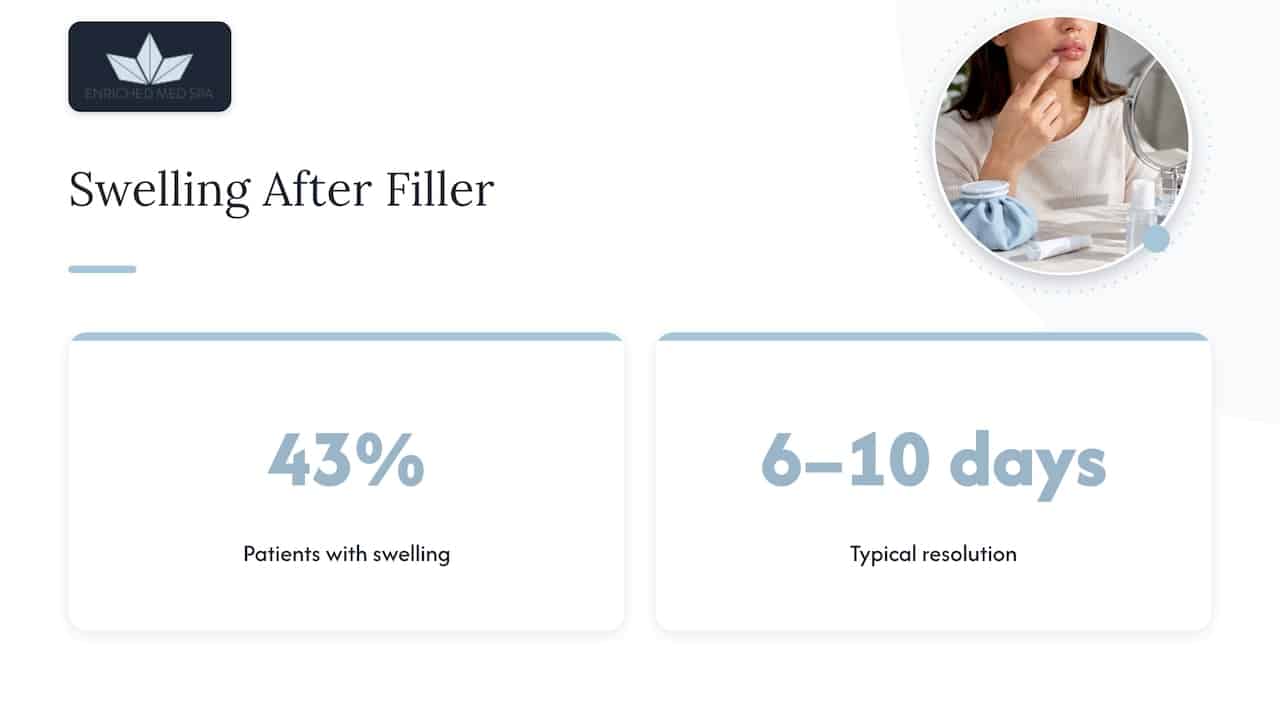
Health Canada lists pain, bruising, redness, swelling and nodules among the expected or reported reactions to dermal fillers, and notes that many are temporary. In a randomized controlled lip-filler study, lip swelling occurred in 43% of patients, with events typically starting within a day and generally resolving within 6 to 10 days. So if your lips swell, you are in good company.
How much you swell is not the same for everyone. An expert consensus review states that timing and severity vary with the filler type, the injection volume, the technique and patient factors. That is why a friend’s timeline is a rough guide, never a promise for your own lips.
The lip filler swelling stages, day by day
The pattern below is a typical one. Your own experience may run a little faster or slower, and a small first treatment usually settles more quietly than a larger one.
| Stage | What you will usually notice | What to do |
|---|---|---|
| Day 0 (treatment day) | Lips feel tight and look fuller. Some tenderness, possibly small pinpoint marks | Cold compress, avoid touching, keep your head slightly raised |
| Day 1 | Swelling builds. Lips can look quite large or slightly uneven | Rest, drink water, skip exercise |
| Days 2 to 3 | Often the fullest point. Firmness or small bumps can be felt | Stay patient, keep following aftercare |
| Days 4 to 5 | Noticeable softening. Lips begin to look more like you | Resume normal routine gradually |
| Days 6 to 7 | Most visible swelling is gone for many people | Check for symmetry, but do not judge yet |
| Week 2 | Filler settles into the tissue. Texture softens | Book a review if something still bothers you |
| Weeks 3 to 4 | Final shape and softness show | Review the result with your injector |
Day 0: the first hours
Right after treatment, lips feel tight and look bigger than you expected. Some of that is the gel itself, some is fluid, and some is the numbing agent in the product or applied beforehand. Mild redness and tenderness are common. HealthLink BC lists pain, redness, swelling and possibly itching after filler injection.
This is the time to keep things simple. Cleveland Clinic suggests an ice pack for up to 10 minutes at a time, avoiding lip products and touching or puckering your lips for at least 24 hours, drinking plenty of water, and skipping exercise for at least 24 hours.
Day 1: swelling builds
It is common to wake up to lips that look larger than they did the night before. The randomized lip-filler study above found treatment-related events typically began within a day. Many clients are surprised by this morning-after picture and message us worried. In most cases it is exactly what we would expect.
Sleeping with your head slightly raised can help fluid drain from the area. Avoid sleeping face-down on a pillow, which presses on the lips.
Days 2 and 3: the peak for many people
For many people the fullest, firmest-feeling point lands on day two or three. Your lips may look noticeably bigger than the final result will be. This is also when lips most often look uneven, because one side can swell more than the other.
That unevenness deserves its own explanation, so it has its own section below. The short version: a lopsided look on day three is common and usually not a reason to judge the work.
One caution belongs here. HealthLink BC advises contacting a doctor if symptoms worsen one to three days after treatment, because worsening can point to infection. Swelling that is stable or slowly improving is a very different picture from swelling that keeps growing, turns hot, or comes with increasing pain.
Days 4 to 7: the fade
From around day four, most people see a clear improvement. Lips soften and begin to move more naturally when you talk and smile. By the end of the first week, many clients look close to their usual selves, perhaps with a little residual fullness in the morning.
The lip-filler trial mentioned earlier reported that common events generally resolved within 6 to 10 days, which lines up with this stage.
Week 2: settling and integration
By now most swelling should be gone. The 2025 anatomical review describes a drop of roughly 10 to 20% of the initial apparent volume over one to two weeks as swelling reduces. In plain terms, the lips you see on day two are slightly bigger than the lips you will keep.
The same review points out that early apparent fullness includes edema, and that when refinement is needed, a staged approach with sessions two to four weeks apart may be preferable. That is a good reason not to rush back for “a little more” at day five.
Weeks 3 and 4: the result you keep
This is when you can judge shape, softness and symmetry fairly. Filler that felt firm early on should feel soft and natural. If you still see a real difference between the two sides, or a lump that is not budging, a review appointment is the right next step.
Why your lips can look uneven or lumpy on day three
“Why do my lips look uneven three days after fillers?” is one of the most common worries, and it is a reasonable one.
Swelling rarely spreads evenly. Natural asymmetry matters too: most of us have one lip side that is slightly fuller or sits differently, and swelling can exaggerate that. Product placement on each side, a small bruise and how you slept all play a part.
Small bumps are also common early on. Cleveland Clinic says small bumps or a bumpy texture right after lip filler can be normal, but large, obvious, hard or painful lumps, or lumps that last beyond a couple of days, should be reported to your provider.
A practical rule we like to share with clients:
- Mild unevenness that is changing, even slowly, for the better: wait and keep following your aftercare.
- Unevenness that is getting worse, or comes with increasing pain, heat or colour change: contact your injector the same day.
- Mild unevenness that is still there at two to four weeks: book a review. Small adjustments, when needed, are usually best made after the tissue has settled.
What changes how much you swell
Two people can have the same treatment and very different recoveries. These are the factors that matter most.
The product
Formulation can change early swelling. In a prospective randomized trial of 280 lip-enhancement patients, acute volume change was assessed on day one and was similar between the two products by day 14, yet one product with lidocaine caused less short-term swelling than the other. In other words, filler choice can influence the first days even when the longer-term outcome is comparable. If you want to compare options, our guide on how to choose the best lip filler for your needs explains what to ask.
The amount and the technique
More volume generally means more tissue response. This is one reason a conservative first treatment is a sensible plan for first-time patients: the recovery is gentler, and you can add later if you want to. The expert consensus review also lists injection technique among the factors that shape swelling.
Your own body
Skin that reacts strongly to light pressure (dermographism) is one of the patient factors named in the same review. Beyond that, we ask about bleeding tendencies, previous cold sores in the lip area, allergies, and medications or supplements that thin the blood, because they can all affect bruising and swelling.
Health Canada’s dermal-filler guidance identifies pregnancy or lactation, hypersensitivity, bleeding disorders, infected or inflamed tissue, and a tendency toward keloids or abnormal pigmentation or scarring as contraindication or precaution topics. A thorough consultation should cover all of these before any needle comes out.
Aftercare that helps swelling settle
Good aftercare will not make swelling vanish, but it can keep it from being worse than it needs to be. Here is what we usually recommend, in the order it tends to matter.
- Cold, briefly. Use a clean, wrapped ice pack for short intervals, up to about 10 minutes, and never directly on the skin.
- Keep your hands off. Avoid pressing, massaging, puckering or testing the lips for at least the first 24 hours, unless your injector tells you to massage.
- Skip exercise for 24 hours. Raised blood pressure and body heat tend to increase swelling.
- Avoid heat for the first days. Saunas, hot yoga, very hot showers and long sun exposure can make lips puffier.
- Drink water and eat gently. Soft, easy foods and a straw can make the first day more comfortable.
- Go easy on alcohol and lip products during the first day, as Cleveland Clinic advises avoiding lip products for 24 hours.
- Sleep with your head raised for the first couple of nights.
For more detail, our own pages on how to reduce swelling after lip fillers, lip filler aftercare and dermal filler recovery tips go further.
Plan around your calendar
If you have a wedding, photoshoot or important meeting coming up, do not book lip filler for the week before it. Allow at least two to four weeks so swelling, any bruising and a possible touch-up all fit comfortably. Many clients who come to us before an event find that a conservative plan, started early, gives them the most natural look on the day.
Normal swelling versus a warning sign
Most swelling is harmless. A few signs are not, and you should know them in advance rather than search for them at midnight.
Call your injector or doctor promptly if
- Swelling, redness or pain gets worse between one and three days after treatment. HealthLink BC says this may indicate infection.
- You develop new redness, swelling or pain after the first day.
- A lump is hard, painful or large, or has not eased after a couple of days.
- You have a fever, warmth spreading across the lip, or pus.
Seek urgent care straight away if
Rare but serious complications can happen when filler affects a blood vessel. HealthLink BC notes rare serious complications that include blockage of a retinal artery causing blindness, and skin necrosis. A peer-reviewed study by University of British Columbia authors describes vascular compromise as rare but serious, with eight of its 12 cases involving the nasolabial fold or lip. The same authors observed it in eight of 14,355 filler injections in their practice, so it is uncommon, but it is time-sensitive.
Watch for:
- Skin that turns pale, white, blotchy, mottled or dusky. A consensus paper describes blanching or a lace-like pattern as an early sign of arterial occlusion.
- Pain that seems out of proportion to the treatment, or swelling that is far greater than expected.
- Later blistering, weeping or discolouration of the skin.
- Any eye pain or change in vision. The same consensus paper says this needs immediate hospital transfer.
A perioral-filler review recommends immediate return for care because the chance of reversal is greatest in the first four to five hours. If you cannot reach your injector quickly, go to the nearest emergency department and tell them you recently had filler. Do not wait to see whether it improves overnight.
Safe treatment starts before the swelling
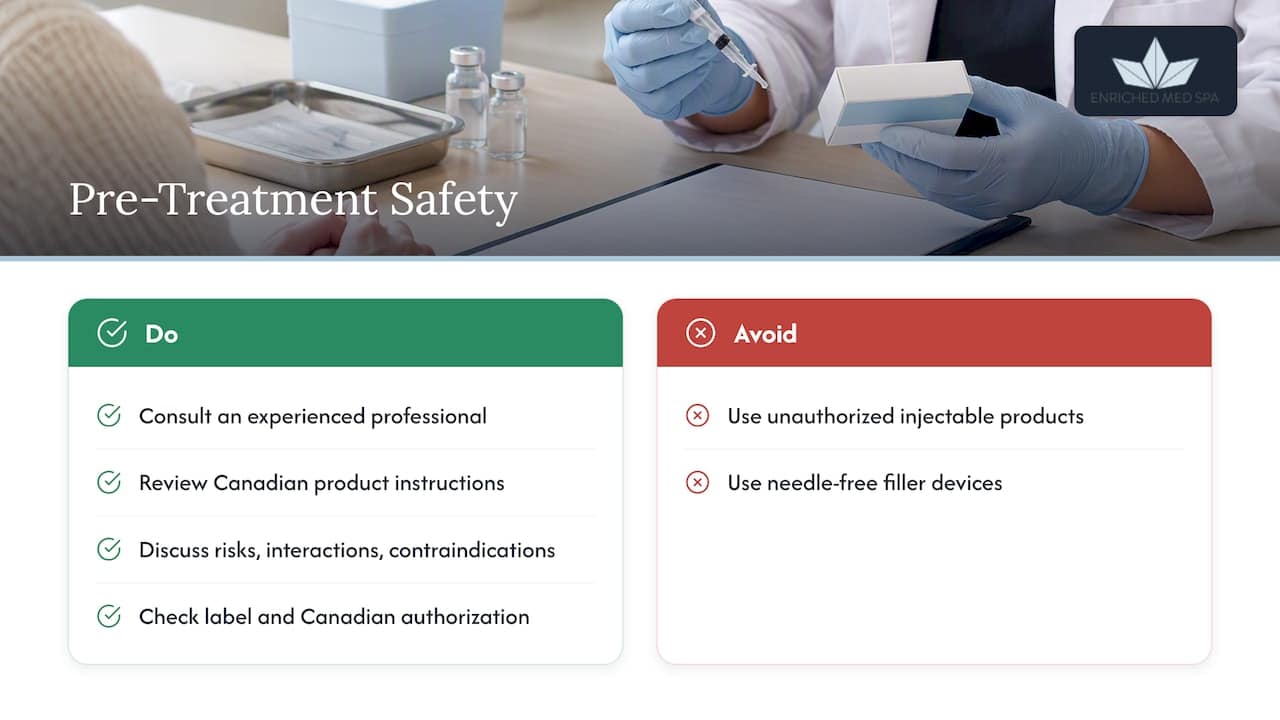
How smoothly your lips recover depends partly on decisions made before the appointment. Health Canada advises consulting an experienced medical professional, reviewing the product’s Canadian instructions or monograph, and discussing risks, benefits, interactions and contraindications before any injectable cosmetic treatment.
It also matters what is in the syringe. In an August 2026 Ontario alert, Health Canada advised people not to use unauthorized injectable health products, and to ask the administering professional to show the label and verify Canadian authorization. It is a fair question to ask any clinic, and a good clinic will welcome it. Health Canada has also warned that needle-free dermal-filler devices are not authorized for sale in Canada and can cause inflammatory reactions, infection and injury. For a wider look at the topic, see our page on whether lip fillers are safe.
Our perspective on lip filler recovery
Many clients come in expecting a subtle change and are startled by the first 48 hours. We understand that. The most useful thing we can do is set the picture before treatment: your lips will look bigger and a little imperfect for a few days, and that is the swelling talking, not the result.
That is why we lean toward conservative first treatments, a full consultation and clear written aftercare. Smaller volumes mean a calmer recovery and a more natural outcome, and you can always build gradually. We would rather you come back for a small refinement at the two to four week mark than chase a look while your lips are still swollen.
We also encourage you to message us if something feels off. Reassurance takes a minute. A missed warning sign can cost much more.
— Felix
Lip filler with Enriched Med Spa
If you are considering lip filler in Woodbridge, Vaughan or East Gwillimbury, our treatments are performed by experienced nurse-level injectors. Your visit starts with a consultation covering your goals, your medical history and what recovery will look like, followed by written pre- and post-care guidance. You can read about our dermal filler services and book a consultation from there. The page does not list a fixed price, so we quote after assessing what you actually need.
FAQ
How long does lip filler swelling last?
Official guidance says swelling after filler may last up to 36 hours, but visible puffiness often lingers longer. Most people see the bulk of it fade over about one to two weeks. Studies report common treatment-related effects resolving within roughly 6 to 10 days.
When does lip filler swelling peak?
It usually builds through the first day and is often fullest around days two to three, then eases from about day four. The pattern varies with the product, amount injected and your own body. If swelling keeps worsening between days one and three, contact your injector.
Can I speed up lip filler recovery?
You cannot make swelling disappear, but you can avoid making it worse. Use short cold compresses, keep your head raised, drink water, avoid exercise for 24 hours and stay away from heat such as saunas. Do not press or massage the lips unless your injector asks you to.
Why do my lips look uneven after filler?
Swelling is rarely symmetrical, and natural differences between the two sides can show up more. Small bumps can be normal early on. Hard, painful or large lumps, or lumps lasting beyond a couple of days, should be reported to your provider, and a review at two to four weeks is sensible if unevenness remains.
Who should not get lip filler?
Health Canada’s guidance names pregnancy or lactation, hypersensitivity, bleeding disorders, infected or inflamed tissue and a tendency toward keloids or abnormal scarring as precautions or contraindications. Tell your injector about your full history, medications and allergies before treatment so they can advise whether filler is right for you.
Sources
- Filler Injections, HealthLink BC
- Cosmetic injections, Health Canada
- Anatomical-Based Diagnosis and Filler Injection Techniques (2025)
- Randomized, evaluator-blinded, controlled lip-filler study
- Treatment of Soft Tissue Filler Complications: Expert Consensus
- Lip Fillers: What to Expect, Cleveland Clinic
- Lip Filler Aftercare: What Not To Do, Cleveland Clinic
- Juvéderm Volbella with lidocaine for lip and perioral enhancement
- Health Canada dermal-filler premarket guidance
- Vascular Compromise from Soft Tissue Augmentation
- Facial aesthetic injections in clinical practice
- Complications of fillers in the lips and perioral area
- Unauthorized injectable health products alert, Health Canada
- Needle-free dermal filler devices alert, Health Canada