Yes, chin filler can sharpen the jawline for many people, but it works by building projection and structure, not by melting fat or tightening skin. It suits mild to moderate concerns like a weak chin, a soft jaw angle, or subtle asymmetry, and the effect is temporary, usually settling into its final look within a few weeks. Safety comes down almost entirely to anatomy knowledge and injector skill, and with hyaluronic acid (HA) fillers, an unwanted result can be dissolved rather than lived with.
TL;DR:
- Chin filler can improve jawline sharpness by adding projection and structure, especially in cases of mild to moderate deficiency.
- The typical duration of hyaluronic acid fillers for jawline definition is 12 to 18 months, with longer-lasting options like calcium hydroxylapatite being less reversible.
- Serious risks such as vascular occlusion are rare but require injector expertise and safe techniques, including the use of cannulas and thorough anatomical knowledge.
- Staged, conservative treatments are recommended to accurately assess tissue response and avoid overcorrecting, with full results visible after about one month.
- Filler is most effective when the primary concern is lack of projection or structure, not excess fat or skin laxity, which may require alternative or combined treatments.
Table of Contents
- How chin filler for jawline definition actually changes your profile
- Which filler type is right for chin and jawline sculpting?
- What happens during a chin and jawline filler appointment?
- What are the real risks of jawline filler, and how are they managed?
- Are you a good candidate, and what else should you consider?
- How we plan chin and jawline treatments at Enriched Med Spa
- Why staged treatment beats going big on day one
- Ready to talk about your jawline goals?
- Sources
- FAQ
How chin filler for jawline definition actually changes your profile
The jawline you see in the mirror is a combination of bone structure, fat distribution, skin tone, and muscle position. Filler cannot change your skeleton, but it can add volume in ways that mimic what a stronger jaw or chin would look like from the outside. When we place filler along the mandible or add projection to the chin, we are essentially building a more defined transition between the neck and the lower face.
Forward projection is the most common goal. A chin that sits slightly behind the lower lip, sometimes called retrogenia, tends to make the jawline look softer than it is, even in people with a normal amount of jaw bone. Adding volume at the pogonion, the most forward point of the chin, pushes that point out and down slightly, which visually lengthens the lower third of the face and reduces the appearance of a “double chin” even when there is minimal excess fat. This is one of the more predictable changes in facial injectables because the anatomy is relatively simple and the improvement is easy to see from a side profile photo.
Lateral placement along the jaw itself works differently. Filler placed along the mandibular border, particularly near the angle of the jaw, can create a sharper, more squared transition from cheek to neck. This is popular with clients chasing a more angular look, but it needs a careful hand. Too much volume here, especially in someone with a naturally narrow face, can widen the lower face in a way that looks heavy rather than sculpted. We generally place small amounts and reassess before adding more.
Common goals we see in consultations include:
- Sharpening a soft or rounded jaw angle for a more contoured profile
- Correcting mild asymmetry where one side of the jaw sits lower or less defined than the other
- Softening a dimpled or “orange peel” chin texture caused by overactive muscle pull
- Adding length to a short chin to better balance the nose and lips in profile
Magnitude of change is usually modest. This is not a treatment that reshapes your face; it refines what is already there. Most clients see a noticeably sharper angle or a longer chin, not a dramatically different face. Immediately after treatment, the area often looks slightly fuller than the final result because of swelling, and it typically takes two to four weeks for that swelling to resolve and the filler to “settle” into its true shape. Injectable fillers for chin and jawline rejuvenation can offer meaningful, non-surgical contouring, but the technique and product selection have to match the individual’s anatomy and goals, which is why a generic approach rarely gives the best outcome.
Which filler type is right for chin and jawline sculpting?
Not all fillers behave the same way once they are under the skin, and the material you choose changes how the result looks, how long it lasts, and how easily it can be corrected if something needs adjusting.
Hyaluronic acid (HA) remains the most commonly used option for chin and jawline work, largely because of one feature no other filler category offers as reliably: reversibility. If the result is uneven, feels too firm, or simply is not what the client pictured, hyaluronidase can dissolve it. HA fillers used for structural chin projection are typically formulated with higher G’ (a measure of gel firmness), which lets the product hold its shape under the pull of chewing and speaking muscles instead of spreading out. Longevity for chin and jawline HA treatments tends to run around 12 to 18 months, though this varies based on metabolism, the specific product, and how much movement occurs in the treated area.
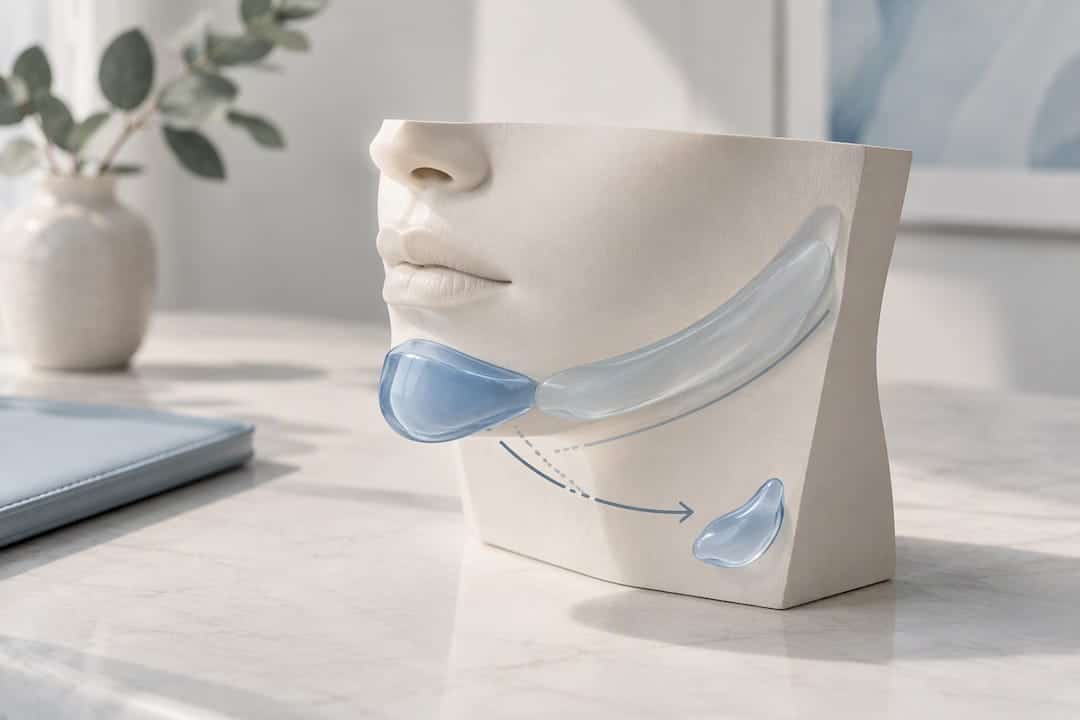
Calcium hydroxylapatite (CaHA) offers a different trade-off. It provides firmer scaffolding right away and also stimulates the body’s own collagen production over time, which means results can continue to improve subtly for a few months after treatment. The downside is that it is not reversible with hyaluronidase, so correction options are more limited if the outcome needs adjusting. CaHA and other biostimulatory fillers are usually reserved for clients who want longer-lasting structural support and understand they are trading some flexibility for durability, a distinction supported by reviews of dermal filler safety and material selection.
A few physical properties matter more than most people realize when comparing products:
- G’ (elastic modulus): higher values hold projection better under muscle movement, which matters more at the chin than almost anywhere else on the face
- Viscosity: thicker gels resist migration but can be harder to mould smoothly
- Cohesivity: how well the product holds together as one mass versus spreading into surrounding tissue
Technique matters as much as product choice. Needles allow precise, targeted placement, which is useful for small corrective touches like softening a dimple. Cannulas, which are blunt-tipped rather than sharp, let us move product across a broader area with fewer entry points and a lower risk of piercing a blood vessel, which is one reason they are frequently chosen for lateral jawline work.
Pro Tip: Ask your injector which product they plan to use and why, specifically for your goal. A firm, high G’ HA filler chosen for chin projection is a very different decision than a softer product used to blend the jawline into the neck, and a confident injector should be able to explain that choice in plain terms.
What happens during a chin and jawline filler appointment?
A proper consultation is where most of the planning happens, and it should feel more like a conversation than a sales pitch. Many clients come in with a general sense that their jawline looks “soft” or “undefined” without being able to pinpoint why, and that is exactly what the assessment is for.
- Facial analysis and photo documentation. We look at the face from multiple angles, front, both sides, and often a slight downward angle, to see how the chin and jaw interact with the neck and profile. Photos also give us a baseline to compare against after healing.
- Medical history and consent. This covers allergies, prior filler or surgical history, blood thinning medications, and any autoimmune conditions that might affect healing or increase risk.
- Treatment mapping. Based on the assessment, we mark the injection points, commonly using a three point technique along the mental crease, pogonion, and jaw angle, along with linear threads along the mandibular border for definition.
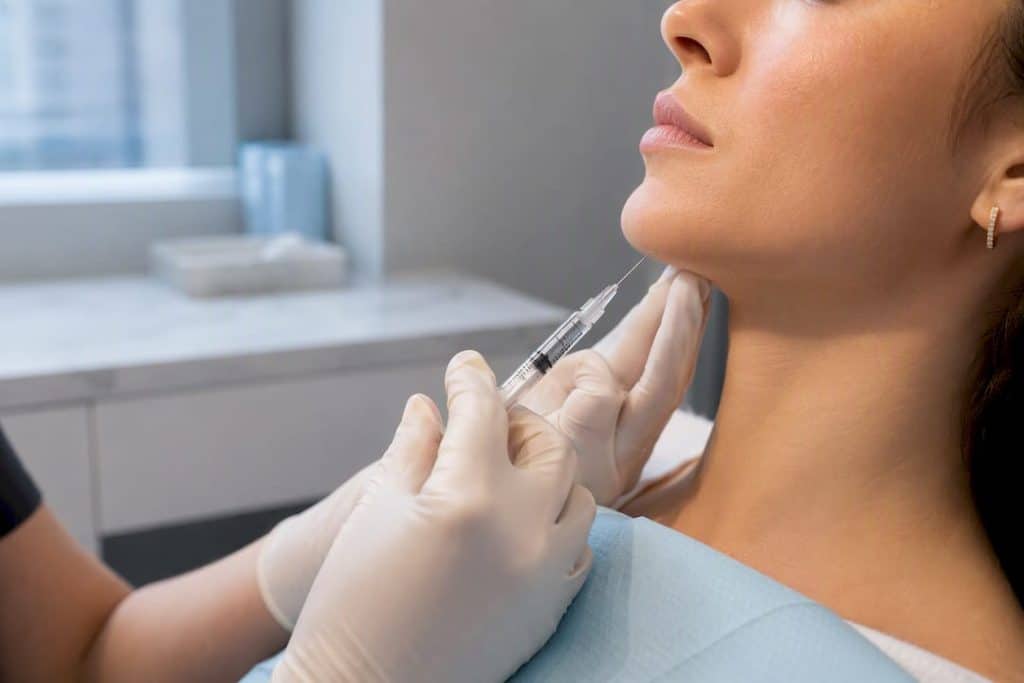
- In-clinic procedure. After topical or local anaesthetic, the filler is injected in small, controlled amounts, often through a combination of needle for precise depot placement and cannula for smoother distribution along the jawline. Typical volumes vary widely depending on starting anatomy and goals, ranging from a small amount for subtle chin projection to larger amounts for combined chin and full jawline contouring.
- Immediate checks. After injection, we check symmetry, capillary refill, and overall shape while the client is still upright, since gravity changes how volume sits compared to lying flat.
Downtime is usually mild. Swelling and bruising are common in the first three to five days, and most clients feel comfortable in public within a week with some concealer for bruising. The area may feel firm or slightly lumpy at first, which typically softens over the following two to four weeks as the product integrates with surrounding tissue. We generally recommend waiting the full settling period, about a month, before booking any touch-up, so we are adjusting the real result rather than reacting to temporary swelling.
What are the real risks of jawline filler, and how are they managed?
Most side effects from chin and jawline filler are minor and expected. Swelling, bruising, tenderness, and small temporary lumps are common in the days following treatment, and they usually resolve on their own or with light massage, cold compresses, and time. Systematic reviews of dermal filler safety confirm that the large majority of adverse events across HA treatments are mild and transient, resolving within days to a couple of weeks.
The risks that matter, though rare, are the ones every reputable clinic plans around before the needle ever touches skin:
- Vascular occlusion: filler accidentally injected into or compressing a blood vessel, which can cause tissue damage if not caught quickly
- Skin necrosis: a consequence of prolonged occlusion where blood supply to skin is cut off
- Infection: rare with proper sterile technique but possible with any injectable
- Vision changes: an extremely rare but documented risk when filler enters certain vessels connected to the ophthalmic circulation
Warning signs of occlusion include sudden severe pain out of proportion to the injection, skin that turns unusually pale or mottled, or a dusky, purplish discolouration that spreads beyond the injection site. If any of these appear, the injection stops immediately, and for HA fillers, hyaluronidase is administered promptly to dissolve the product and restore blood flow. This is one of the biggest practical advantages HA has over non-reversible fillers: there is an antidote.
The single biggest factor in avoiding these complications is injector knowledge of facial anatomy, specifically the path of the facial and submental arteries relative to the injection site. Guidance on safe injection planes and depths recommends supraperiosteal or subdermal placement in the chin and prejowl area specifically to stay clear of these vessels. Cannula use also plays a measurable role: retrospective research comparing needle and cannula technique found meaningfully lower rates of vascular occlusion when cannulas were used, which is a large part of why many injectors default to cannula for lateral jawline passes even though needles still have a place for precise, small corrections.
A mild, expected side effect like next-day swelling calls for home care and patience. A sign of vascular compromise, severe pain, colour change, or a rapidly expanding firm area, calls for immediate contact with your injector or, if they are unreachable, urgent medical attention. Knowing that difference before treatment, not after, is part of informed consent that every client deserves.
Are you a good candidate, and what else should you consider?
Filler works best on a specific kind of problem: a jawline that lacks structure or projection, not one that is obscured by other issues. Before recommending it, we look at a few things.
- Structural deficiency versus excess fat. If the softness under the chin is mostly fat rather than a lack of bone or projection, filler will not create the sharp line you are picturing. Submental fat reduction is a separate conversation.
- Skin laxity. Meaningful loose or sagging skin along the jaw is a skin quality issue, and filler cannot tighten it. In these cases, radiofrequency skin tightening often does more for the actual concern.
- Medical history. Active infection in the area, certain autoimmune conditions, and some medications can affect candidacy and need to be discussed openly.
- Realistic expectations. Clients looking for a dramatic, surgical-level jaw reshaping are usually better served by a conversation about surgical options than by filler.
For clients whose main concern is muscle bulk rather than bone structure, particularly a wide, square jaw caused by an overactive masseter muscle, a neuromodulator like Botox can slim the jawline rather than build it out, which is close to the opposite mechanism of filler. Some clients benefit from combining approaches: filler for chin projection, neuromodulator for masseter reduction, and skin tightening for laxity, layered over a few appointments rather than attempted all at once.
How we plan chin and jawline treatments at Enriched Med Spa
Every consultation starts with a full facial assessment, not just a look at the chin in isolation. Photos are taken from multiple angles, the jawline is mapped against the neck and profile, and we discuss what “sharper” or “more defined” actually means to that specific client, since the phrase means something different for everyone.
From there, we document a plan before any product is opened. This typically includes the number of syringes we expect to use, the injection technique, and a written note of what we are correcting for future reference at follow-up. Toronto-area jawline filler sessions at Enriched Med Spa generally run between $1,400 and $4,800 for a two to four syringe session, with the final number depending on how much correction is needed and which product best suits the anatomy.
Our safety protocols follow the same principles outlined in clinical literature: procedures performed by practitioners trained in facial vascular anatomy, emergency protocols that include hyaluronidase availability for HA complications, and scheduled follow-ups to check healing and symmetry. In the weeks after treatment, many clients notice the area looking a little sharper each week as swelling fades, with the true result visible by the one-month mark. Maintenance typically means a touch-up appointment somewhere between 12 and 18 months later, depending on how the individual metabolizes the product.
- Full facial mapping and photo documentation before treatment
- Written treatment plan noting product, technique, and expected syringe count
- Emergency protocol and hyaluronidase availability for HA-based complications
- Scheduled follow-up to assess final settled results
Why staged treatment beats going big on day one
The instinct to fix everything in one appointment is understandable, but it rarely produces the best result. A conservative first session lets you and your injector see how your tissue responds to volume before adding more, and it avoids the overcorrected, “done” look that is hard to reverse even with HA on hand.
When you sit down for a consultation, be specific about what you’re prioritizing. Projection, angularity, and softness pull in different directions, and an injector who understands which one matters most to you will make better decisions with the syringe. Ask how they’d handle a vascular complication, how many jawline cases they treat regularly, and whether they’d recommend starting conservative. Their answers tell you more than any before-and-after photo.
— Felix
Ready to talk about your jawline goals?
Chin and jawline concerns are treated as a planning problem first, not a product sale. Consultations start with the client’s actual facial structure and build a plan around it, using the syringe count and product that fit individual goals rather than a one-size approach. A typical dermal filler session for chin and jawline contouring at our Toronto-area clinic runs $1,400 to $4,800 for two to four syringes, with the range reflecting how much correction is needed and which material best suits your tissue. If masseter reduction or skin tightening might serve your goals better than filler alone, we’ll say so during your consultation rather than after you’ve booked. Book a consultation to get a personalized assessment of your chin and jawline, including an honest read on whether filler, a neuromodulator, or a combination approach fits your face best.
Sources
For deeper clinical detail, see the anatomical review of facial filler technique, the systematic safety review of dermal fillers, and Cleveland Clinic’s patient guide to jawline filler.
This article is general information, not a substitute for advice from a qualified doctor. Consult a qualified healthcare professional about your own circumstances before acting on anything here.
- Using injectable fillers for chin and jawline rejuvenation
FAQ
Does chin filler actually improve jawline definition?
For many people with a mild to moderate structural deficiency, yes. Adding projection at the chin or volume along the mandible can visibly sharpen the jaw’s angle, though it works by adding structure, not by removing fat or tightening skin, as outlined in clinical reviews of chin and jawline filler techniques.
How long does jawline and chin filler last?
Hyaluronic acid filler in this area typically lasts around 12 to 18 months, though this varies with metabolism and how much the jaw muscles move during normal use. Calcium hydroxylapatite can last longer due to its collagen-stimulating effect, but it isn’t reversible if adjustment is needed.
How risky is jawline filler, really?
Most reactions are mild, swelling, bruising, and temporary firmness, and resolve within days to a couple of weeks according to safety reviews of dermal filler treatment. Serious complications like vascular occlusion are rare but real, which is why injector experience and technique, including cannula use in higher risk zones, matter so much.
What type of filler works best for jaw jowls and sagging along the jaw?
Hyaluronic acid fillers are the most common choice for softening the jaw and jowl area because they’re reversible and can be layered conservatively over multiple sessions. If the concern is mostly loose skin rather than lost volume, radiofrequency skin tightening or a combination approach often gives a more accurate result than filler alone.
How much does jawline filler cost?
At Enriched Med Spa, jawline filler sessions typically run $1,400 to $4,800 for a two to four syringe treatment, with the total depending on how much correction is needed and which product is used. A personalized quote is provided after your consultation and facial assessment.