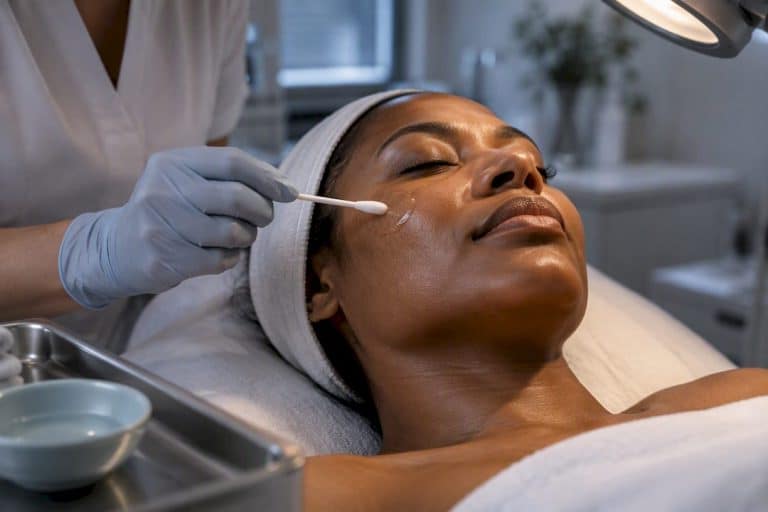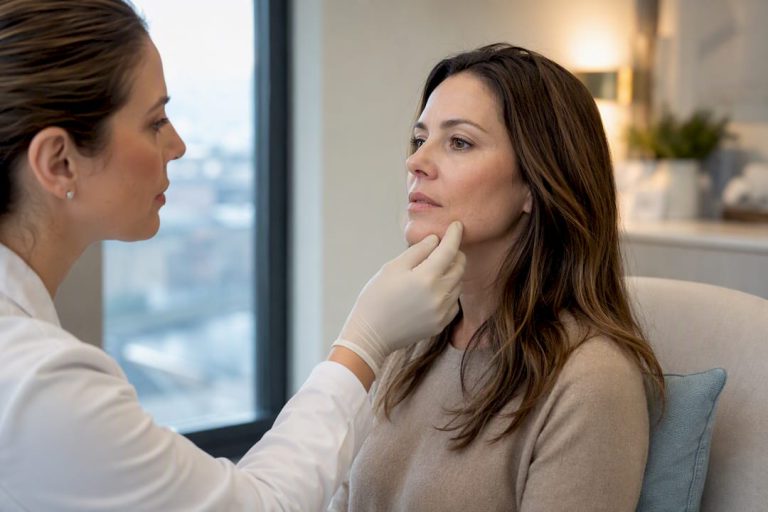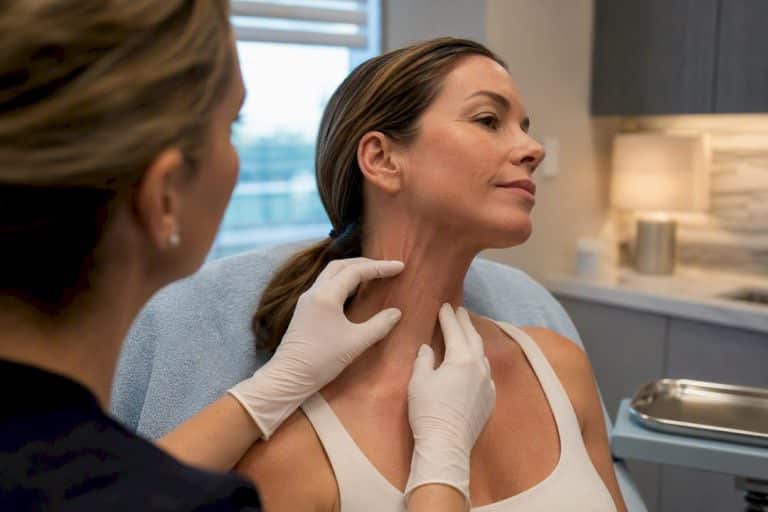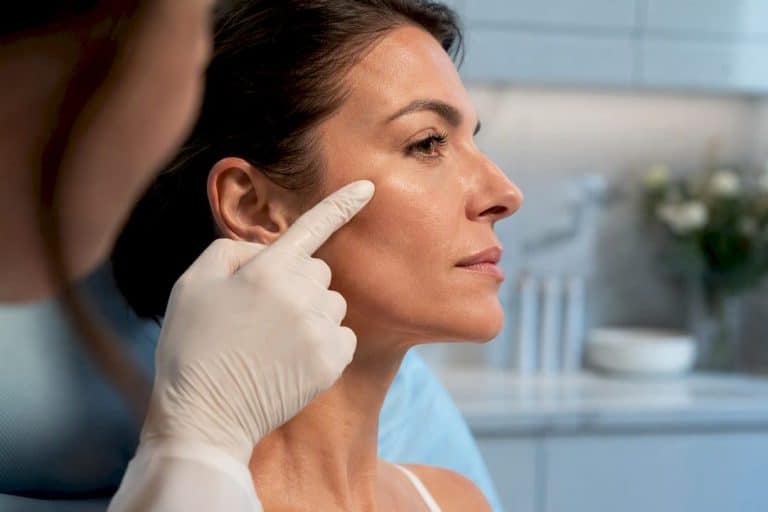
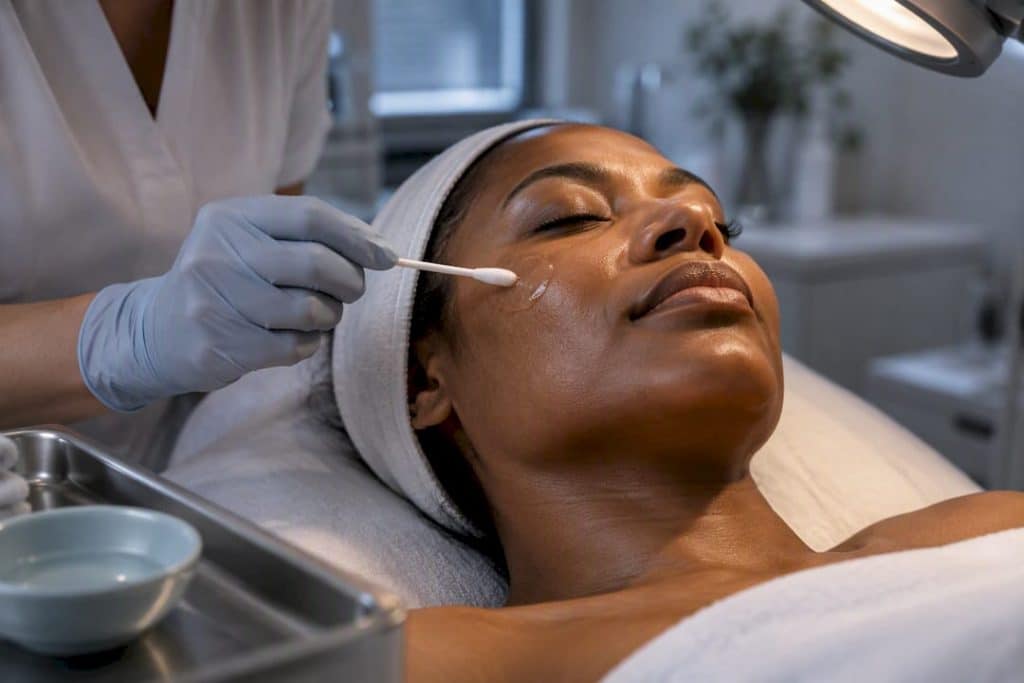
A melasma chemical peel can lighten epidermal pigment, but it works as a second-line, adjunctive treatment, not a stand-alone fix. The best-supported approach uses superficial peels, spaced over a series of sessions, layered onto a priming regimen of topical lightening agents and daily broad-spectrum sunscreen. Medium and deep peels are generally avoided in darker skin because the risk of post-inflammatory hyperpigmentation (PIH) tends to outweigh any extra benefit. Expect gradual improvement over months, not a single dramatic reveal, and plan for ongoing maintenance afterward.
TL;DR:
- Superficial chemical peels used as part of a combined protocol can gradually lighten epidermal and mixed melasma, but only if the pigment is properly assessed first.
- Priming skin with topical agents like hydroquinone or tranexamic acid for four to eight weeks prior to peeling significantly improves outcomes and reduces the risk of hyperpigmentation.
- Repeated peel sessions spaced weeks apart are necessary for meaningful lightening, as a single session rarely provides dramatic or lasting results.
- In darker skin types, superficial peels are preferred because medium or deep peels increase the risk of post-inflammatory hyperpigmentation without substantially improving pigment.
- Sun protection and ongoing maintenance are essential, as melasma is a chronic condition prone to relapse even after successful peel treatments.
Table of Contents
- Which chemical peels treat melasma, and how do they work?
- How do clinicians decide who is a good candidate?
- How should you prime skin before a melasma peel?
- What does a melasma peel series actually look like?
- What are the real risks, and how do you reduce them?
- How do peels fit into a bigger melasma treatment plan?
- What does a melasma consultation at Enrichedmedspa involve?
- The conventional advice on melasma peels misses the point
- Considering a chemical peel for melasma? Start with an assessment
- Sources
- FAQ
Which chemical peels treat melasma, and how do they work?
Melasma responds best to peels that lift pigment gently rather than ones that strip skin aggressively. Clinical guidelines from 2026 treat chemical peels as second-line, adjunctive therapy for melasma, meant to be paired with topical agents and sunscreen rather than used alone.
The agents that show up most often in melasma protocols include:
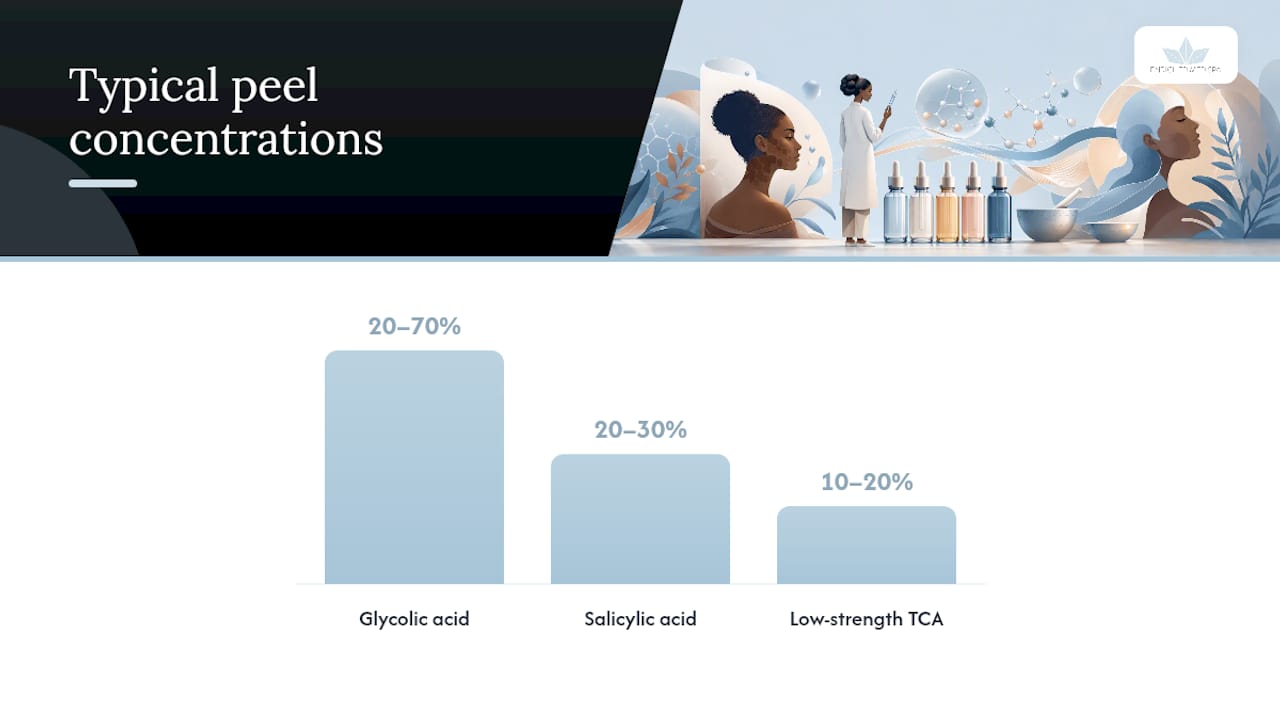
- Glycolic acid (20 to 70%) — an alpha hydroxy acid that loosens the bonds between surface skin cells, speeding up turnover and helping topical lighteners penetrate more evenly.
- Mandelic acid — a gentler alpha hydroxy acid, often the starting point for darker or more reactive skin because it penetrates more slowly and irritates less.
- Lactic acid — mild, hydrating, and useful for patients who cannot tolerate glycolic acid’s sting.
- Salicylic acid (20 to 30%) — a beta hydroxy acid that also calms surface inflammation, useful when melasma overlaps with acne or oily skin.
- Jessner’s solution — a combination peel (salicylic acid, lactic acid, and resorcinol) that produces more visible peeling than a single-acid formula.
- Low-strength TCA (10 to 20%) — reserved for carefully selected, well-primed patients; anything stronger moves into medium-depth territory and raises PIH risk substantially.
- Tretinoin peels — a newer, gentler option that works more through cell turnover than acid-driven exfoliation, with minimal visible peeling.
Mechanically, these peels work by triggering controlled keratolysis. The damaged outer layer sheds, carrying pigmented keratinocytes with it, while the wound-healing response speeds epidermal turnover. That faster turnover also helps active ingredients like hydroquinone or tranexamic acid sink in more effectively during the following days.
Not every peel on this list causes visible peeling. Mandelic acid, lactic acid, and tretinoin peels often produce only faint flaking, while Jessner’s solution and TCA typically cause a few days of visible frosting and shedding. That distinction matters when you are choosing a peel around a work schedule or event.
How do clinicians decide who is a good candidate?
Not every case of melasma responds the same way to a peel, and figuring out why starts with locating the pigment.
- Wood’s lamp examination. Under ultraviolet light, epidermal melasma shows enhanced contrast between pigmented and normal skin, while dermal melasma shows little to no change. Mixed melasma shows a blend of both patterns.
- History taking. Duration, hormonal triggers (pregnancy, oral contraceptives), sun exposure patterns, and prior treatment response all help clinicians estimate how deep the pigment sits.
- Response tracking. Epidermal and mixed melasma tend to improve more reliably with peels because the pigment sits within reach of a superficial exfoliation. Purely dermal melasma often barely moves, since the pigment lives too deep for a superficial peel to touch.
- Fitzpatrick skin typing. Patients with Fitzpatrick IV through VI carry more melanocyte reactivity, which is exactly why deeper peels are avoided in this group. A consensus review from the Indian Pigmentary Expert Group recommends acceptable use of chemical peels for epidermal melasma specifically when patients are properly selected and primed beforehand.
- Contraindication screening. Active cold sores, open lesions, recent isotretinoin use, unrealistic expectations, and unstable hormonal melasma (active pregnancy, for example) are reasons to delay or avoid peeling altogether.
Skipping this assessment step is where a lot of disappointing outcomes start. A peel chosen without knowing whether pigment is epidermal or dermal is essentially a guess.
How should you prime skin before a melasma peel?
Priming is not an optional extra step. It is what separates a peel that lightens melasma from one that triggers a rebound of pigment.
The core priming agents and their roles:
- Hydroquinone — still the topical reference standard for melasma; it inhibits melanin production and calms melanocyte activity before any exfoliation begins.
- Azelaic acid — a gentler alternative or adjunct, useful for patients who cannot tolerate hydroquinone long-term or want to rotate agents to avoid resistance.
- Tranexamic acid — increasingly used alongside peels because it reduces the inflammatory signalling that drives melanocyte overactivity; many clinicians pair mild peels with topical tranexamic acid specifically to improve outcomes and cut down on recurrence.
- Topical retinoids — support turnover and improve penetration of lightening agents, though they are usually paused in the days immediately before a peel to reduce irritation.
Consensus recommendations generally call for priming over four to eight weeks before the first peel where scheduling allows it. That window gives topical agents time to stabilize melanocytes and calm background inflammation, which lowers the odds of the peel itself triggering new pigment.
Certain actives get paused rather than layered on top of a peel. Retinoids, physical exfoliants, and any recent laser or waxing near the treatment area typically get held for several days beforehand, since irritated or sensitized skin peels unpredictably.
Pro Tip: If your skin flares or reddens easily, ask about starting with mandelic acid rather than jumping straight to glycolic or TCA. Slower penetration means a gentler introduction, and you can always intensify the protocol once your skin proves it tolerates exfoliation well.
What does a melasma peel series actually look like?
Most protocols run as a series rather than a one-time visit, because melasma pigment clears gradually with repeated, mild stimulation rather than a single aggressive event.
- Session count and spacing. A typical course consists of a series of superficial peels spaced several weeks apart, which lines up with the series structure described in current melasma treatment guidelines.
- What happens in the chair. Skin is cleansed and degreased, the peel solution is applied in even passes, timed carefully, then neutralized or left to self-neutralize depending on the acid. Redness and mild warmth are expected; frosting depth is watched closely with stronger agents.
- Immediate aftercare. A bland moisturizer, sunscreen application before leaving, and instructions to avoid picking at any flaking skin over the following days.
- Expected timeline. Visible lightening usually builds over multiple sessions rather than appearing after the first. A 2020 meta-analysis of 478 patients found that peel-based protocols using TCA or Jessner’s solution produced statistically significant improvement in MASI scores compared with topical hydroquinone alone in darker skin types.
- When to change course. If two to three sessions pass with no visible change, or if any darkening appears instead of lightening, that is the signal to reassess the diagnosis or switch strategy rather than push forward with more of the same peel.
What are the real risks, and how do you reduce them?
Post-inflammatory hyperpigmentation is the risk that matters most with melasma peels, and it is also the most preventable one when the protocol stays conservative.
- Recognize early signs. New or darker patches appearing where the peel was applied, typically within one to four weeks after the procedure, signal early PIH rather than normal healing.
- Understand why depth matters. Medium and deep peels penetrate further into the dermis, which triggers a stronger wound-healing inflammatory cascade. In Fitzpatrick IV through VI skin, that inflammation frequently overshoots and deposits excess pigment instead of clearing it, which is exactly why superficial peels are the preferred depth for this population.
- Manage PIH if it appears. Initial steps typically include strict photoprotection, temporarily stopping active exfoliants, and topical anti-inflammatory measures; cases that do not settle within several weeks warrant a dermatology referral.
- Reduce risk before it starts. Choosing a milder acid, completing a full priming course, avoiding sun exposure in the days around treatment, and spacing sessions conservatively all lower the odds of a flare.
The same 2020 meta-analysis that found peels outperformed topical hydroquinone alone in darker skin types is a reminder that “works better” and “risk-free” are not the same claim. TCA and Jessner’s peels have shown greater improvement than hydroquinone in properly selected, primed patients, but both figures come from carefully selected, well-primed study populations, not casual at-home use.
Any peel that causes prolonged redness, blistering, or spreading darkness beyond the treated area needs prompt clinical attention rather than a wait-and-see approach.
How do peels fit into a bigger melasma treatment plan?
Topical therapy and daily sunscreen remain the foundation of melasma management, and peels sit on top of that foundation rather than replacing it. Guidelines consistently point to daily sun protection as the single most important factor in preserving whatever gains a peel or topical regimen produces.
Once topical therapy is established, other tools can layer in depending on how skin responds:
- Chemical peels — best for epidermal or mixed melasma that has plateaued on topicals alone; our guide to medical-grade peel depths breaks down how clinics match peel strength to skin type.
- Laser and light-based treatments — can address stubborn or mixed melasma but carry their own risk of rebound pigmentation if settings are too aggressive for the patient’s skin type.
- Microneedling — sometimes combined with topical tranexamic acid to improve penetration, generally with a gentler risk profile than laser.
- Oral tranexamic acid — used in some cases under medical supervision, typically for patients with widespread or resistant melasma who have not responded to topical and procedural options.
- Maintenance — ongoing sunscreen, a rotating topical lightening regimen, and periodic touch-up peels or procedures keep melasma controlled over time; our overview of pigmentation reduction methods covers how these pieces work together.
Melasma is a chronic, relapsing condition, and treating it as one is more realistic than chasing a permanent cure. Most patients who keep pigment under control long-term are the ones who stay consistent with sunscreen and maintenance, not the ones who had the most aggressive single treatment.
What does a melasma consultation at Enrichedmedspa involve?
Many clients come to us frustrated after trying over-the-counter brighteners with no real change, unsure whether their pigment is even a good candidate for peeling. We start by assessing your skin type, pigment pattern, and history before recommending anything. If a peel is appropriate, we favour a conservative, staged approach: medical-grade peels selected for your skin’s tolerance, paired with a priming plan and strict aftercare guidance. Some clients benefit more from a gentler option like microneedling layered alongside topicals rather than repeated peeling. We will walk through what is realistic for your skin before booking anything.
The conventional advice on melasma peels misses the point
Most articles on melasma peels sell the peel itself as the hero. The evidence says otherwise. The meta-analysis showing TCA and Jessner’s outperforming hydroquinone alone is real, but it measured peels used on top of proper selection and priming, not peels as a shortcut around them. Strip away the priming phase and the same peel becomes a PIH risk rather than a treatment.
What gets underrated is how much patience the protocol demands. A single aggressive session almost never beats a slower, staged series, especially in darker skin. What gets overrated is peel strength. Reaching for TCA before mandelic acid has been given a fair trial is a common mistake, and it is usually the impatience, not the pigment, that causes the setback.
If there is one thing to prioritize first, it is photoprotection. No peel, however well chosen, outlasts a summer of unprotected sun exposure. Get that right before worrying about which acid to use.
— Felix
Considering a chemical peel for melasma? Start with an assessment
An informed approach to melasma starts by assessing pigment depth and skin type first, then matching you to a conservative, medical-grade peel protocol rather than defaulting to whatever peel is trending. That matters because the wrong depth or agent for your skin type can worsen pigmentation instead of improving it, and a proper priming plan makes a measurable difference to outcomes. Our full range of medical-grade peels and skin treatments includes options suited to different skin tones and sensitivities, chosen after a real conversation about your history and goals rather than a one-size-fits-all recommendation. If melasma has been resistant to over-the-counter products, consider a professional consultation to find out which peel, if any, makes sense for your skin.
This article is general information, not a substitute for advice from a qualified doctor. Consult a qualified healthcare professional about your own circumstances before acting on anything here.

Sources
Readers who want to verify the clinical basis for this guide can consult the 2026 melasma treatment guideline summarized on Medscape, the consensus review on chemical peels in melasma from the Indian Pigmentary Expert Group, the 2020 systematic review and meta-analysis comparing peels with topical hydroquinone in darker skin types, and the 2023 Dermatological Reviews discussion of peel efficacy and safety limitations. Together, they represent the clinical backbone most conservative, skin-of-colour-aware peel protocols are built on.
- Treatment: Melasma guideline (Medscape) — 2026
- Chemical Peels in Melasma: A Review with Consensus Recommendations by Indian Pigmentary Expert Group (PMC)
- Systematic review/meta-analysis (PubMed) — 2020
FAQ
Is a chemical peel good for melasma?
A chemical peel can help lighten epidermal or mixed melasma when used as an adjunct to topical therapy and sunscreen, not as a stand-alone fix. Guidelines recommend superficial peels given as a series, combined with priming and strict photoprotection, for the best and safest results.
What do Koreans use for melasma?
Skincare routines popular in Korea for melasma typically combine gentle exfoliating acids like mandelic or lactic acid with brightening ingredients such as niacinamide and vitamin C, alongside heavy daily sunscreen use. These approaches echo the same principle guidelines emphasize: gradual, low-irritation exfoliation paired with consistent photoprotection rather than aggressive single treatments.
Is it possible to peel off melasma?
Melasma pigment can lighten with repeated superficial peeling, but it cannot be peeled away in one session, and dermal pigment often does not respond to peeling at all. Consensus reviews describe melasma as a chronic, relapsing condition that needs ongoing management rather than a single corrective treatment.
What is the best procedure to remove melasma?
There is no single best procedure. Superficial chemical peels, topical lightening agents, and in some cases laser or microneedling all play a role depending on pigment depth and skin type, and combining them under professional guidance tends to outperform any one treatment alone. A consultation to assess whether your melasma is epidermal, dermal, or mixed is the right starting point before choosing between chemical peels and other options.