

Yes, a deviated septum can contribute to post-nasal drip, though it is rarely the only cause. When the nasal septum shifts significantly to one side, it can narrow a passage and impair normal mucus drainage, allowing mucus to pool and eventually reach the throat. Cleveland Clinic confirms this mechanical link. That said, CMAJ guidance is clear that a deviated septum does not typically cause substantial nasal discharge on its own. Inflammation from allergies or chronic rhinosinusitis is usually also present, and treating only the structural problem without addressing that inflammation often leaves symptoms behind.
Your immediate next steps:
- Try conservative measures first: daily saline rinses, an intranasal steroid spray, and antihistamines if allergies are suspected.
- Track your symptoms for two to four weeks, noting which side is blocked, whether symptoms worsen seasonally, and whether throat clearing is worse at night or after eating.
- See your primary care provider or an ENT if symptoms persist beyond four weeks, worsen, or include facial pain, fever, or any of the red flags listed below.
Pro Tip: Keep a brief symptom log before your appointment. Noting the timing, laterality, and what makes symptoms better or worse will shorten your path to the right diagnosis.
Table of Contents
- How does a deviated septum produce or worsen post-nasal drip?
- What else could be causing your post-nasal drip?
- How do clinicians figure out what is causing your symptoms?
- What are your treatment options, from conservative care to surgery?
- When should you see a doctor about nasal symptoms?
- Key takeaways
- A note from Enrichedmedspa on nasal health and aesthetic care
- Useful sources and further reading
How does a deviated septum produce or worsen post-nasal drip?
The mechanism is primarily mechanical. When a significant septal deflection narrows one nasal passage, airflow through that side drops, mucosal surfaces dry out unevenly, and the normal ciliary sweep that moves mucus toward the throat slows down. Mucus stagnates, thickens, and can pool in a way that eventually drains posteriorly.
Three pathways are worth understanding:
- Narrowed passage and impaired drainage: A deviated septum can block sinus drainage into the nasal cavity, increasing the risk of sinus inflammation and infection.
- Altered mucosal airflow: Turbulent or reduced airflow dries the mucosa on the narrowed side, triggering compensatory mucus production.
- Blocked sinus ostia: If the deflection compresses the middle meatus, sinus drainage openings can be partially obstructed, promoting stasis and secondary infection.
The interaction with inflammation matters enormously here. Allergic rhinitis, turbinate hypertrophy, and chronic rhinosinusitis all amplify mucus production independently of the septum. A structural fix alone, without treating co-existing inflammation, often leaves the drip unchanged.
Pro Tip: Persistent blockage on one side only, or symptoms that shift with head position, suggest a mechanical component. Bilateral symptoms that respond to antihistamines point more toward allergy or rhinitis.

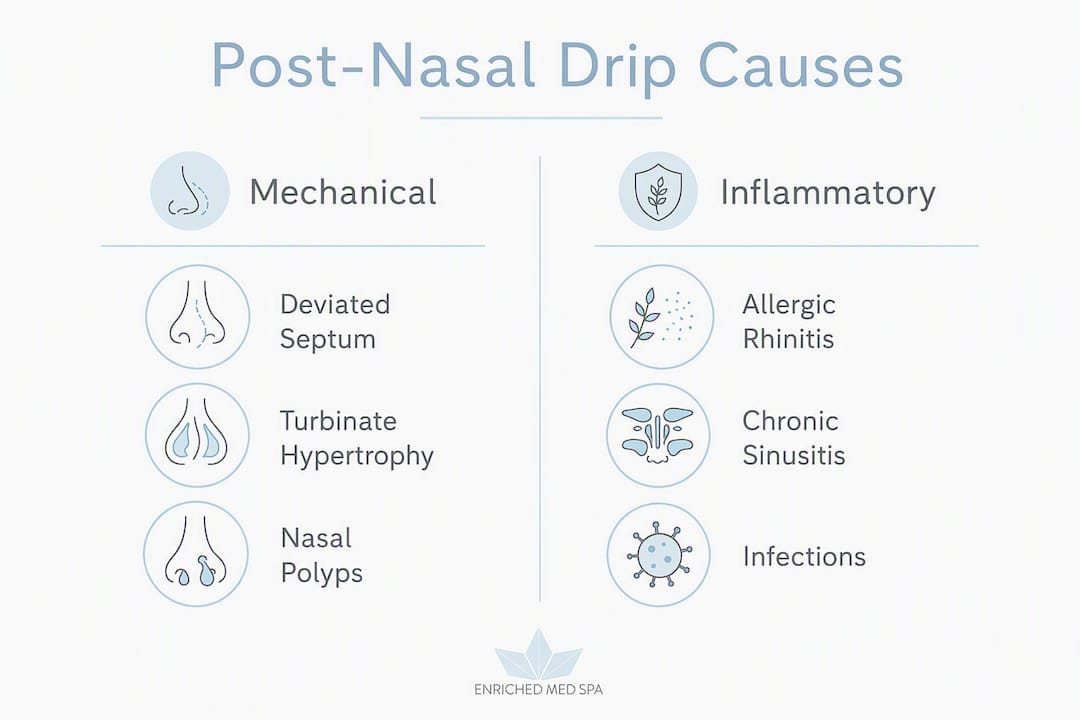
What else could be causing your post-nasal drip?
Several conditions mimic one another, so recognising the pattern matters before assuming the septum is responsible.
| Cause | Secretion character | Key associated signs | Typical triggers |
|---|---|---|---|
| Allergic rhinitis | Clear, thin | Sneezing, itchy eyes | Seasonal or allergen exposure |
| Chronic rhinosinusitis | Thick, discoloured | Facial pressure, reduced smell | Persistent, year-round |
| GERD | Variable, throat-only | Heartburn, worse lying down | Meals, recumbency |
| Deviated septum | Minimal discharge | Unilateral blockage | Positional, structural |
| Medication effect | Variable | Onset after new medication | Drug-related (e.g., ACE inhibitors) |
CMAJ notes that secretion character and associated signs are the most reliable differentiators. Clear thin secretions with sneezing favour allergic rhinitis; facial pressure with thicker mucus points toward chronic rhinosinusitis; positional or meal-related throat symptoms suggest GERD.
Bring this checklist to your appointment:
- Which side is blocked, or is it both?
- Does it worsen in spring or fall (seasonal pattern)?
- Does throat clearing happen more after meals or when lying flat?
- Have antihistamines helped, even partially?
- Any facial pain, pressure, or reduced sense of smell?
- Any recent nasal trauma or prior nasal surgery?
How do clinicians figure out what is causing your symptoms?
The diagnosis combines a focused history with a physical exam. Imaging and nasal endoscopy are reserved for cases that remain unclear or when surgery is being considered.
A typical clinical assessment follows this sequence:
- Focused history: Duration, laterality, response to prior treatments, allergy history, and any trauma.
- Anterior rhinoscopy: A quick in-office look at the septum and inferior turbinates.
- Nasal mucosa inspection: Healthy mucosa appears pinkish-orange and moist; pale, boggy mucosa suggests allergy; red, inflamed mucosa points toward infection or irritant exposure.
- Nasal endoscopy: Provides a direct view of the middle meatus, sinus drainage pathways, and posterior septum when anterior exam is inconclusive.
- CT sinuses: Reserved for surgical planning or when the history suggests significant sinus involvement.
Merck Manuals notes that ENT specialists often use endoscopic assessment first and reserve CT imaging for surgical planning or complex presentations.
Pro Tip: Tell your clinician if symptoms are strictly unilateral, if you have a history of nasal trauma, or if you have already tried maximal medical therapy without relief. These three details move the assessment toward endoscopy and ENT referral much faster.
What are your treatment options, from conservative care to surgery?
Start with medical management. Canadian guidance recommends a trial of maximum medical therapy for several weeks before surgery is considered.
Medical options to try first:
- Saline nasal rinses (e.g., NeilMed or a neti pot) once or twice daily to clear mucus and moisturise the mucosa.
- Intranasal corticosteroid sprays (e.g., fluticasone, mometasone) to reduce mucosal inflammation.
- Antihistamines if allergy is suspected; immunotherapy referral if allergy testing confirms significant sensitisation.
- Humidification at home, particularly in dry Canadian winters.
- Short-course antibiotics only when bacterial sinusitis is confirmed, not as a first-line measure.
Statistic to know: Chronic rhinosinusitis imposes a measurable burden on Canadian workers, leading to lost productivity. That burden is exactly why clinicians prioritise evidence-based medical management before recommending surgery.
When septoplasty makes sense:
| Criterion | Details |
|---|---|
| Significant anatomical obstruction | Confirmed on exam or endoscopy |
| Failed maximal medical therapy | At least 4–12 weeks of full medical treatment |
| Functional impairment | Sleep disruption, recurrent infections, breathing difficulty |
| Inflammatory drivers controlled | Allergies and rhinitis treated first |
Cleveland Clinic confirms that septoplasty can permanently improve airflow when structural blockage is the primary driver. However, if inflammatory causes are not addressed beforehand, mucus production and throat symptoms can persist despite a technically successful operation.
Typical recovery milestones after septoplasty:
- Days 1–7: Nasal packing removed; expect swelling and congestion.
- Weeks 2–4: Breathing begins to improve noticeably.
- Months 1–3: Full airflow benefit becomes apparent; follow-up with ENT to assess drainage.
- Month 3 onward: Reassess residual post-nasal drip symptoms; additional medical management may still be needed.
When should you see a doctor about nasal symptoms?
See your primary care provider if symptoms persist despite a full trial of conservative measures, or if any of the following appear:
- Severe facial pain accompanied by fever
- New unilateral nasal obstruction with bloody discharge
- Sudden or progressive loss of smell
- Visual changes or eye swelling alongside nasal symptoms
- High fever with signs of systemic infection
Alberta Health guidance defines chronic sinusitis as long-term inflammation lasting several weeks or more. If you have crossed that threshold without improvement, an ENT referral is appropriate.
To prepare for your appointment:
- Bring your symptom log (timing, laterality, triggers, what helps).
- List every treatment you have already tried and for how long.
- Note your allergy history and any known sensitivities.
- Bring any prior imaging reports if available.
Pro Tip: Your family doctor is the right first contact. ENT referral follows if symptoms are severe, unilateral, or unresponsive to maximal medical therapy. You do not need to wait for a crisis to ask for a referral.
Key takeaways
A deviated septum can contribute to post-nasal drip through mechanical obstruction, but inflammation from allergies or chronic rhinosinusitis is almost always a co-driver and must be treated alongside any structural fix.
| Point | Details |
|---|---|
| Septum is rarely the sole cause | Structural obstruction and inflammation usually coexist; treat both. |
| Medical therapy comes first | Try saline, steroid sprays, and allergy management for 4–12 weeks before considering surgery. |
| Septoplasty has real limits | Surgery improves airflow reliably but may not resolve mucus production if inflammation persists. |
| Pattern recognition matters | Secretion character, laterality, and seasonal timing help distinguish the true cause. |
| Know your red flags | Unilateral bloody discharge, sudden smell loss, or fever with facial pain warrant prompt medical review. |
A note from Enrichedmedspa on nasal health and aesthetic care
We ask about nasal breathing and post-nasal drip during consultations because it genuinely affects how certain aesthetic treatments perform and heal. Clients who come in looking for help with under-eye hollows, facial puffiness, or a tired appearance sometimes also mention chronic throat clearing or persistent congestion. Those two things are often connected. Chronic sinus congestion can contribute to facial swelling, under-eye shadowing, and a generally fatigued look that no injectable alone will fully correct.
When uncontrolled sinus infection or significant nasal inflammation is present, we typically recommend addressing that first before proceeding with invasive facial procedures. Active infection increases healing risk and can compromise results. For clients managing mild, stable nasal symptoms, many non-surgical facial treatments remain appropriate, and we adjust our approach accordingly. Understanding facial anatomy and how nasal structure influences treatment is part of how we plan safely.
If you are considering dermal fillers or Botox and you are also managing nasal symptoms, bring it up at your consultation. We will help you sequence care in a way that supports both your health and your aesthetic goals.
Useful sources and further reading
These Canadian and internationally recognised resources are worth bookmarking, whether for your own reference or to share with your clinician:
- CMAJ: Diagnosis and management of chronic rhinosinusitis — The primary Canadian clinical reference for differential diagnosis, treatment pathways, and the evidence base for medical management before surgery.
- HealthLinkBC: Sinusitis — should I have surgery? — Plain-language BC patient guidance on when surgery is and is not appropriate; useful for understanding the 4–12 week medical trial recommendation.
- Merck Manuals (Canada): Septal deviation — Professional-level overview of when septal deviation is clinically significant and how it is assessed.
- Merck Manuals (Canada): Deviated septum — patient version — Accessible patient-facing explanation of symptoms, drainage effects, and treatment options.
- Cleveland Clinic: Post-nasal drip — Clear overview of causes, including the mechanical role of septal deviation, and when septoplasty may help.
- Canadian Family Physician: Nasal mucosa inspection guidance — Canadian family medicine reference explaining what mucosal appearance tells clinicians about the nature of nasal symptoms.
- Alberta Health / MyHealth: Sinusitis — Regional patient resource defining chronic sinusitis and listing deviated septum as a contributing structural factor.
This article is general health information, not medical advice. Confirm your specific situation with a qualified healthcare provider or ENT specialist.
Recommended
- Does a Lip Flip Affect Talking? What Patients Really Experience – Botox Laser Hair Removal OxyGeneo Medi Facial Microneedling – Enriched Med Spa – Vaughan Woodbridge Maple Vellore Village
- Can a Lip Flip Make Lips Look Uneven? | What You Should Know – Botox Laser Hair Removal OxyGeneo Medi Facial Microneedling – Enriched Med Spa – Vaughan Woodbridge Maple Vellore Village
- How to Reduce Swelling After Lip Fillers: Expert Tips & Remedies – Botox Laser Hair Removal OxyGeneo Medi Facial Microneedling – Enriched Med Spa – Vaughan Woodbridge Maple Vellore Village
- Does a Lip Flip Help With a Gummy Smile? | Expert Answers – Botox Laser Hair Removal OxyGeneo Medi Facial Microneedling – Enriched Med Spa – Vaughan Woodbridge Maple Vellore Village