
There is a persistent myth that dermal fillers always produce an exaggerated, “pillow face” look. If that image has kept you from exploring non-surgical rejuvenation, you are not alone. Many people in Woodbridge and East Gwillimbury share the same hesitation. The truth is that modern fillers, when chosen thoughtfully and administered with skill, are among the most effective tools available for restoring a refreshed, naturally youthful appearance. This guide walks you through how fillers actually work, what the clinical evidence says, and how to ensure your results look like the best version of you.
Table of Contents
- How do fillers work for facial rejuvenation?
- Types of facial fillers and their effects
- What results can you expect? Outcome and safety evidence
- Ensuring natural results: Expert strategies for local patients
- Risks, complications, and how to manage them
- Why most people misunderstand fillers—and what actually works
- Ready to discover your most natural look?
- Frequently asked questions
Key Takeaways
| Point | Details |
|---|---|
| Different fillers, different benefits | Hyaluronic acid and biostimulators provide immediate or long-term rejuvenation for a soft, natural look. |
| Safety is backed by evidence | Modern fillers are safe, with rare complications when administered by skilled professionals. |
| Natural results depend on technique | Skilful, conservative approaches deliver refreshed results without overcorrection or artificial appearance. |
| Aftercare boosts outcome | Following expert aftercare and choosing the right provider optimizes filler longevity and appearance. |
How do fillers work for facial rejuvenation?
Now that we have reframed the image of fillers, let us break down exactly how these products rejuvenate the face.
Dermal fillers are injectable gels placed beneath the skin to restore volume, smooth lines, and improve facial contours. The most widely used types are hyaluronic acid (HA), calcium hydroxylapatite (CaHA), poly-L-lactic acid (PLLA), and polycaprolactone (PCL). Each works through a slightly different mechanism, but all share a common goal: addressing the volume loss and structural changes that come with ageing. As research confirms, these fillers restore facial volume by providing immediate structural support and stimulating neocollagenesis, the production of new collagen, for long-term skin quality improvement.

HA fillers, such as Juvéderm and Teosyal, are the most popular choice in most clinics because they offer immediate, visible results. HA is a naturally occurring sugar molecule found in your own skin, which means it integrates smoothly and feels soft to the touch. Biostimulatory fillers like PLLA and CaHA work differently. Rather than simply filling space, they trigger your skin’s own collagen-building processes. The result is more gradual but also longer lasting. Clinical evidence shows that HA fillers last 6 to 18 months, while biostimulators like PLLA and CaHA can sustain their effects for up to two years.
Here is a quick overview of what each filler type does:
- HA fillers: Attract and hold water molecules, creating immediate volume and hydration
- CaHA: Provides structural lift and stimulates collagen over time
- PLLA: Gradually rebuilds collagen framework for a natural, progressive improvement
- PCL: The longest-lasting option, stimulating collagen and elastin simultaneously
One of the greatest advantages of HA fillers is reversibility. If you are ever unhappy with your results, an enzyme called hyaluronidase can dissolve the filler quickly and safely. This built-in safety net makes HA the preferred starting point for many first-time patients. Many clients find that combining BOTOX and Juvéderm delivers a more complete, balanced rejuvenation than either treatment alone.
| Filler type | Mechanism | Onset | Duration |
|---|---|---|---|
| Hyaluronic acid (HA) | Volume and hydration | Immediate | 6 to 18 months |
| Calcium hydroxylapatite (CaHA) | Structural lift and collagen stimulation | Gradual | 12 to 18 months |
| Poly-L-lactic acid (PLLA) | Collagen biostimulation | Gradual | Up to 2 years |
| Polycaprolactone (PCL) | Collagen and elastin stimulation | Gradual | Up to 2 years |
“Fillers are not simply about adding volume. When chosen correctly, they work with your anatomy to restore what time has taken away, in a way that looks and feels completely natural.” — Enriched Med Spa clinical team
Types of facial fillers and their effects
Understanding the science is important, but knowing the options helps you choose the best fit for your needs.
Not every filler suits every concern. The right choice depends on where you want improvement, how quickly you want results, and how long you want them to last. Clinical evidence confirms that HA fillers provide immediate results lasting 6 to 18 months, while biostimulators offer slower but longer-lasting effects of up to two years. This distinction matters when you are planning your treatment timeline and budget.
Here is a practical breakdown of which filler might suit which goal:
- Subtle lip enhancement or fine lines around the mouth: HA fillers (Juvéderm, Teosyal) are ideal for their softness and reversibility. Explore best lip fillers compared to understand the differences between leading brands.
- Cheek volume and midface lifting: CaHA provides structural lift with a collagen-stimulating bonus, making it well suited for areas that need both volume and firmness.
- Overall skin quality and gradual facial contouring: PLLA works best for patients who want a progressive, natural-looking improvement rather than an instant change.
- Long-term maintenance with minimal repeat treatments: PCL is gaining popularity for patients who want to reduce the frequency of their appointments while still enjoying lasting results.
- Tear trough (under-eye hollows): Soft HA formulations placed carefully by an experienced injector can significantly reduce the tired appearance without looking puffy or unnatural.
| Filler | Best for | Key benefit | Reversible? |
|---|---|---|---|
| HA (Juvéderm, Teosyal) | Lips, folds, hydration | Immediate, adjustable | Yes |
| CaHA | Cheeks, jawline | Structural lift | No |
| PLLA | Temples, overall volume | Gradual collagen rebuild | No |
| PCL | Long-term contouring | Longest duration | No |
Choosing the right filler is not a decision you need to make alone. A thorough consultation with a trained injector will assess your facial anatomy, skin quality, and personal goals before recommending any product.
What results can you expect? Outcome and safety evidence
After comparing the types of fillers, let us focus on what people actually experience and the evidence behind these outcomes.
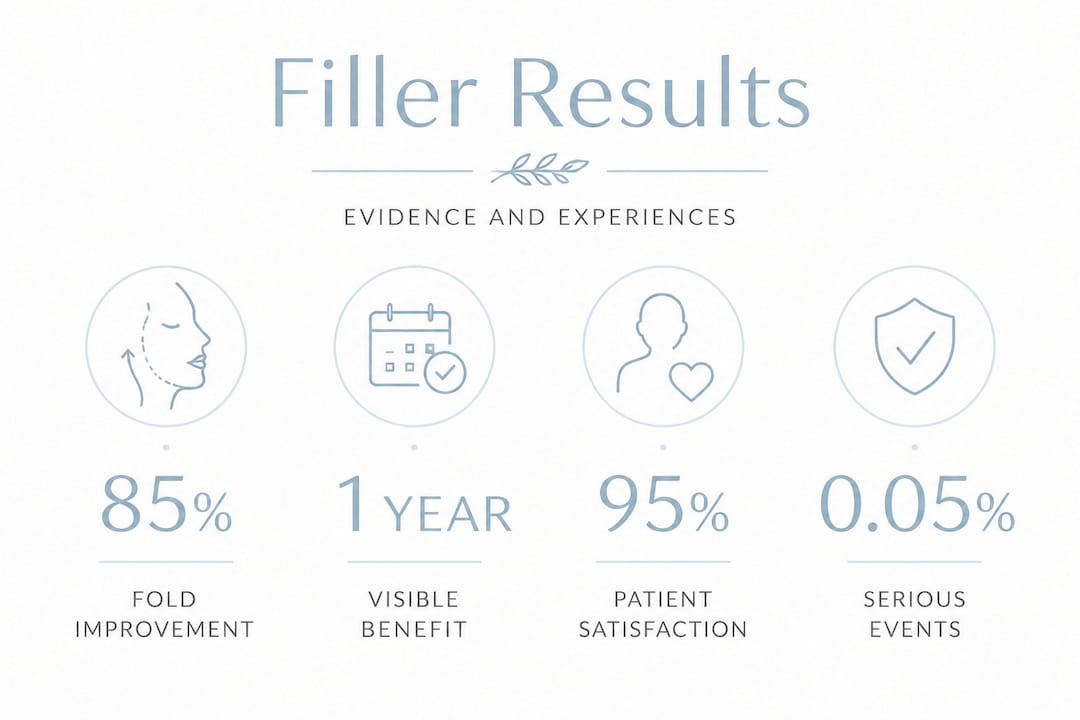
The clinical data on filler satisfaction is genuinely encouraging. Studies measuring nasolabial fold severity using the Wrinkle Severity Rating Scale (WSRS) show that 76 to 92 percent of patients experience meaningful improvement at 6 to 12 months, with midface volume restoration persisting for close to a year. These are not just marketing figures. They reflect real patient outcomes measured in controlled clinical settings.
| Outcome measure | Result at 6 months | Result at 12 months |
|---|---|---|
| WSRS improvement in nasolabial folds | 85 to 92% responders | 76 to 85% responders |
| Midface volume restoration | Significant improvement | Maintained near baseline |
| Patient satisfaction | High | Moderate to high |
Swelling and bruising are the most common side effects, and both are temporary. Most people return to their regular routine the same day or the next morning. Serious complications are rare. Vascular occlusion occurs in fewer than 0.05% of procedures, and other issues such as the Tyndall effect (a bluish tint from superficially placed HA) or nodules from PLLA are manageable when identified early.
Pro Tip: Always ask your injector whether they stock hyaluronidase on-site. This enzyme dissolves HA fillers quickly in the rare event of a vascular complication. A clinic that carries it demonstrates genuine preparedness and commitment to your safety.
Following your treatment, good aftercare makes a real difference in how long your results last and how smoothly you heal. Our post-filler aftercare tips cover everything from sleeping positions to sun protection in the days after your appointment. If you have had lip filler specifically, our dedicated lip filler aftercare guide offers targeted advice for that delicate area.
Ensuring natural results: Expert strategies for local patients
But how do you ensure your results look refreshed and not “done”? Here is how experts guide the process.
The difference between a natural result and an overdone one almost always comes down to technique and philosophy, not the filler itself. Anatomical knowledge and conservative volumes are the two most important factors in preventing overcorrection. An injector who understands the precise location of facial vessels, fat compartments, and bone structure will place product where it truly belongs, not simply where it is easiest to inject.
For patients in Woodbridge and East Gwillimbury seeking subtle, natural-looking outcomes, here is the process we follow at Enriched Med Spa:
- Thorough consultation: We assess your facial anatomy, skin quality, and personal goals before recommending any product or volume.
- Photographic assessment: Before-and-after photos help both you and your injector track changes objectively and plan conservatively.
- Conservative starting volumes: Less is genuinely more. We can always add product at a follow-up; removing too much is harder.
- Layered placement technique: Placing filler at multiple depths (deep, mid, and superficial) creates a more natural, three-dimensional result.
- Adjunct treatments when appropriate: Combining fillers with Botox or skin boosters often produces more balanced outcomes than fillers alone.
- Review appointment: A follow-up at two weeks allows us to assess settling and make minor refinements if needed.
“Natural enhancement in facial rejuvenation prioritises restoring what was lost rather than adding what was never there. The goal is always harmony.” — Enriched Med Spa clinical team
Combining treatments thoughtfully is a key strategy. Getting natural-looking fillers is as much about restraint as it is about skill. For patients curious about subtle lip enhancement specifically, understanding natural lip flip results can help clarify whether a lip flip with Botox or a small amount of HA filler better suits your goals.
Research supports a holistic approach to rejuvenation that treats the face as a whole rather than addressing isolated lines or areas in isolation. This perspective is central to how we work with every patient who walks through our doors.
Risks, complications, and how to manage them
Although the vast majority of experiences are positive, understanding the risks and their prevention is empowering.
No medical procedure is entirely without risk, and fillers are no exception. Being informed helps you make confident decisions and respond quickly if anything unexpected occurs. The good news is that serious complications are genuinely uncommon, and most issues resolve on their own or with straightforward management.
Common and rare risks include:
- Bruising and swelling: Very common, typically resolving within 3 to 7 days
- Asymmetry: Usually correctable at a follow-up appointment
- Tyndall effect: A bluish tint caused by HA placed too superficially; treated with hyaluronidase
- Nodules: More common with PLLA; managed with massage or, in persistent cases, medical intervention
- Infection: Rare; prevented by sterile technique and proper aftercare
- Vascular occlusion: The most serious risk, occurring in fewer than 0.05% of cases, managed with hyaluronidase, high-dose protocols, and ultrasound guidance; early intervention within 4 to 6 hours is critical for reversal
Pro Tip: If you notice unusual pain, blanching (whitening of the skin), or any vision changes after a filler treatment, contact your clinic immediately. These can be early signs of vascular compromise, and rapid response makes a significant difference in outcomes.
Knowing how to reduce swelling after fillers is a practical skill that helps you feel more comfortable in the first few days. Cold compresses, avoiding strenuous exercise, and staying upright for several hours post-treatment are all simple steps that support your recovery.
Why most people misunderstand fillers—and what actually works
The fear of looking “overdone” is one of the most common reasons people delay or avoid filler treatments altogether. But here is the truth we see every day in our clinic: the dramatic, exaggerated results that fuel this fear are almost always the product of poor technique, excessive volumes, or treatments repeated without reassessment, not of fillers themselves.
The images that circulate on social media tend to represent outliers. They are memorable precisely because they look unusual. The vast majority of filler patients walk out of their appointments looking like a well-rested, refreshed version of themselves. Nobody asks what they had done. That is the goal, and it is absolutely achievable.
What most conversations about fillers miss is the role of the injector-patient relationship. The best outcomes come from a genuine dialogue about your goals, an honest assessment of what is realistic, and a shared commitment to restraint. A skilled injector will sometimes recommend less than what a patient requests, because they understand that facial harmony depends on proportion, not volume.
We also believe that fillers work best as part of a broader skin health strategy. Maintaining your results with good post-filler maintenance habits, protecting your skin from UV damage, and staying hydrated all extend the life of your treatment and support your skin between appointments. Fillers are a powerful tool. Like any tool, their value depends entirely on how thoughtfully they are used.
Ready to discover your most natural look?
If you are curious about what fillers could do for your face, expert support and artistry make all the difference in achieving results you will love. At Enriched Med Spa, we serve clients across Woodbridge and East Gwillimbury with a patient-first approach that prioritises your comfort, safety, and natural beauty above all else. Whether you are exploring options for the first time or looking to refine a previous treatment, we invite you to discover Botox and fillers at Enriched Med Spa and learn how our team can personalise a plan for you. If you want to understand the science behind your options before booking, our guide on how lip fillers work is a great place to start. Book a consultation with us today and take the first step toward looking like the best, most refreshed version of yourself.
Frequently asked questions
How long do facial fillers last?
HA fillers typically last 6 to 18 months, while biostimulatory fillers like PLLA or CaHA can maintain their effects for up to two years, depending on the product and area treated.
Can filler treatments look completely natural?
Yes, natural-looking results are consistently achievable when conservative volumes and anatomical precision guide the treatment, especially when combined with adjunct options like Botox or skin boosters for overall facial harmony.
Are facial fillers safe?
Serious complications are rare, with vascular occlusion occurring in under 0.05% of procedures; most side effects are mild and temporary when treatment is performed by a trained, experienced injector.
What should I do if I experience swelling or unevenness after fillers?
Contact your provider promptly and follow your aftercare instructions, as most swelling resolves within a few days; early intervention within 4 to 6 hours is particularly important if you notice any unusual pain or skin colour changes.
Is there a recovery period after facial fillers?
Most people return to their regular activities immediately, though minor swelling or bruising may last a few days; fillers provide immediate structural support while longer-term skin quality improvements develop gradually over the following weeks.
Recommended
- Post-Filler Aftercare: Maximizing and Maintaining Results – Botox Laser Hair Removal OxyGeneo Medi Facial Microneedling – Enriched Med Spa – Vaughan Woodbridge Maple Vellore Village
- Can Lip Fillers Look Natural? Tips for a Subtle, Beautiful Look – Botox Laser Hair Removal OxyGeneo Medi Facial Microneedling – Enriched Med Spa – Vaughan Woodbridge Maple Vellore Village
- Juvéderm Lips: How to Achieve the Perfect Natural-Looking Pout! – Botox Laser Hair Removal OxyGeneo Medi Facial Microneedling – Enriched Med Spa – Vaughan Woodbridge Maple Vellore Village
- Keep Your Lips Looking Fabulous: Essential Post-Care Tips for Maintaining Lip Fillers – Botox Laser Hair Removal OxyGeneo Medi Facial Microneedling – Enriched Med Spa – Vaughan Woodbridge Maple Vellore Village