A single PRP session for hair restoration in Canada typically costs a few hundred to around a thousand dollars, and most clinics recommend an initial package of multiple sessions rather than a one-off visit. That package usually lands somewhere in the low thousands, with cheaper touch-up visits once a year or so after that. Where you fall in that range depends on three things: the equipment your clinic uses, how much blood gets processed, and who is actually doing the injecting.
A few quick facts to anchor your budget:
- Single-session pricing: varies depending on the clinic and region
- An initial package of multiple sessions is standard, often priced with some discount compared to paying per visit
- Maintenance sessions after the initial series are typically less expensive
- Many patients need ongoing sessions spaced several months apart to maintain results
Key Takeaways
PRP hair restoration cost in Canada depends less on finding the lowest price and more on matching equipment quality and practitioner skill to a realistic treatment plan.
| Point | Details |
|---|---|
| Typical session price | Single sessions run $500 to $1,200, with 3 to 4 session packages priced in the low thousands. |
| Equipment quality matters | Medical-grade centrifuges and higher platelet concentration often mean fewer sessions needed overall. |
| Results take months, not weeks | Early signs appear around 2 to 3 months, with clearer density improvement by 4 to 6 months. |
| No insurance coverage | Provincial health plans treat PRP as cosmetic, so most patients budget for it out of pocket. |
| Enriched Med Spa offers tailored quotes | Consultations include scalp assessment and photo mapping to price your specific treatment plan accurately. |
This article is general information, not a substitute for advice from a qualified doctor. Consult a qualified healthcare professional about your own circumstances before acting on anything here.
Table of Contents
- PRP hair restoration cost breakdown: what you’re actually paying for
- What actually drives PRP hair therapy price differences?
- What happens during a PRP session, step by step?
- When will you see results, and how long do they last?
- Is PRP hair restoration safe for most people?
- How to budget and compare PRP quotes fairly
- Enriched Med Spa perspective: what clients typically experience
- Does insurance cover PRP hair restoration in Canada?
- Why the “cheapest PRP” search is the wrong question
- Booking a PRP consultation at Enriched Med Spa
- Sources
PRP hair restoration cost breakdown: what you’re actually paying for
The national picture for PRP hair restoration cost in Canada centres on a single-session range of $500 to $1,200, with most clinics clustering closer to the middle of that band. Alberta clinics, for instance, report per-session pricing between $650 and $1,100, which tracks closely with what we see quoted across Ontario as well.
Statistic callout: Multiple session initial packages are common across Canadian clinics, and package pricing generally offers some discount compared to booking sessions individually.
What’s usually bundled into that quoted price:
- An initial consultation and scalp assessment
- The blood draw and centrifuge processing kit
- Topical numbing before injections
- The injection session itself, including mapping of treatment zones
Common add-ons that push the price higher include microneedling paired with PRP application (sometimes called a scalp version of the microneedling PRP treatment), platelet-rich fibrin (PRF) instead of standard PRP, which tends to cost more due to a different processing method, or combination visits with growth-factor serums.
Pricing also shifts by region. Larger metro clinics in Toronto, Vancouver, and Calgary often price at the higher end of the national range because of overhead and physician availability, while smaller cities and suburban clinics, including those serving Vaughan and Woodbridge, can offer comparable quality at a more moderate price point without sacrificing the medical-grade equipment that actually drives results.
What actually drives PRP hair therapy price differences?
Two clinics can quote wildly different numbers for what looks like the same treatment, and the gap almost always comes down to equipment, volume, and who’s holding the needle.
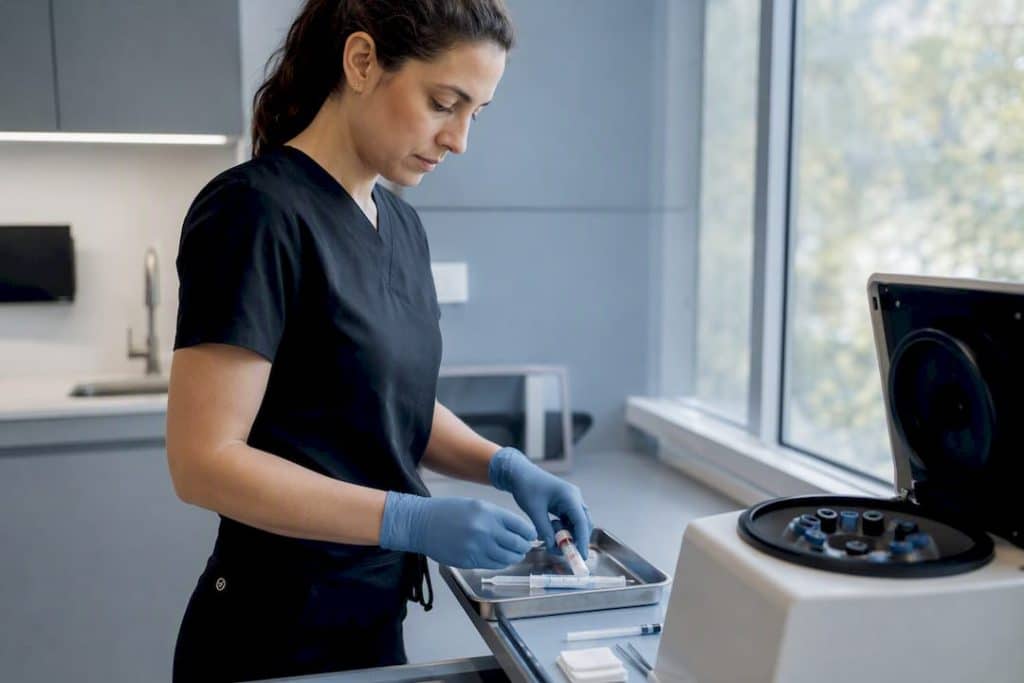
Basic PRP kits separate platelets using simple bench centrifuges, while medical-grade centrifuge systems achieve a higher, more consistent platelet concentration from the same blood draw. That consistency matters more than people assume:
- Higher platelet yield generally means a stronger biological signal to the scalp
- Clinics using validated protocols often need fewer total sessions for a clinical response
- The amount of blood processed (commonly 20 to 60 ml) affects how much concentrated plasma is available to inject
Who performs the injections matters just as much as the kit. A physician or trained nurse injector with a defined mapping technique distributes plasma across the scalp in a pattern designed to target thinning zones, rather than a handful of surface injections.
Pro Tip: If a quote seems unusually low compared to everything else you’ve seen, ask directly what centrifuge system the clinic uses and how much blood gets processed per session. A rock-bottom price is sometimes a sign of a basic kit or less experienced staff, not a bargain.
What happens during a PRP session, step by step?
Here’s what a typical visit looks like once you’ve booked your initial course:
- Assessment first. Your practitioner reviews your medical history, current medications, and takes baseline photos of your scalp to track change over time.
- Blood draw. A small sample, usually one or two vials, is taken just like a routine blood test.
- Centrifuge spin. The blood spins for several minutes to separate platelet-rich plasma from red blood cells and other components.
- Extraction. The concentrated plasma is drawn off and prepared for injection.
- Numbing. A topical anesthetic is applied to the scalp to reduce discomfort during injections.
- Mapping and injection. The practitioner injects the plasma across predetermined zones of thinning, following a pattern based on your specific pattern of hair loss.
Most initial courses involve several sessions spaced a few weeks apart, giving your scalp time to respond between treatments. After the initial series, maintenance sessions are usually spaced several months apart to sustain results.
When will you see results, and how long do they last?
Patience matters here. Most patients notice early changes, less shedding, slightly thicker-feeling hair, around two to three months into treatment, with clearer improvement in density typically visible by the four to six month mark.
- Early signs such as reduced shedding often appear within a few months
- Noticeable density improvement typically occurs several months after treatment
- Maintenance sessions are recommended periodically to sustain results
Your age, the stage of your hair loss, and whether you’re also using medications like minoxidil or finasteride all influence how well you respond. Clinical overviews from the International Society of Hair Restoration Surgery note that PRP can help some patients but doesn’t guarantee full regrowth, and combining it with established medications often improves outcomes compared to PRP alone.
Finasteride is FDA-indicated for men only. Women who are or may become pregnant must not handle crushed or broken finasteride tablets, due to the risk of harm to a male fetus. It can also cause sexual side effects (reduced libido, erectile dysfunction) in a minority of men, which usually resolve after stopping treatment. Discuss these risks with a physician before starting.
It’s worth setting your definition of success early. For many patients, “successful” means slower shedding and modest thickening rather than a dramatic transformation. Understanding how long PRP results last for hair before you start helps you plan your maintenance budget instead of being surprised by it a year later.
Is PRP hair restoration safe for most people?
PRP uses your own blood, which limits certain risks compared to treatments involving foreign substances. That said, it isn’t without side effects, and it isn’t right for everyone.
The most common reactions are mild and temporary. According to Johns Hopkins Medicine, PRP commonly causes redness, swelling, and soreness at injection sites, with serious complications remaining rare.
Typical contraindications include:
- Active scalp infection or skin conditions at the treatment site
- Certain blood disorders or blood-thinning medications
- Pregnancy or breastfeeding
- Some autoimmune conditions, depending on severity
A thorough consultation should screen for all of these before your first session. Bring a list of current medications and any relevant medical history, since honest screening protects you far more than it slows you down. It’s also worth knowing that Health Canada doesn’t broadly “approve” PRP as a cosmetic procedure the way it regulates specific drugs; clinics operate under provincial medical oversight, and the kits themselves carry their own regulatory status.
How to budget and compare PRP quotes fairly
Comparing quotes across clinics gets easier once you know which questions actually reveal quality differences.
- Ask what kit or system the clinic uses, and whether it’s a medical-grade centrifuge or a basic bench model.
- Ask how much blood gets processed per session and whether platelet concentration is measured or documented.
- Confirm who performs the injection, physician, nurse injector, or technician, and their level of training.
- Clarify what’s included in the quoted price versus what counts as an add-on, including numbing, consultation, and follow-up photos.
- Compare package pricing against single-session pricing to see the real discount, and ask if maintenance visits are priced separately.
Many clinics offer monthly financing or in-house payment plans to spread the cost of a full package, and some fold the consultation fee into your first session to keep pricing straightforward. If you’re also considering combination treatments, like microneedling with PRP, factor that into your total budget rather than treating it as a separate decision later.
Enriched Med Spa perspective: what clients typically experience
At Enriched Med Spa, a PRP hair restoration quote typically includes your initial assessment, the processing kit, topical numbing, the injection session, and a follow-up conversation about your progress. We find many clients come in after noticing more hair in the shower drain or a widening part line, often months before they mention it to anyone else.
Most clients who commit to the full initial series of sessions report a similar pattern: subtle changes around the two to three month point, followed by a more confident sense of thickness by month five or six. Maintenance sessions every 6 to 12 months tend to keep that progress steady rather than letting it slide back.
What tends to matter most for local clients:
- Realistic timeline expectations set at the consultation, not after treatment starts
- A clear breakdown of what the initial package covers before committing
- Follow-up photos to track change instead of relying on memory alone
Does insurance cover PRP hair restoration in Canada?
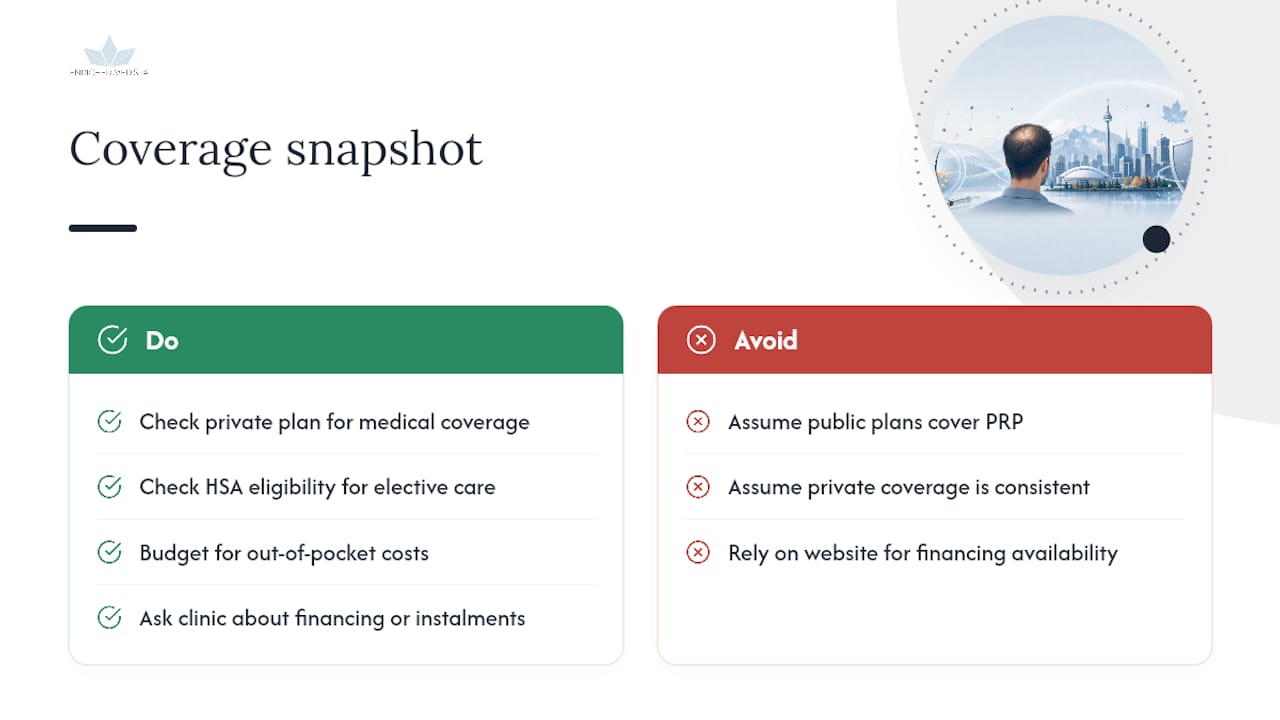
Most provincial health plans, including OHIP, classify PRP hair restoration as a cosmetic procedure, which means it isn’t covered under public health insurance anywhere in Canada. That’s the case regardless of whether you’re treating pattern hair loss, thinning from stress, or hormonal shedding.
Private extended health plans occasionally cover a portion of costs, but only when PRP is prescribed for a documented medical condition rather than cosmetic thinning, and even then, coverage is inconsistent between insurers. If you have a health spending account through your employer, it’s worth checking whether cosmetic or elective treatments qualify, since some accounts have more flexibility than standard extended health benefits.
Practically speaking, most patients budget for PRP as an out-of-pocket expense. This is one reason package pricing and financing options matter so much: without insurance reimbursement, the total cost of a three to four session course, plus ongoing maintenance, is money you’re paying directly. Some clinics offer payment plans specifically because they recognize this reality, spreading a package cost over several months rather than requiring the full amount upfront.
If cost is the main barrier, it’s worth asking your clinic directly whether they offer any financing partnerships or instalment options at your consultation, since these arrangements aren’t always advertised on a website or price list.
Why the “cheapest PRP” search is the wrong question
Most people researching PRP hair restoration cost start by hunting for the lowest number they can find, and that instinct is understandable but a little misguided. Price alone tells you almost nothing about whether a clinic uses a validated centrifuge system, processes an adequate blood volume, or has a practitioner who actually understands scalp mapping.
The conventional advice, “shop around and compare prices,” misses the real lesson buried in the pricing data: the spread between $500 and $1,200 per session isn’t random noise. It largely reflects equipment quality and practitioner training, two variables that directly affect whether you need three sessions or six to see a result worth paying for.
If you’re weighing PRP hair restoration cost against affordability, prioritize asking about kit brand and injector credentials before you compare dollar figures. A slightly higher price tied to a medical-grade system and a physician-led protocol often costs less in the long run than a cheaper option that requires extra sessions to achieve the same outcome. That’s the calculation worth doing before you book anything.
— Felix
Booking a PRP consultation at Enriched Med Spa
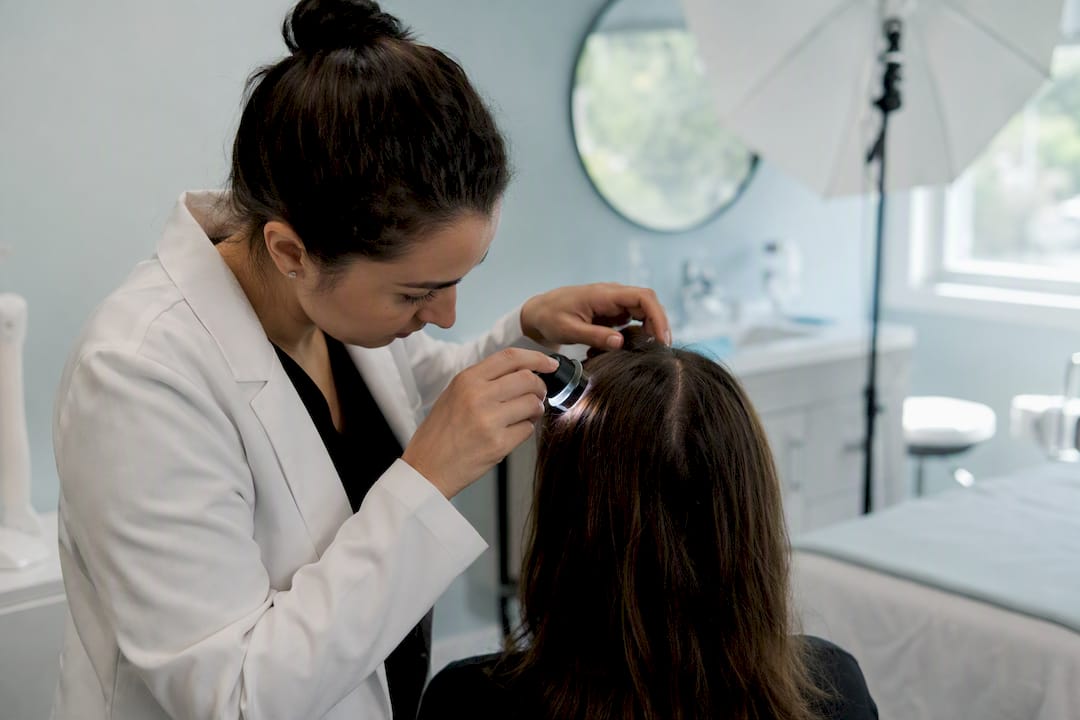
Enriched Med Spa gives you a clear, personalized quote instead of a generic number pulled from a price list, because your scalp, hair loss pattern, and goals are what actually determine your treatment plan and total cost. During a consultation, we review your medical history, examine your scalp in detail, and take baseline photos so we can map out realistic expectations before you commit to a package.
Bring a list of current medications and, if you’ve tried other treatments like minoxidil or finasteride, mention those too, since they factor into how we plan your sessions. We’ll walk you through what our kit and protocol involve, how many sessions we’d recommend based on your specific thinning pattern, and exactly what’s included in your quoted PRP hair restoration package before you decide anything.
If you’re ready to find out what PRP would realistically cost for your situation, book an assessment with Enriched Med Spa to get a price tailored to your scalp rather than a national average. You can also read more about what cosmetic injectables involve if you’re considering combining treatments during the same visit.