For most people with dark, coarse hair and lighter skin, Brazilian laser hair removal is one of the most reliable ways to achieve long-term hair reduction in the intimate area, provided the clinic matches the laser to your skin type. It is not permanent removal in the strictest sense, and it is not the right first step if you’re currently tanned, pregnant, or on certain photosensitising medications. Here’s the quick version before we get into the details:
- Real benefits: fewer ingrown hairs, less time spent shaving or waxing, and smoother skin between sessions once your course is complete.
- The main caveat: laser hair removal works through selective photothermolysis, which targets pigment in the hair shaft. It’s most effective on dark hair and pales in effectiveness on blonde, grey, or red hair, and it requires careful device selection for anyone with a deeper Fitzpatrick skin type.
- Your next step: book a consultation and patch test so a trained provider can assess your skin, discuss your hair growth pattern, and confirm you’re a safe candidate before your first full session.
Key Takeaways
Brazilian laser hair removal delivers long-term hair reduction for most candidates with pigmented hair, but it requires the right laser for your skin type and realistic expectations about maintenance.
| Point | Details |
|---|---|
| Best candidates | Dark, coarse hair paired with lighter skin responds fastest; darker skin tones need Nd:YAG or longer wavelengths and conservative settings. |
| Session count | Plan for six to ten sessions spaced four to eight weeks apart for the Brazilian area, longer if hormonal factors are involved. |
| Preparation matters | Avoid tanning for four weeks, stop waxing four weeks prior, and shave 12 to 24 hours before your appointment. |
| Results aren’t permanent | Expect substantial long-term reduction, with occasional touch-ups every six to twelve months. |
| Provider choice is a safety decision | Enrichedmedspa offers physician-informed patch testing, device matching, and a documented consultation before your first session. |
Table of Contents
- What a Brazilian treatment includes and how it differs from bikini or Hollywood
- How does laser hair removal work, and which devices suit different skin types?
- Step-by-step: what happens during a Brazilian laser session
- How many sessions will you need, and how far apart should they be?
- What results should you realistically expect, and how long do they last?
- What are the risks, side effects, and reasons to delay treatment?
- Exactly how to prepare for your appointment
- What should you do (and avoid) after your session?
- How do you choose a safe, qualified provider?
- How much does a Brazilian laser hair removal course cost, and what affects the price?
- Why clinical oversight matters more than people expect
- Common client questions we hear, and honest answers
- If you want a consultation: how we help
- Sources
What a Brazilian treatment includes and how it differs from bikini or Hollywood
The terms get used loosely, and that’s where a lot of confusion starts. A “bikini” treatment typically clears hair that would show outside a swimsuit line, a small, visible strip. A “Hollywood” (sometimes called full Brazilian) removes everything front to back, including the labia and perianal area. A “Brazilian” sits in between, though exact mapping varies quite a bit from one provider to another.
At most clinics, a Brazilian covers the front pubic area, the labia, and often extends to the perineum and perianal region, but it can be adjusted to leave a small strip or triangle on the mons pubis if that’s your preference. According to guidelines on photoepilation for intimate body areas, definitions genuinely differ by clinic, which is exactly why the treated zone needs to be confirmed with your provider before anything begins, not assumed.
A few practical points worth knowing before your first visit:
- You can request full clearance, a defined shape, or a smaller strip. Nothing is fixed.
- Chaperone options are usually available if you’d feel more comfortable with a second staff member present.
- Draping and positioning are designed to keep you covered as much as possible while allowing the provider access to the treatment zone.
- The treatment area can be adjusted between sessions if you change your mind partway through a course.
Pro Tip: Ask your provider to draw or describe the exact margin and shape they’re planning to treat before the first pass of the laser. A thirty-second conversation avoids the “that’s more than I expected” moment after the fact.
If you’re weighing which zones make sense for your goals, our overview of what areas can be treated with laser hair removal walks through the options beyond the intimate area too.
How does laser hair removal work, and which devices suit different skin types?
Laser hair removal relies on a principle called selective photothermolysis: the laser emits a wavelength of light that’s absorbed by melanin, the pigment in your hair follicle, and converts that light into heat. The heat damages the follicle enough to disrupt future growth, ideally without harming the surrounding skin.
That’s also why hair colour and skin tone both matter so much. A laser can’t tell the difference between pigment in your hair and pigment in your skin. The more contrast between the two (dark hair, lighter skin), the easier it is for the laser to target the follicle safely and precisely. Lower-contrast combinations, like dark skin, require a longer wavelength that passes through the epidermis with less absorption by surface melanin.
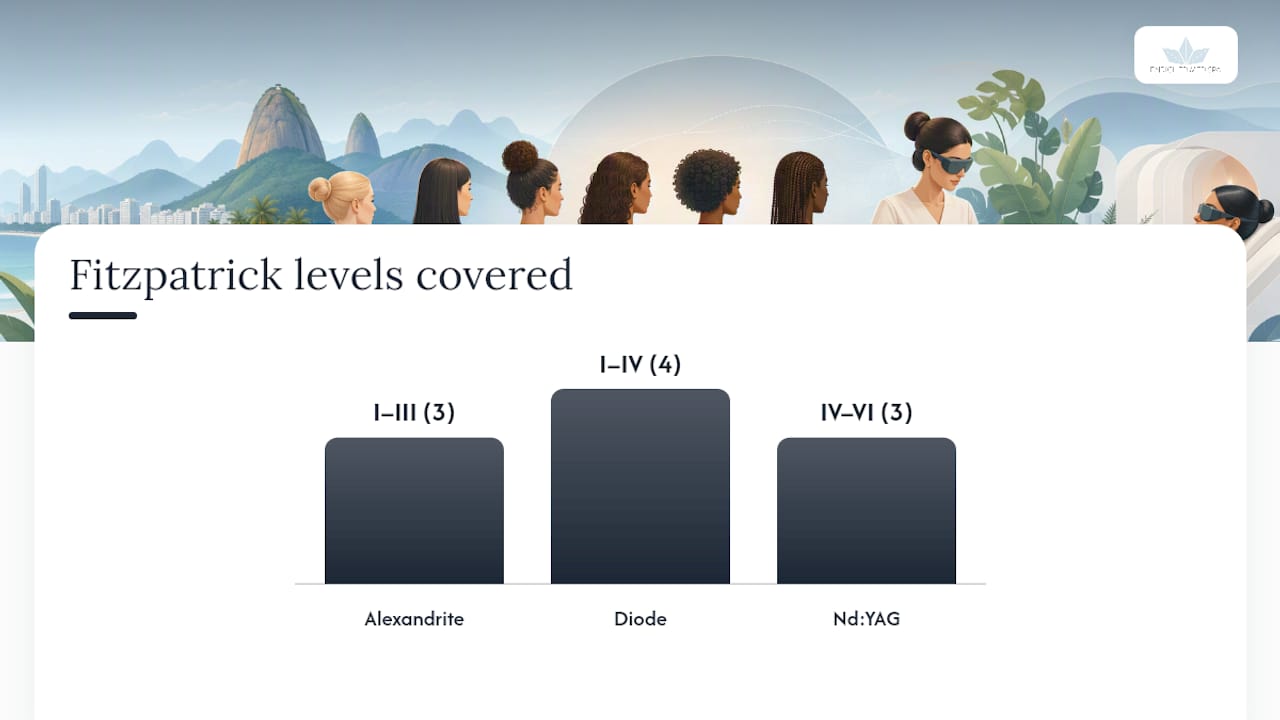
Different devices are built for different situations. Alexandrite lasers work quickly and effectively on lighter skin, but they carry more pigment risk on deeper tones. Diode lasers cover a wider range of skin types and are common in many clinics. Nd:YAG lasers, at 1064 nm, penetrate deeper and skip past epidermal melanin more effectively, making them a safer choice for Fitzpatrick IV through VI. IPL (intense pulsed light) isn’t a true laser at all. It’s broader-spectrum light, generally less precise, and less predictable for coarse or resistant hair.
| Device | Typical wavelength | Best suited for |
|---|---|---|
| Alexandrite | Alexandrite laser | Fitzpatrick I–III, fine to coarse dark hair |
| Diode | Diode laser | Fitzpatrick I–IV, versatile for most skin tones |
| Nd:YAG | 1064 nm | Fitzpatrick IV–VI, deeper penetration, lower pigment risk |
| IPL | Broad-spectrum intense pulsed light | Limited precision, less reliable for coarse or resistant hair |
This wavelength range and skin-type matching is well documented in clinical overviews of laser hair removal, and it’s one reason a proper consultation matters more than the marketing name of any single device.
Multiple sessions are necessary because hair grows in cycles. Only follicles in the active growth phase, called anagen, are vulnerable to laser damage at any given time. At any moment, only a portion of your hair is in that phase, which is why a single treatment can’t catch everything. You can read more about how the hair growth cycle interacts with laser timing if you want the fuller picture.
Step-by-step: what happens during a Brazilian laser session
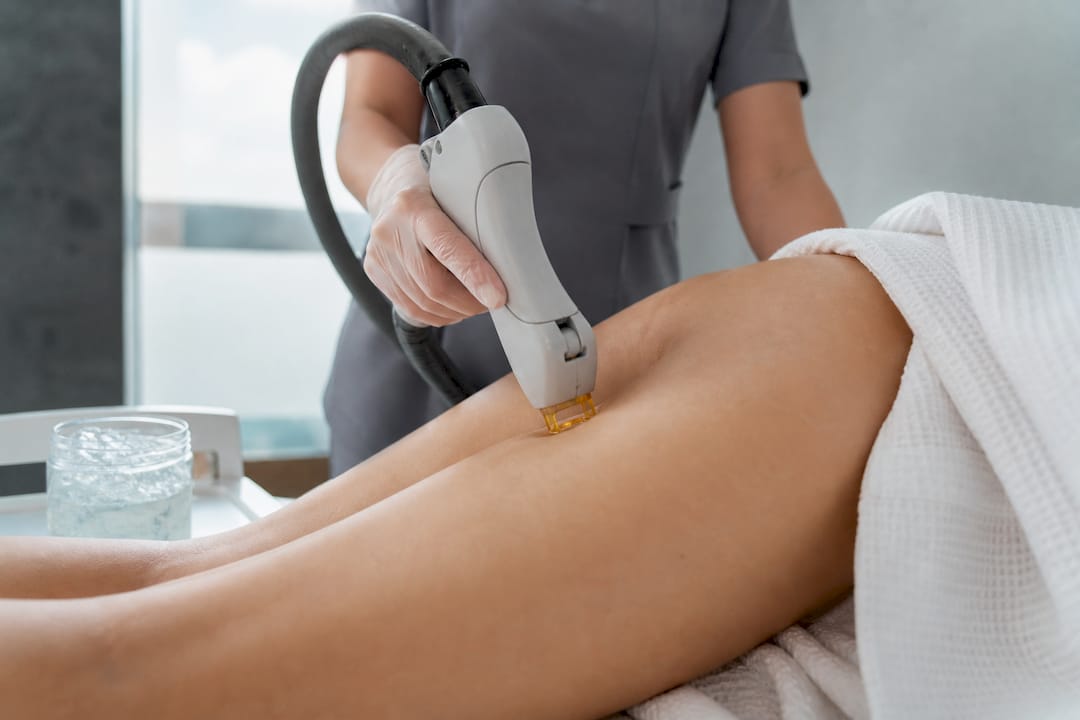
Your first appointment usually starts with a conversation, not a laser. Your provider reviews your medical history, checks for contraindications, and confirms your Fitzpatrick skin type. If it’s your first visit or you’re trying a new device setting, a patch test on a small area lets the team confirm the settings are safe for your skin before treating the full zone.
From there, a typical session runs through a few consistent steps:
- Cleansing the treatment area to remove any lotion, deodorant, or residue that could interfere with laser accuracy.
- Marking or zoning the area so shots are placed evenly without gaps or overlap.
- Applying topical numbing cream, if you’ve requested it, and giving it time to take effect.
- Providing protective eyewear for both you and the technician.
- Treating the area, usually starting with less sensitive zones and moving toward more sensitive ones as you both get a feel for your comfort level.
- Cooling the skin during and after treatment, either through a built-in cooling tip on the device or a separate cooling method.
Sensation varies by person and by area, but most people describe it as a quick snapping or stinging feeling rather than a constant burn. A full Brazilian session generally takes 20 to 45 minutes, depending on the area size and device speed. If pain tolerance is a concern, some clients use a topical numbing product beforehand. For anyone comparing options, numbing cream formulations designed for sensitive procedures can be worth discussing with your provider ahead of time.
Pro Tip: Starting on the least sensitive part of the treatment zone and working inward gives the technician a chance to fine-tune fluence and cooling before reaching more delicate skin. If a session ever feels more uncomfortable than expected, say something immediately. Settings can be adjusted mid-appointment.
For a deeper look at what discomfort actually feels like across different areas, our article on whether laser hair removal hurts breaks it down by zone.
How many sessions will you need, and how far apart should they be?
Most people need a minimum of four to six sessions to see meaningful reduction, but for the Brazilian area specifically, six to ten sessions is a more realistic range for durable results, spaced four to eight weeks apart depending on how quickly your hair cycles through its growth phases, according to treatment planning guidance for Brazilian laser hair removal.
| Hair and skin profile | Typical sessions needed | Recommended spacing |
|---|---|---|
| Fine, dark hair on lighter skin | Four to six sessions | Four weeks |
| Coarse, dense hair | Six to ten sessions | Four weeks |
| Darker skin tones (conservative settings) | More than six sessions | Four to eight weeks |
| Hormonal hair growth (e.g., PCOS) | 10+ sessions, ongoing maintenance likely | Four to eight weeks, reassessed regularly |
A few things push session counts higher than average. Finer hair takes longer to fully clear because it holds less pigment for the laser to grab onto. Darker skin often calls for more conservative laser settings to protect against pigment changes, which slows progress slightly but keeps things safe. And conditions like polycystic ovary syndrome (PCOS) or other hormonal imbalances can keep triggering new hair growth throughout a course, meaning maintenance becomes a longer-term expectation rather than a one-time finish line.
Scheduling tips worth keeping in mind:
- Book sessions consistently. Skipping spacing windows or delaying too long between appointments can slow your overall progress.
- Track shedding and regrowth between sessions so you and your provider can adjust timing if needed.
- Plan around events, not the other way around. Start a course several months before anything you want smooth skin for, not two weeks prior.
What results should you realistically expect, and how long do they last?
Clinicians generally avoid the phrase “permanent hair removal” in favour of long-term hair reduction, and that distinction isn’t just semantics. Hormonal shifts and previously dormant follicles can produce new hair growth even after a full course, which is why clinical literature on long-term hair reduction treats maintenance as a normal part of the process rather than a sign something went wrong.
Progress tends to follow a fairly predictable arc. The first session often produces modest results, sometimes barely noticeable beyond slightly slower regrowth. By your third or fourth session, most people see visible thinning and patchier regrowth. By the end of a full course, most clients report a substantial, lasting reduction in density and coarseness.
Guideline summaries commonly cite long-term reduction rates of 70 to 90 percent at minimum follow-up intervals, though the exact number depends on hair colour, skin tone, hormonal factors, and how closely you follow the recommended session schedule.
Maintenance sessions, usually spaced six to twelve months apart, are common even after a successful course. Hormones change, new follicles mature, and a touch-up here and there keeps results consistent over the years. If you’re curious how this plays out over the long haul, our pieces on whether laser hair removal is truly permanent and whether hair grows back slower afterward go into more detail on what “done” actually looks like.
What are the risks, side effects, and reasons to delay treatment?
Most side effects are mild and short-lived. Redness, slight swelling, and a warm, tingling sensation in the treated area are common and usually settle within a few hours to a couple of days, similar to a mild sunburn.
More serious complications are uncommon but worth understanding. Blistering, burns, and lasting changes in pigmentation (either darker or lighter patches) can happen, particularly when the wrong device or an overly aggressive setting is used on someone with a deeper skin tone or recently tanned skin. Reviews of laser device safety and regulation point to incorrect device selection and recent sun exposure as two of the most consistent risk factors behind these outcomes.
Certain situations call for delaying or avoiding treatment altogether:
- Pregnancy, as a precaution, since safety data in this population is limited.
- Active skin infection or open irritation in the treatment area.
- Recent use of photosensitising medications, including certain acne treatments like isotretinoin.
- Recent tanning or sunburn, natural or artificial.
- Certain skin conditions that increase sensitivity or scarring risk.
Hormonal disorders like PCOS don’t rule out laser treatment, but they may benefit from medical management alongside your sessions, since ongoing hormonal hair stimulation can limit how much reduction laser alone can achieve.
Matching the laser wavelength to your Fitzpatrick skin phototype isn’t a nice-to-have detail. It’s the single factor most closely tied to whether your treatment is both effective and safe, which is why an operator’s training and familiarity with parameter adjustment matters as much as the device itself.
Exactly how to prepare for your appointment
Preparation isn’t complicated, but timing genuinely matters. Getting it wrong doesn’t just reduce effectiveness. It can also mean your appointment gets rescheduled if your skin doesn’t meet the safety threshold that day.
The core rules, drawn from Mayo Clinic’s guidance on laser hair removal, are consistent across most reputable clinics:
- Four to six weeks before your appointment, stop tanning, whether that’s sun exposure or a tanning bed. Tanned skin absorbs more laser energy at the surface, raising the risk of burns and pigment changes.
- At least four weeks before starting, stop waxing, plucking, or using electrolysis. These methods remove the hair root, and the laser needs an intact follicle with pigment to target.
- Twelve to twenty-four hours before your session, shave the treatment area. This removes surface hair so the laser energy reaches the follicle rather than burning hair on the skin’s surface.
- In the days leading up to treatment, mention any new medications to your provider, particularly anything photosensitising, and hold off on retinoids or other active topical products in the treatment area.
- On the day of your appointment, arrive with clean skin, free of lotion, deodorant, or makeup in the treatment zone.
If you’ve recently started isotretinoin or another photosensitising medication, flag it during your consultation. Some clinics will ask you to wait a set period after stopping before beginning laser treatment. Our guide on how to prepare for laser treatment covers this in more depth, and if timing around the seasons is on your mind, fall is often a smart window to start, simply because sun exposure naturally drops off.
What should you do (and avoid) after your session?
The first 24 to 48 hours set the tone for how smoothly your skin recovers. Redness and mild sensitivity are normal and typically fade within a few hours to a couple of days. Cold packs or aloe vera gel can help calm the area if it feels warm or tender.
Hair that seems to “grow back” one to three weeks after your session usually isn’t new growth at all. It’s dead hair being pushed out of follicles that the laser already damaged. Plucking or waxing it out during this shedding window undoes the treatment’s work, since it removes the very root the laser needs to target next time.
A few things to avoid in the short term:
- Sun exposure, hot baths, saunas, and vigorous sweating for 24 to 48 hours, since heat and friction can aggravate freshly treated skin.
- Sexual activity for a day or two if your provider recommends it, particularly after treatment to sensitive intimate zones.
- Plucking or waxing between sessions. Shaving is fine and actually preferred if you need to manage regrowth in between.
- Tight clothing that rubs against the treated area right after your appointment.
Watch for a short list of red flags that warrant a call to your provider: blistering, spreading redness beyond the treated area, pus or discharge, or fever. These are uncommon, but they’re not something to wait out on your own. For a full rundown of do’s and don’ts, our tips for laser hair removal article covers the practical side in more detail.
How do you choose a safe, qualified provider?
Not every clinic offering laser hair removal has the same level of oversight, and for an intimate-area treatment, that gap matters more than it might for a smaller, less sensitive zone.
Look for these signals before you book:
- Physician oversight or a clear medical director who reviews treatment plans and complications.
- Documented operator training and certification specific to the laser device being used.
- A patch test offered as standard, not an optional extra you have to request.
- Transparency about the device and settings, including willingness to explain why a particular laser suits your skin type.
- Before-and-after photos from clients with a similar skin tone to yours, not a generic stock gallery.
- A written consent process that documents contraindications and expected outcomes before treatment begins.
| Trust signal | Red flag |
|---|---|
| Patch test offered before first session | Patch test skipped or discouraged |
| Clear explanation of laser type and settings | Vague or evasive answers about the device |
| Physician-supervised clinic with documented training | No visible medical oversight or credentials |
| Realistic session estimate based on your hair/skin | Guarantees of “permanent” results in a fixed number of sessions |
| Flexible packages with clear refund/touch-up terms | Pressure to prepay for a large package with no flexibility |
At your consultation, ask directly: which laser will you use and why does it suit my skin and hair? How many sessions do you expect for someone with my hair density and colouring? Can I see results from clients with a similar skin tone? Who performs the treatment, and what’s their training? Operator training and physician supervision are consistently identified as the strongest predictors of both safety and satisfaction, more so than the specific brand of laser in the room.
How much does a Brazilian laser hair removal course cost, and what affects the price?
Pricing varies quite a bit depending on where you live, the device used, and whether you buy sessions individually or as a package. As a general guide, single Brazilian sessions commonly range within a moderate price range, while a full package of six to ten sessions often falls within a moderate price range, though your provider can give you an exact quote based on your hair and skin.
A few factors drive that range:
- Provider type: a medical clinic with physician oversight typically prices differently than a walk-in chain or day spa, reflecting the added training and equipment standards.
- Device technology: clinics using multiple laser types (to match different skin tones and hair densities) may price slightly higher than single-device operations.
- Hair density and area size: denser hair growth generally means more energy and time per session.
- Add-ons: numbing cream, extended touch-ups, or combination packages with other treatments can shift the total cost.
Package pricing usually reduces the per-session cost compared to booking individually, and many clinics build in a maintenance rate for touch-ups after your initial course is complete. When comparing quotes, ask specifically what’s included: is numbing cream extra? Are touch-ups within the first year covered? Is the package based on a fixed number of sessions or unlimited until a reduction target is met? Those details matter more than the headline price.
Why clinical oversight matters more than people expect
A lot of people assume laser hair removal is a low-stakes cosmetic service, similar to a facial or a manicure. For most areas of the body, that’s a reasonable assumption. However, for the intimate area, the margin for error is smaller, and the value of medical oversight becomes much more apparent.
A clinic with genuine medical governance screens your health history before ever turning on the laser, checking for medications, skin conditions, or hormonal factors that could change your treatment plan. That screening is what allows safe settings to be chosen for darker skin tones or higher-risk patients rather than defaulting to a one-size-fits-all approach.
Operator training matters just as much. A well-trained technician working under physician supervision recognizes early signs of an adverse reaction and adjusts settings before a minor issue becomes a bigger one. Documented training and supervision standards are consistently linked to lower complication rates in the clinical literature, and that’s not a coincidence.
At an accredited clinic, you can also expect proper documentation: photographic records to track progress, notes from your patch test, and a follow-up plan that adjusts as your hair responds. It’s a more structured process than a quick walk-in appointment, but that structure is exactly what protects you over a multi-month course.
Pro Tip: Clients who’ve been through laser treatment at clinics with strong medical governance often mention how quickly small concerns get addressed, a slightly stronger reaction, an unexpected sensitivity, rather than being told to “wait and see.” That responsiveness is one of the clearest signs you’re in good hands.
Common client questions we hear, and honest answers
People ask a lot of the same questions at consultation, and most of them come from a completely reasonable place of wanting to know what they’re actually signing up for.
Pain comes up constantly. Most clients describe the sensation as more manageable than they expected, closer to a rubber band snap than anything dramatic, especially once the technician adjusts settings to your comfort level. Privacy is another common concern, and it’s a fair one. We’ve found that clearly explaining draping, positioning, and chaperone options upfront, before anyone gets near the treatment table, does more to ease nerves than anything said during the appointment itself.
Some clients ask whether laser treatment affects sexual sensation or function. It doesn’t. The laser targets the hair follicle, not the surrounding nerve tissue, and any temporary sensitivity fades along with the mild redness within a day or two.
We also see a growing number of clients preparing for gender-affirming surgery, where pre-surgical hair removal in the intimate area is often a medical requirement rather than a cosmetic choice. These cases usually need more sessions and tighter coordination with a surgical timeline, and we treat that scheduling conversation as seriously as the treatment itself.
First-timers tend to worry most about the unknown, what it’ll feel like, how long recovery takes, whether it’ll actually work for their hair type. Clients with darker skin tones ask smart, specific questions about device choice, which tells us they’ve done some homework, and we take the time to explain exactly why Nd:YAG or a longer wavelength diode makes sense for their case. And for clients managing PCOS or other hormonal hair growth, we’re upfront that laser can meaningfully reduce density, but ongoing hormonal management alongside treatment tends to produce the most consistent long-term results.
If you want a consultation: how we help
Enrichedmedspa’s approach to Brazilian laser hair removal starts with a real consultation, not a rushed sign-up form. That’s the practical difference between booking with a clinic built on medical oversight versus a walk-in service: you get a skin assessment, a patch test, and a device recommendation based on your actual hair and skin, not a generic package.
During your consult, we review your Fitzpatrick skin type, discuss your hair growth pattern, and go through your medical history together, including any medications or recent tanning that might affect timing. Bring a list of current medications and be ready to talk through your tanning history over the past few months. From there, we’ll walk you through which laser suits your skin, roughly how many sessions to expect, and a clear, itemized plan before you commit to anything.
If you’re ready to see whether Brazilian laser hair removal fits your goals, you can book a consultation for Brazilian laser hair removal and get a personalized plan built around your skin and hair, not a one-size-fits-all package.
Sources
The guidance in this article draws on established clinical and dermatological sources rather than general marketing claims. For readers who want to verify details or dig deeper:
- Laser hair removal – Mayo Clinic
- Laser hair removal: an overview (NCBI Bookshelf)
- Operator training and safety considerations in laser procedures (PMC article)
- Guidelines on Photoepilation: Techniques for intimate body areas (Town et al.)
- Photo-epilation guidelines (European Society of Laser Dermatology / ESLD)
This article is general information, not a substitute for advice from a qualified doctor. Consult a qualified healthcare professional about your own circumstances before acting on anything here.