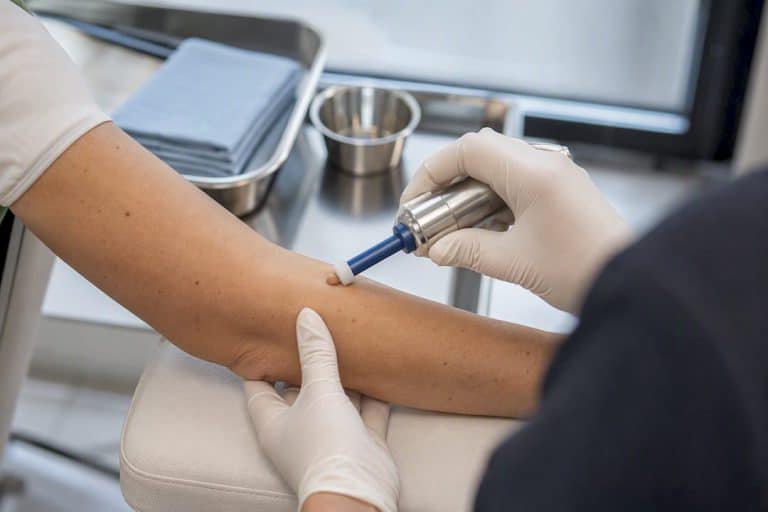

Most people need somewhere between four and eight laser hair removal sessions, spaced four to eight weeks apart depending on the treatment area, to see meaningful, lasting hair reduction. Many clinics build treatment plans around six sessions as a starting point, then reassess. Laser hair removal reduces hair growth rather than erasing it forever, so occasional touch-ups down the line are part of the normal picture, not a sign anything went wrong.
TL;DR:
- Most individuals require four to eight laser hair removal sessions, with hormonal conditions or lighter hair possibly extending the treatment timeline.
- Facial and hormonal hair growth areas often need more sessions and longer courses, especially for conditions like PCOS, sometimes up to 10 to 15 treatments.
- Darker skin tones (Fitzpatrick types IV to VI) respond well to Nd:YAG lasers, which are safer and more effective for deeper skin, usually requiring fewer sessions in the long run.
- Significant hair reduction typically begins after three sessions, with most seeing lasting results after six or more, though touch-ups may be needed for hormonal or hormonal-driven regrowth.
- Proper pre- and post-treatment care, including shaving, avoiding sun exposure, and consistent appointment spacing, is key to safety and optimal results.
Table of Contents
- How many laser hair removal sessions do you need by area?
- Does skin tone or hair colour change how many sessions you need?
- What happens in the first few laser hair removal sessions?
- What if hormones like PCOS are driving your hair growth?
- How should you prepare for and recover from each appointment?
- What does maintenance look like after your initial course?
- How Enriched Med Spa builds a realistic treatment plan
- Realistic session planning matters more than the number itself
- Ready to plan your laser hair removal sessions?
- Sources
- FAQ
How many laser hair removal sessions do you need by area?
Session counts aren’t universal because hair density, follicle depth, and growth-cycle timing differ by body part. The Canadian Dermatology Association notes that most individuals need four to eight sessions for significant reduction, and rarely see lasting results in fewer than four. Where you fall in that range depends heavily on what part of the body you’re treating.
Here’s how the ranges typically break down:
- Face (upper lip, chin): multiple sessions generally more than other areas. Facial hair is often hormonally influenced, which slows the response.
- Underarms: several sessions are typically needed. Hair here tends to be coarse but grows in fairly predictable cycles, which makes it one of the faster areas to clear.
- Bikini and Brazilian: multiple sessions generally more than average. Density and mixed hair thickness in this region mean more passes are usually needed than clients expect going in.
- Legs: multiple sessions typically needed. Larger surface area means more follicles cycling at different times, so full-leg treatments often take the full course.
- Back and chest: multiple sessions usually required. Hormonal hair growth patterns in these areas, especially in men, can extend the timeline slightly.
Appointment length follows the same logic. A lip or underarm session might take 10 to 15 minutes, while full legs or a full back can run 45 to 60 minutes. That difference matters when you’re booking around a schedule, because density, not just size, drives how long the laser needs to work an area properly.
If you’re planning around an event, book your first session at least four to five months out. That gives you room for a full course with proper spacing, rather than cramming sessions closer together than is safe. It’s also worth avoiding tanning beds or heavy sun exposure during your treatment window, since a tan changes how your skin absorbs the laser’s energy and can affect both safety and results. For a closer look at which body parts respond fastest and which take longer, see our breakdown of what areas can be treated with laser hair removal.
Does skin tone or hair colour change how many sessions you need?
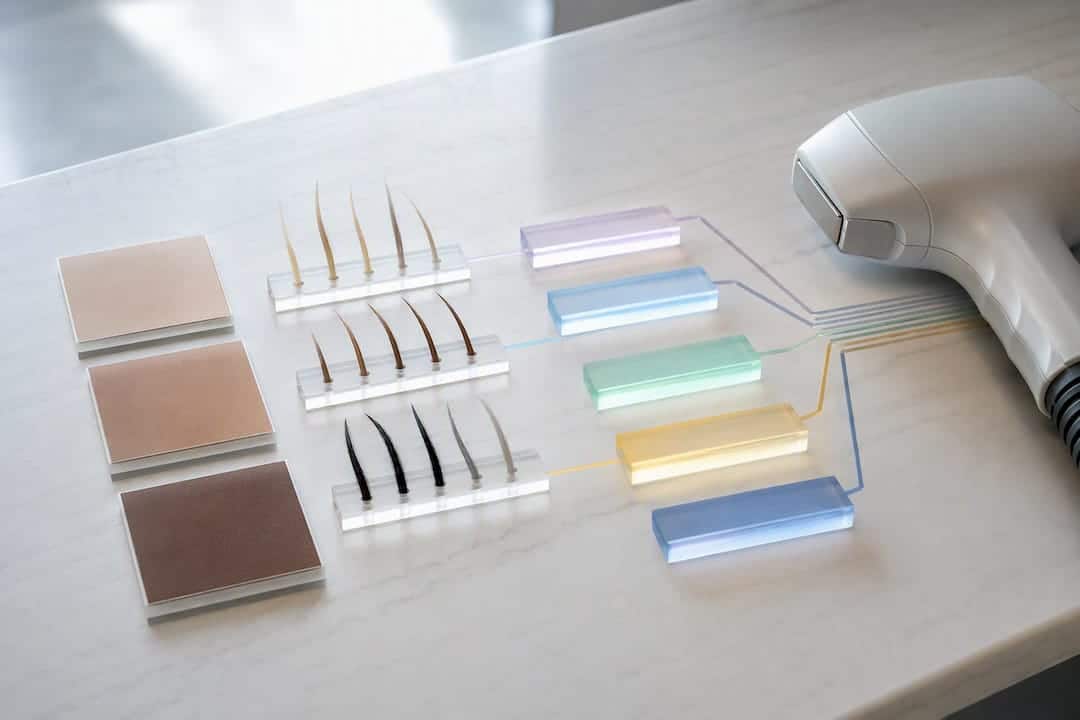
Skin tone and hair colour are two of the biggest variables in how a laser hair removal course unfolds, because lasers work by targeting pigment. The Fitzpatrick scale classifies skin from Type I (very fair, burns easily) to Type VI (deeply pigmented, rarely burns), and that classification guides which laser wavelength is safest and most effective for you.
- Types I to III (fair to medium skin): Alexandrite and diode lasers work well here because there’s enough contrast between skin and hair pigment for the laser to target follicles precisely.
- Types IV to VI (medium to deeply pigmented skin): Nd:YAG lasers are the safer choice. This wavelength passes through the upper skin layers with less absorption by melanin, lowering the risk of burns or pigment changes. Clinical studies on Nd:YAG in darker skin types report strong, safe results across three to six sessions, with response improving each time.
- Blond, red, grey, or very fine (vellus) hair: These respond poorly to most lasers because they lack the pigment the device needs to lock onto. Clients with this hair type often need more sessions than average, and some see limited improvement no matter how many rounds they complete.
An experienced clinic will always match the device to your skin type rather than using one setting for everyone. Choosing the wrong laser for a given skin tone isn’t just less effective, it raises the risk of burns, blistering, or pigment changes that take months to fade. If you have deeper skin and want to understand what that means for your session count, our guide to safe Nd:YAG laser hair removal for dark skin walks through what to expect.
What happens in the first few laser hair removal sessions?
During treatment, you’ll feel warmth and a quick snapping sensation, often compared to a rubber band flick against the skin. Most clinics use a built-in cooling tip or cooling gel to keep this manageable, and any redness or slight swelling around follicles usually settles within a few hours.
Here’s a rough timeline of how progress tends to unfold:
- After session 1: Treated hairs shed over the following 1 to 3 weeks. This can look like regrowth, but it’s actually the dead hair working its way out, not new growth starting.
- After 3 sessions: Areas like the underarms and bikini line often show noticeable thinning, since large clinical datasets report 75%+ clearance in these zones after three treatments for many patients. Facial and trunk areas usually lag behind at this stage.
- After 6+ sessions: Most people see substantial, lasting reduction, with facial and abdominal areas typically catching up to other zones by this point.
Contact your clinician if you notice blistering, unusual pain that persists beyond a day, or skin colour changes that don’t fade within a couple of weeks. Those aren’t normal parts of recovery.
What if hormones like PCOS are driving your hair growth?
If PCOS, thyroid imbalances, or another hormonal condition is behind your excess hair, expect a longer course. Research on facial laser treatment outcomes shows patients with PCOS sometimes need 10 to 15 sessions rather than the standard 4 to 8, because ongoing hormonal signals keep triggering new follicle activity that a standard course doesn’t account for.
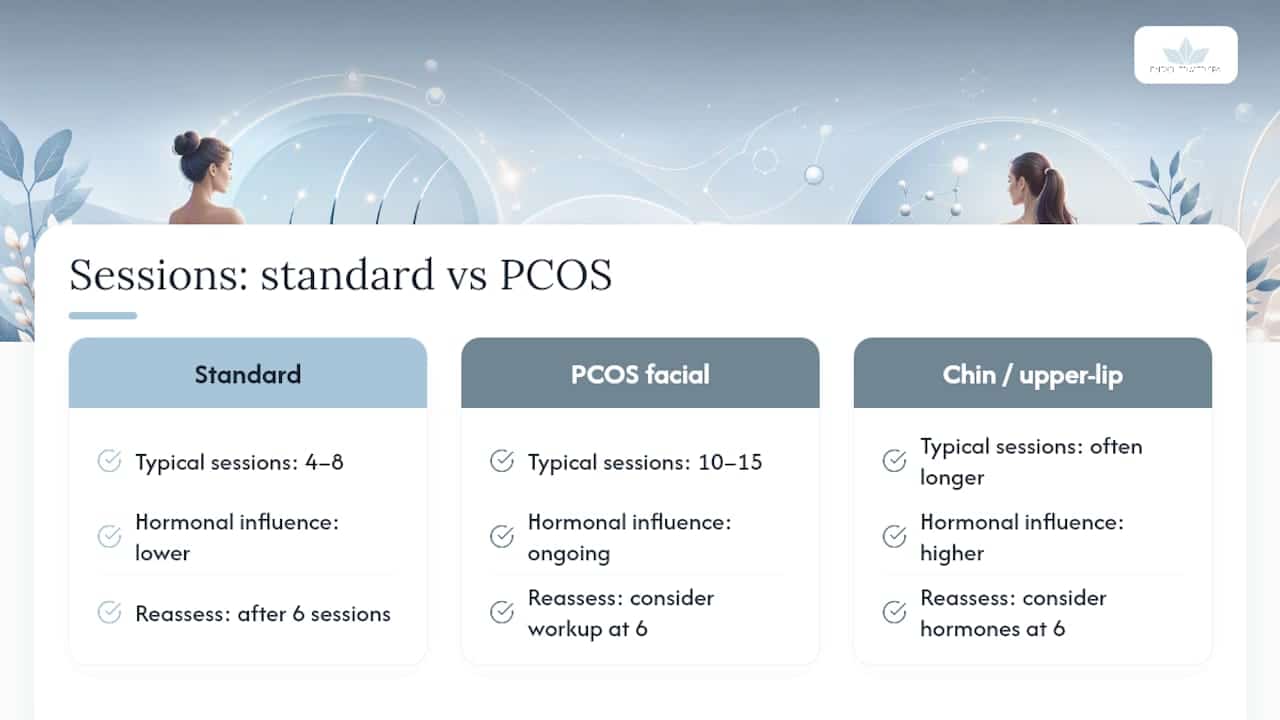
Facial hair, in particular, tends to be more hormonally driven than hair on the legs or underarms. This is part of why chin and upper-lip treatments often run longer regardless of hormonal history.
Pro Tip: If you’ve completed six sessions with little visible change, that’s a reasonable point to pause and ask your provider about a hormonal workup rather than pushing through more rounds at the same pace. Combining laser with medical management of the underlying hormonal issue often gets better results than laser alone. Our page on laser hair removal planning for PCOS goes into more detail on what that combined approach can look like.
How should you prepare for and recover from each appointment?
A few simple habits make a real difference in both comfort and results:
- Stop waxing, tweezing, or using chemical depilatories for 3 to 6 weeks before treatment. The laser needs the follicle intact to target it, and removing it by the root defeats the point.
- Shave the area 24 to 72 hours before your appointment. This leaves the follicle in place while clearing surface hair that could scatter the laser’s energy.
- Avoid tanning and pause retinoids, AHAs, or BHAs in the days leading up to treatment, as your clinician advises.
- Apply broad-spectrum SPF afterward, every day, without exception. Treated skin is more sensitive to sun damage for weeks after each session.
- Call your clinician if you notice blistering, prolonged redness, or unusual discolouration that doesn’t improve within a few days.
For a full pre-appointment checklist, see our guide on how to prepare for laser treatment.
What does maintenance look like after your initial course?
“Permanent reduction” doesn’t mean every hair is gone for life. It means the hair that grows back is finer, sparser, and slower to return. Most clients need one to four touch-up sessions per year after finishing their initial course, depending on how their skin and hormones respond.
Pregnancy, new hormonal shifts, or the appearance of coarser hairs in a previously treated area are the most common reasons to book an extra session. A long-term follow-up study tracking patients over 11.5 years found that 87.9% still reported sustained improvement, which is a solid indication that the results genuinely hold up over time for most people. Budget for occasional maintenance rather than a one-time cost, and rebook when you notice regrowth becoming visible again rather than on a fixed calendar. For more on what “permanent” realistically means, read our piece on laser hair removal as a permanent or temporary fix.
How Enriched Med Spa builds a realistic treatment plan
We start every laser hair removal consultation by reviewing your Fitzpatrick skin type, hair colour, and any hormonal factors, then match you to the right device, often Nd:YAG for deeper skin tones. Many clients begin with a 6-session plan; those with PCOS or thyroid-related growth are told upfront to expect more.
Realistic session planning matters more than the number itself
The obsession with pinning down an exact session count misses the bigger point: outcomes depend far more on consistent attendance and an operator who adjusts settings to your skin than on hitting some magic number. Skipping appointments or spacing them too far apart lets follicles slip past their treatable window, and you end up paying for more sessions later to make up the gap.
We’d rather set expectations around reduction, not a one-and-done promise, because that’s what the evidence actually supports. If you want a precise session estimate instead of a general range, book a consultation and get a plan built around your skin, your hair, and your goals.
— Felix
Ready to plan your laser hair removal sessions?
There are other routes to hair reduction, home IPL devices, waxing, electrolysis, but each comes with trade offs in precision, safety, or how long results actually last. We provide a clinician who matches the laser wavelength to your skin type and hair colour before your first session, so you’re not guessing whether the device in front of you is right for your skin. That matters most for clients with deeper skin tones or hormonally driven hair growth, where the wrong approach can waste months and money.
A first visit starts with a consultation covering your Fitzpatrick type, treatment history, and goals, followed by a personalized session plan you can actually budget around. While you’re exploring your options, take a look at how dermal fillers compare to Botox if facial rejuvenation is also on your radar. To get started on laser hair removal itself, reach out through our treatment consultation page and we’ll walk you through what a realistic plan looks like for your skin and hair.
Sources
- Canadian Dermatology Association — hair removal
- Evaluation of safety and efficacy of laser hair removal with the long-pulsed 755 nm wavelength laser (948-patient study)
This article is general information, not a substitute for advice from a qualified doctor. Consult a qualified healthcare professional about your own circumstances before acting on anything here.
FAQ
How many sessions of laser hair removal do you need?
Most people need four to eight sessions, spaced four to eight weeks apart depending on the area, though hormonal conditions or lighter hair colour can extend that range.
What happens if I shave three days after laser hair removal?
Shaving a few days after your session is fine and often recommended once shedding starts, since it clears loosened hair without disturbing the healing follicle.
Is 12 sessions of laser hair removal too much?
Not necessarily. Facial hair, hormonally driven growth, or PCOS can genuinely require 10 to 15 sessions, so 12 sessions isn’t unusual for those specific cases, though your provider should reassess progress along the way.
What happens if I stop laser hair removal after six sessions?
You’ll likely keep the reduction you’ve achieved so far, but any follicles that hadn’t cycled through treatment yet may continue producing hair, so stopping early often means partial rather than long-term results.