
Getting dermal fillers is one of the most popular non-surgical treatments available today, and for good reason. But what to expect after fillers is a question many clients wish they had asked more thoroughly before their appointment. The reality is that results do not appear instantly, and your face will go through a clear healing process before you see the final outcome. Understanding that process, including the swelling, the settling, and the timeline, makes the difference between feeling confident in your decision and feeling unnecessarily anxious in those first few days.
Table of Contents
- Key takeaways
- What to expect after fillers: the first 48 hours
- Recovery timeline: what changes day by day
- Rare side effects and when to seek help
- How long do fillers last?
- Aftercare tips to support your recovery
- My perspective on recovery expectations
- Ready to take the next step?
- FAQ
Key takeaways
| Point | Details |
|---|---|
| Swelling peaks early | Swelling peaks at 24–48 hours and typically resolves within a week. |
| Bruising is common | Bruising affects 20 to 40% of clients and can last up to 10 days. |
| Results settle over two weeks | Firmness and irregularities soften as the filler integrates into the tissue. |
| Aftercare directly affects outcomes | Avoiding alcohol, heat, and strenuous activity in the first 48 hours supports better healing. |
| HA fillers are reversible | Hyaluronic acid fillers can be dissolved with hyaluronidase if correction is needed. |
What to expect after fillers: the first 48 hours
The hours right after your treatment are the most visually dramatic, and often the most misunderstood. Many clients leave their appointment feeling pleased, only to wake up the next morning wondering what happened to their face. This is completely normal.
Here is what typically occurs in the first two days:
- Swelling: This is the most universal side effect. Swelling peaks within 24 to 48 hours and is most pronounced in the lips. It can make results look exaggerated or uneven at first.
- Bruising: Bruising occurs in 20 to 40% of treatments and usually lasts between 5 and 10 days. Clients who take blood thinners, fish oil, or NSAIDs before treatment have a higher likelihood of bruising.
- Redness and tenderness: Mild redness and sensitivity at the injection sites are normal filler treatment side effects that resolve within a day or two for most people.
- Firmness or lumps: The filler may feel firm or slightly uneven in the first few days. This is not a sign of a problem. Firmness and lumps typically soften as the product integrates over one to two weeks.
Pro Tip: Apply a clean, cold compress to the treated area for the first 24 hours to help reduce swelling. Keep your head elevated, even while sleeping, for the first night. Avoid pressing or massaging the area unless your injector has specifically advised it.
These early effects are part of the normal fillers healing process. Your skin needs time to settle, and what you see in the mirror on day two is not your final result.
Recovery timeline: what changes day by day
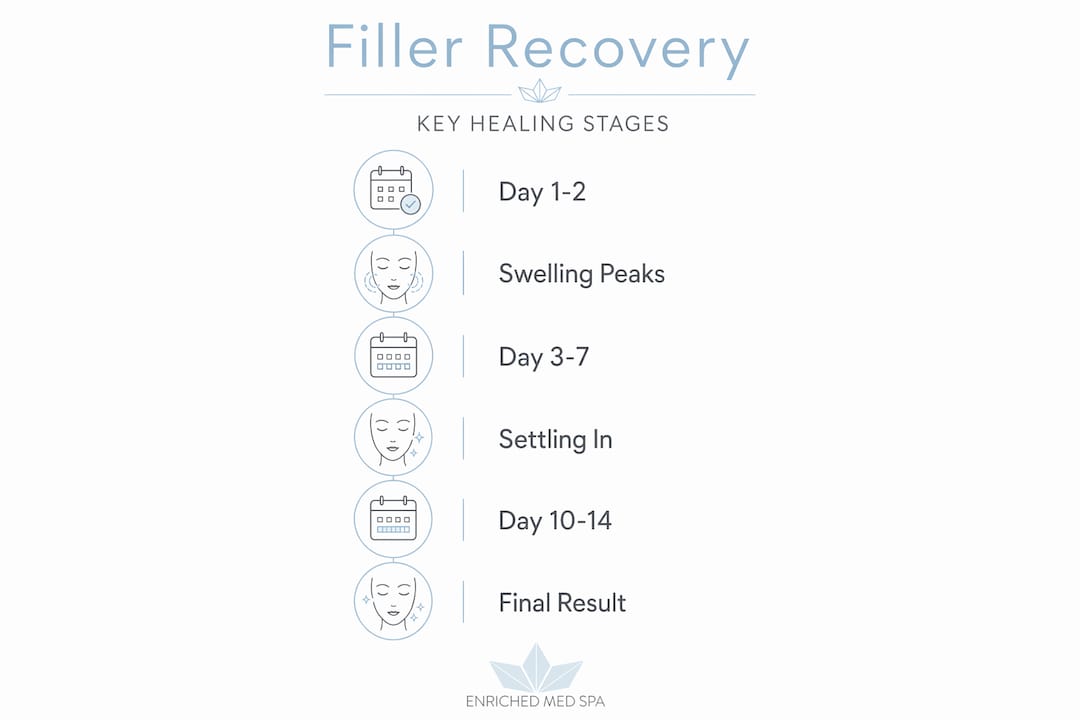
Understanding the recovery time for fillers helps you plan around your social calendar and set realistic expectations. The timeline varies by individual and treatment area, but here is a general guide to how most people heal.
- Days 1 to 3: Swelling, bruising, and redness are at their most visible. Lips in particular can look significantly fuller than intended during this window. Tenderness is normal when touching the treated area.
- Days 4 to 7: Bruising begins to fade, transitioning from darker purple or red tones to lighter yellow or green as the body reabsorbs the blood. Swelling continues to subside noticeably. Most clients feel comfortable returning to work or social settings by day 5 with the help of light concealer.
- Days 7 to 14: The filler begins to settle into the tissue and integrate more naturally. The firmness softens. You will start to see a clearer picture of your actual results during this period. Most swelling and bruising resolve naturally within one to two weeks.
- Week 2 and beyond: By the end of the second week, the majority of clients see the results they were hoping for. The treated area looks and feels natural. Minor asymmetry that was visible in the first week often self-corrects during this phase.
- Four to six weeks post-treatment: This is typically when a follow-up appointment is recommended. A touch-up at this stage addresses any minor irregularities and lets your injector assess the final outcome with precision.
Treatment area matters here too. Lips are the most reactive area due to constant muscle movement, meaning swelling is more intense and lasts slightly longer compared to cheeks or the jawline, which are more stable.
Rare side effects and when to seek help
Most people move through the fillers healing process without significant complications. However, it is worth knowing the less common side effects and the signs that require prompt attention.
- Asymmetry: Some unevenness in the first week is expected and often resolves on its own as swelling subsides. Persistent asymmetry beyond two weeks may warrant a touch-up or correction.
- Tyndall effect: This is a bluish discolouration visible under the skin when filler is placed too superficially, most often seen under the eyes. It can be corrected with hyaluronidase.
- Filler migration: Filler that moves from the intended area is usually related to placement depth or product choice. Qualified injector technique significantly reduces this risk.
- Persistent nodules: Small lumps that do not resolve after two weeks should be assessed by your practitioner. Options include massage, hyaluronidase, or in rare cases, other interventions.
The most serious complication is vascular occlusion, which is rare but requires immediate care. Vascular occlusion occurs when filler is inadvertently injected into or compresses a blood vessel, restricting blood flow to the tissue. Signs include intense and sudden pain, skin blanching, mottled or dusky discolouration, and in severe cases, visual disturbances. If you experience any of these symptoms after treatment, contact your injector or seek emergency care without delay.
“The safest filler outcomes start with choosing a qualified, experienced injector who understands vascular anatomy and knows how to respond to complications immediately.”
It is also worth knowing that hyaluronidase can dissolve HA fillers within 24 to 48 hours if complications arise or if you are simply unhappy with your results. This reversibility is one of the most important safety advantages of hyaluronic acid fillers compared to permanent alternatives.
How long do fillers last?
One of the most common questions clients have after their first treatment is how long they can expect their results to hold. The honest answer is that it depends on the area treated, the product used, and how your body metabolises the filler.
| Treatment area | Typical longevity | Key factors |
|---|---|---|
| Lips | 6 to 12 months | High muscle movement accelerates metabolism |
| Cheeks | 12 to 18 months | Less movement, more stable results |
| Jawline | 18 to 24 months | Deepest placement, longest-lasting area |
| Nasolabial folds | 9 to 12 months | Moderate movement in this area |
Lip fillers typically last 6 to 12 months, while cheek and jawline fillers can hold for 12 to 24 months. The difference comes down to how much a muscle in the area moves on a daily basis. High-movement areas break filler down faster.

Your individual metabolism also plays a role. Clients who are very active, have a faster metabolic rate, or receive smaller volumes may find their results fade more quickly. Staying well-hydrated and protecting your skin from UV exposure helps prolong the effects of hyaluronic acid fillers, as UV damage degrades both the filler and the surrounding skin tissue.
Pro Tip: If you want to understand exactly how long your fillers may last based on the specific product and area, ask your injector at your consultation. They can give you a realistic timeline based on your anatomy and treatment plan.
One important caution: permanent fillers such as silicone or PMMA carry significantly higher complication risks and cannot be dissolved if problems occur. Hyaluronic acid fillers remain the gold standard precisely because they are reversible and clinically well-studied.
Aftercare tips to support your recovery
What you do in the days following your treatment has a direct impact on how well you heal and how long your results last. These fillers aftercare tips are based on what we see work consistently in practice.
- Avoid blood thinners and alcohol: Avoiding aspirin, NSAIDs, and alcohol both before and after treatment reduces bruising risk and supports smoother recovery.
- Use cold compresses wisely: Apply a clean cold pack wrapped in a cloth for 10-minute intervals in the first 24 hours. Do not apply ice directly to the skin.
- Skip the gym for 48 hours: Strenuous exercise increases blood flow and body temperature, both of which can intensify swelling and bruising. Wait at least 48 hours before returning to vigorous activity.
- Avoid excessive heat: Saunas, steam rooms, hot baths, and direct sun exposure in the first two days can worsen swelling. Your skin needs to rest.
- Keep your skincare gentle: Use mild, non-comedogenic cleansers and moisturisers. Avoid retinol, exfoliating acids, and abrasive scrubs for at least one week post-treatment.
- Protect with SPF: Broad-spectrum SPF applied daily supports both healing and the longevity of your results. UV exposure degrades hyaluronic acid and compromises your skin’s overall condition.
- Stay hydrated: Hyaluronic acid attracts and holds moisture, so drinking adequate water supports the filler’s performance and helps maintain that plump, healthy look.
- Attend your follow-up: A review at four to six weeks gives your injector the full picture once swelling has resolved. This is the right time to discuss any after filler treatment advice or touch-ups needed.
My perspective on recovery expectations
I have worked alongside clients at every stage of the filler experience, and if there is one thing I have learned, it is that the first 48 hours can feel discouraging if you are not prepared. The most common thing I hear is: “I looked fine right after but woke up the next day with so much swelling.” That reaction is not a complication. It is the body doing exactly what it should.
What concerns me more is the number of people who skip the consultation conversation about recovery entirely. They focus on the results they want and underestimate the importance of what to know before fillers, including the realistic look of the treatment in those first few days. When someone is not told to expect firmness, asymmetry, or exaggerated volume early on, they panic. And panic leads to touching, pressing, and in some cases, seeking correction before the filler has had a chance to settle.
My honest advice is this: trust the process and respect the timeline. The two-week mark tells a far more accurate story than day two. I have seen clients come in convinced their results were wrong, only to return at week three looking exactly as they had hoped. Patience is genuinely the most underrated part of filler aftercare.
I also want to say plainly that the injector you choose matters enormously. Not just for the aesthetic result, but for your safety. Vascular occlusion, migration, and poor placement are not random occurrences. They are largely preventable with the right level of clinical training, anatomical knowledge, and careful technique. Choose based on credentials and trust, not price.
— Felix
Ready to take the next step?
If you are considering dermal fillers or have recently had treatment and want personalised guidance, the team at Enrichedmedspa is here to help. Serving clients in Woodbridge and East Gwillimbury, Ontario, we take a thorough, patient-first approach to every treatment, from the initial consultation through to your follow-up care. Whether you want to understand the benefits of dermal fillers before committing, or you are ready to book a treatment with a qualified injector, we would love to walk you through your options. Explore our dermal filler treatments and find out what is possible for your skin.
FAQ
How long does swelling last after fillers?
Swelling typically peaks at 24 to 48 hours and resolves within 2 to 7 days for most clients. Lip treatments tend to involve the most swelling due to the density of tissue and muscle movement in that area.
Is bruising normal after dermal filler treatment?
Yes. Bruising is a common filler treatment side effect, occurring in an estimated 20 to 40% of treatments and lasting up to 10 days. Avoiding blood thinners and alcohol before your appointment helps reduce the likelihood.
When do filler results look their best?
Most clients see their final, settled results between 10 and 14 days post-treatment, once swelling has resolved and the filler has fully integrated. A follow-up at four to six weeks gives the clearest assessment.
Can filler complications be reversed?
Hyaluronidase dissolves HA fillers within 24 to 48 hours, making hyaluronic acid fillers fully reversible if complications occur or results need correction. Permanent fillers do not carry this safety option.
How long do dermal fillers last?
Longevity varies by area. Lip fillers last 6 to 12 months while cheek and jawline treatments can last 12 to 24 months. Metabolism, product type, and lifestyle factors all influence how quickly the body breaks down the filler.